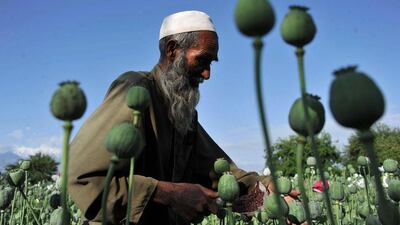
Afghan poppy farmers say that although producing opium is forbidden in Islam, they have no choice but to continue. Photo: AFP

Why opium prices have soared since Taliban takeover in Afghanistan


  • English
  • Arabic

Opium sellers Afghanistan have said prices for their product have soared since the Taliban returned to power.

Though the country’s economy is on the brink of collapse, drug dealers in the south of the country say the price of poppy resin has almost tripled.

Plunging his knife into a large plastic bag filled with four kilograms of what looks like brown mud, Amanullah, who asked to use a fake name, extracts a lump and places it in a small cup suspended over a portable stove. The resin quickly begins to boil and liquefy, an indication the opium is pure.

“It is haram [forbidden] in Islam, but we don’t have any other choice,” his partner, Masoom, said at the market, on the arid plains of Howz-e-Madad, Kandahar province.

Since the Taliban overran Kabul on August 15, the price for opium – which is refined into heroin in Afghanistan, Pakistan or Iran before flooding the European market – has more than tripled. Masoom said smugglers now pay him $100 per kilogram. In Europe, it has a street value of more than $50 a gram.

As he sat beneath a canvas screen suspended from four stakes to protect the wares from the sun, he said the price prior to the Taliban takeover stood at only a third of what he can make today.

Speaking on his field a few kilometres away, poppy farmer Zekria confirms that prices have shot up. He said his opium is more concentrated – and therefore of better quality – than that of Masoom and Amanullah because the flowers were picked at the start of the harvesting season.

He said he now makes more than $145 per kilogram, up from a little under $45 before the Taliban’s takeover.

Back at the market, hundreds of producers, vendors and buyers chat over green tea around sacks of opium and hashish, discussing the surging prices. The weather, insecurity, political unrest and border closures can all affect the opium price, but everyone seems to agree it was a single statement by Taliban spokesman Zabihullah Mujahid last month that made it take off.

  • An Afghan farmer collects raw opium as he works in a poppy field in Khogyani District of Nangarhar province. Noorullah Shirzada / AFP Photo
    An Afghan farmer collects raw opium as he works in a poppy field in Khogyani District of Nangarhar province. Noorullah Shirzada / AFP Photo
  • Afghan farmers collect raw opium as they work in a poppy field in Khogyani district of Jalalabad east of Kabul, Afghanistan. Rahmat Gul / AP Photo
    Afghan farmers collect raw opium as they work in a poppy field in Khogyani district of Jalalabad east of Kabul, Afghanistan. Rahmat Gul / AP Photo
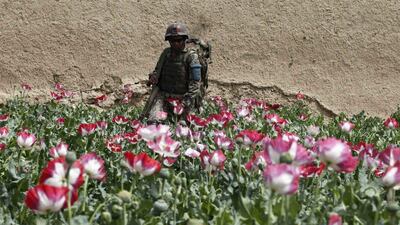
  • An Afghan army soldier walks through a poppy field during a joint mission with US Army soldiers from Charlie troop 4-73 Cavalry Regiment, 4th Brigade, 82nd Airborne Division in the Maiwand district in Kandahar province, southern Afghanistan in April 7, 2012. Baz Ratner / Reuters
    An Afghan army soldier walks through a poppy field during a joint mission with US Army soldiers from Charlie troop 4-73 Cavalry Regiment, 4th Brigade, 82nd Airborne Division in the Maiwand district in Kandahar province, southern Afghanistan in April 7, 2012. Baz Ratner / Reuters
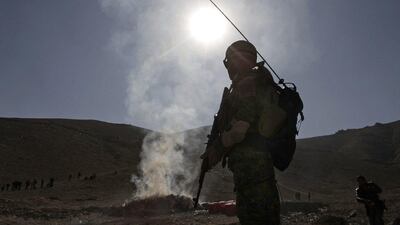
  • An Afghan security man stands guard during a drug burning ceremony on the outskirts of Kabul, Afghanistan, on November 12, 2013, where around 20 tons of opium, heroin and hashish were set on fire, officials said. Rahamt Gul / AP Photo
    An Afghan security man stands guard during a drug burning ceremony on the outskirts of Kabul, Afghanistan, on November 12, 2013, where around 20 tons of opium, heroin and hashish were set on fire, officials said. Rahamt Gul / AP Photo
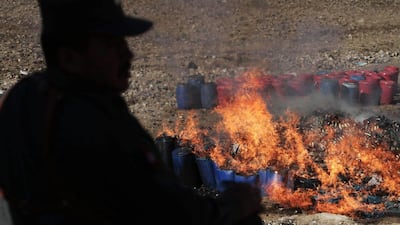
  • An Afghan security man stands guard during a drug burning ceremony on the outskirts of Kabul, Afghanistan, Tuesday. Rahmat Gul / AP Photo
    An Afghan security man stands guard during a drug burning ceremony on the outskirts of Kabul, Afghanistan, Tuesday. Rahmat Gul / AP Photo

At the time, he told the world the Taliban did not want to see “any narcotics produced” – but said international backing was needed to allow farmers to move away from the trade. The rumour that a ban on poppy growing was imminent spread through the province, a historical Taliban stronghold and the centre of the country’s opium production and drug trafficking.

Buyers are bracing for a shortage, “so the opium price is soaring”, Zekria said.

But the 40-year-old, who like his father and grandfather has spent much of his life growing poppies, said he did not believe the Taliban could end their cultivation in the country.

“We know it’s not good, but we don’t have enough water or seeds,” he said.

In 2000, during the hardliners’ last stint in power, the Taliban banned poppy growing, declaring it forbidden under Islam, and almost eradicated the crop. After their US-led removal in 2001, poppy farming proliferated, even as the West poured millions of dollars into pushing non-narcotic crops such as saffron.

Then, with the Taliban switching from ruling Afghanistan to insurgency against US-led forces, they relied on opium production to pay for their rebellion. In 2016, half of their revenue came from the trade, according to the UN.

Afghanistan’s opium production has since remained high year after year.

The UN says about 6,300 tonnes were produced last year alone. It estimates the trade is worth $2 billion in annual revenue in the country.

But like many farmers in the south, Masoom says it will never be eradicated.

“We cannot grow anything else right now.”

Gothia Cup 2025

4,872 matches 

1,942 teams

116 pitches

76 nations

26 UAE teams

15 Lebanese teams

2 Kuwaiti teams

Specs

Engine: Dual-motor all-wheel-drive electric

Range: Up to 610km

Power: 905hp

Torque: 985Nm

Price: From Dh439,000

Available: Now

The biog

Name: Sari Al Zubaidi

Occupation: co-founder of Cafe di Rosati

Age: 42

Marital status: single

Favourite drink: drip coffee V60

Favourite destination: Bali, Indonesia 

Favourite book: 100 Years of Solitude 

How to invest in gold

Investors can tap into the gold price by purchasing physical jewellery, coins and even gold bars, but these need to be stored safely and possibly insured.

A cheaper and more straightforward way to benefit from gold price growth is to buy an exchange-traded fund (ETF).

Most advisers suggest sticking to “physical” ETFs. These hold actual gold bullion, bars and coins in a vault on investors’ behalf. Others do not hold gold but use derivatives to track the price instead, adding an extra layer of risk. The two biggest physical gold ETFs are SPDR Gold Trust and iShares Gold Trust.

Another way to invest in gold’s success is to buy gold mining stocks, but Mr Gravier says this brings added risks and can be more volatile. “They have a serious downside potential should the price consolidate.”

Mr Kyprianou says gold and gold miners are two different asset classes. “One is a commodity and the other is a company stock, which means they behave differently.”

Mining companies are a business, susceptible to other market forces, such as worker availability, health and safety, strikes, debt levels, and so on. “These have nothing to do with gold at all. It means that some companies will survive, others won’t.”

By contrast, when gold is mined, it just sits in a vault. “It doesn’t even rust, which means it retains its value,” Mr Kyprianou says.

You may already have exposure to gold miners in your portfolio, say, through an international ETF or actively managed mutual fund.

You could spread this risk with an actively managed fund that invests in a spread of gold miners, with the best known being BlackRock Gold & General. It is up an incredible 55 per cent over the past year, and 240 per cent over five years. As always, past performance is no guide to the future.

RACE CARD

6.30pm: Maiden (TB) Dh82,500 (Dirt) 1,200m

7.05pm: Maiden (TB) Dh82,500 (D) 1,900m

7.40pm: Handicap (TB) Dh102,500 (D) 2,000m

8.15pm: Conditions (TB) Dh120,000 (D) 1,600m

8.50pm: Handicap (TB) Dh95,000 (D) 1,600m

9.25pm: Handicap (TB) Dh87,500 (D) 1,400m

The specs

Engine: 2.0-litre 4cyl turbo

Power: 261hp at 5,500rpm

Torque: 405Nm at 1,750-3,500rpm

Transmission: 9-speed auto

Fuel consumption: 6.9L/100km

On sale: Now

Price: From Dh117,059

THE SPECS

Engine: 6.75-litre twin-turbocharged V12 petrol engine 

Power: 420kW

Torque: 780Nm

Transmission: 8-speed automatic

Price: From Dh1,350,000

On sale: Available for preorder now

Racecard

6pm: Mina Hamriya – Handicap (TB) $75,000 (Dirt) 1,400m

6.35pm: Al Wasl Stakes – Conditions (TB) $60,000 (Turf) 1,200m

7.10pm: UAE Oaks – Group 3 (TB) $150,000 (D) 1,900m

7.45pm: Blue Point Sprint – Group 2 (TB) $180,000 (T) 1,000m

8.20pm: Nad Al Sheba Trophy – Group 3 (TB) $200,000 (T) 2,810m

8.55pm: Mina Rashid – Handicap (TB) $80,000 (T) 1,600m

Avatar: Fire and Ash

Director: James Cameron

Starring: Sam Worthington, Sigourney Weaver, Zoe Saldana

Rating: 4.5/5

UAE SQUAD

Mohammed Naveed (captain), Rohan Mustafa, Ashfaq Ahmed, Rameez Shahzad, Shaiman Anwar, Mohammed Usman, Mohammed Boota, Zawar Farid, Ghulam Shabber, Ahmed Raza, Sultan Ahmed, Imran Haider, Qadeer Ahmed, Chirag Suri , Zahoor Khan

Updated: October 06, 2021, 4:54 AM