


Susan Page still remembers the excitement she felt when she arrived in Juba, South Sudan, as the first US ambassador to the world’s newest country in the summer of 2011.
“You don't get to be the first at something like that,” Ms Page tells The National.
On July 9, 2011, South Sudan gained independence from Khartoum after more than 99 per cent of South Sudanese voted to secede from the north.
It was the product of decades of violence, one of Africa’s longest-running civil wars and years of delicate negotiations led by successive US administrations.
The story of South Sudan once captivated the world’s attention, thanks in large part to the work of celebrities including film star George Clooney, who advocated for the country’s establishment on the world stage.
On the day of independence, then-president Barack Obama celebrated the establishment of South Sudan.
“Today is a reminder that after the darkness of war, the light of a new dawn is possible,” Mr Obama said.
“A proud flag flies over Juba and the map of the world has been redrawn.”
But the hope and optimism of that day quickly faded.

Ms Page, who spent much of her professional career working on Sudan, had seen warning signs of some of the issues South Sudan would face years earlier, during her work on the Comprehensive Peace Agreement in the early 2000s.
The agreement ended the 22-year civil war and outlined a path to the referendum six years later.
But the former ambassador wasn't confident the peace agreement would hold long enough for the South to make it to the vote.
“I was pretty sceptical that they would actually get to the referendum,” Ms Page said.
She knew the players and problems and quickly realised that even if the referendum took place, it would not be a panacea.
“I had witnessed the parties, the southerners in particular, during meetings, for instance, with the assessment and evaluation commission, and just how woefully underprepared they were,” Ms Page said.
The South had been neglected for decades. On top of establishing a government and state institutions necessary for any country, it had to build infrastructure, procure electricity and deal with the long established divides between its various sects and tribes.
Ultimately that proved too great a task.
In December 2013, war broke out between factions loyal to President Salva Kiir and those who supported Vice President Riek Machar.
Between 2013 and 2018, almost 400,000 South Sudanese were killed in fighting based on ethnic divides.
Another almost 2.3 million South Sudanese were forced to flee their homes, becoming refugees and asylum seekers.
“To see it go so, so badly, even what you predicted you couldn't predict,” Ms Page said.
The US decided to suspend its operations in Juba, ordering the evacuation of all non-essential staff and stopping consular services.
Ms Page said the US made the decision knowing the ramifications it could have.
“Recognising that if we left and closed our doors, the message that we would be sending to everyone else, that there was really no hope,” she said.
-
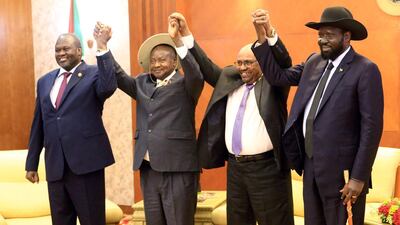
South Sudanese rivals President Salva Kiir, right, and rebel leader Riek Machar, left, with Uganda's President Yoweri Museveni, second left, during peace talks hosted by Sudan's former president Omar Al Bashir, second right, on June 25, 2018. Reuters -
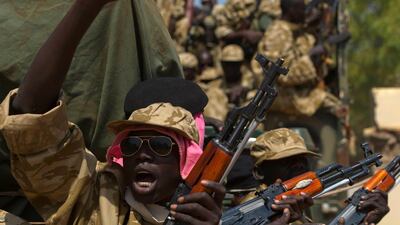
A soldier of the Sudan People's Liberation Army, predecessor to the South Sudan People's Defence Forces, gestures as he sits in a vehicle in the capital Juba, on December 21, 2013. Reuters -
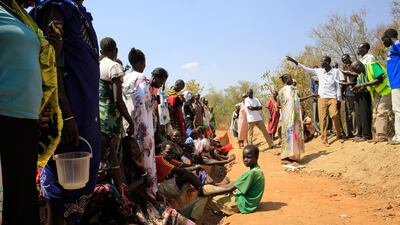
Families displaced by the civil war in South Sudan gather to be registered to receive food rations at a makeshift camp inside the UN Mission in Sudan's centre in Jabel, on the outskirts of Juba, on December 23, 2013. Reuters -
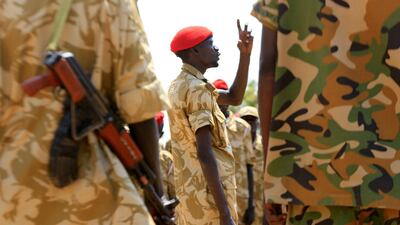
South Sudanese soldiers gather for a briefing at the army general headquarters in Juba, on January 8, 2014. Reuters -
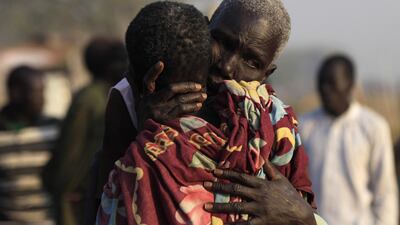
Women displaced by the fighting in Bor county hug each other in the port in Minkaman, in Awerial county, Lakes state, South Sudan, on January 15, 2014. Reuters -
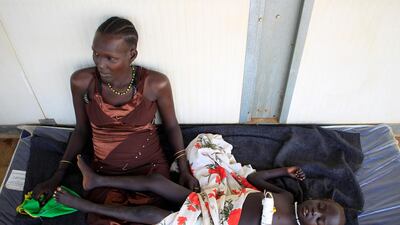
A displaced mother tends to her sick child at a UN hospital at Tomping camp, where some 15,000 displaced people who fled their homes are shelterednear South Sudan's capital Juba on January 7, 2014. Reuters -
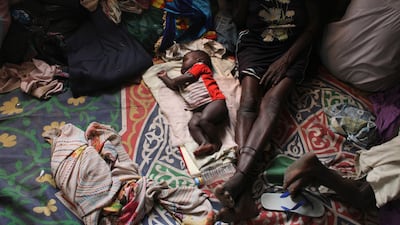
A baby sleeps next to a woman at a Catholic church in Malakal, South Sudan, on January 21, 2014. Reuters -
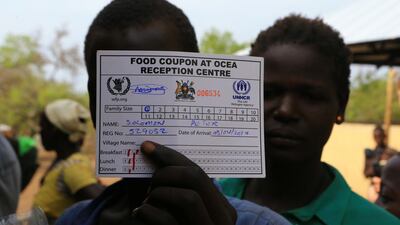
A South Sudanese refugee uses his meal card to cover his face as he waits to be served porridge at Imvepi settlement in Arua district, northern Uganda, on April 4, 2017. Reuters


The hardest moment for Ms Page came when she had to put a South Sudanese "lost boy" on a plane to the US.
He had endured the Sudanese Civil war and managed to get to the US as a refugee and obtain a college degree but chose to return to South Sudan to help his fledgling nation.
“That one really broke my heart,” she said.
Looking back on the past 10 years, former US officials cannot help but feel “disappointment” at how the situation unfolded.
Michael Morrow, US charge d’affaires in Juba from 2017 to 2018, called it “a squandered opportunity".
In 2018, Nikki Haley, then US ambassador to the UN, called Mr Kiir and his government an “unfit partner" during a Security Council meeting.
The public redressing complicated Mr Morrow’s relationships in South Sudan, but he said it was not unwarranted.
“If the South Sudanese government wants to freeze us out for a while, because they're angry at us calling it like it is, then fine,” he told The National.
At the end of Mr Morrow's time there, Mr Kiir and Mr Machar signed a peace deal, officially ending the five-year civil war, but the situation remains tense and violence continues to plague the young nation.
Mr Morrow and Ms Page have bleak outlooks for the country.
“I'd like to be hopeful but there's nothing I can grab on to,” Mr Morrow said.
Ms Page said: “If you don't have any other way to make money or have a chance to be sitting on top somewhere, your only option is to go into government.
“So it's very hard to see how are they going to stop the corruption.”

