The Lebanese Civil War – in pictures
-
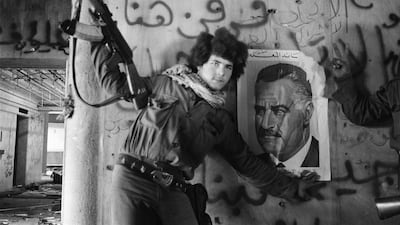
A pro-Palestinian fighter poses by a poster of late Egyptian President Gamal Abdel Nasser on the wall of the Holiday Inn in Beirut on March 24, 1976, days after pro-Palestinian militias dislodged Lebanese Christian forces from the 27-storey hotel. All photos: AFP -
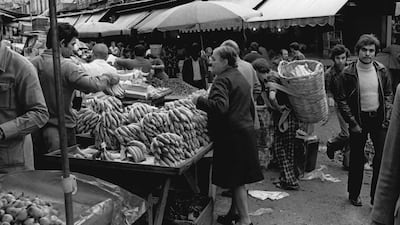
This picture taken in Beirut in the early 1970s shows people shopping in the old vegetable market that was destroyed in the 1975-90 civil war, when the city was split into two warring sectors. -
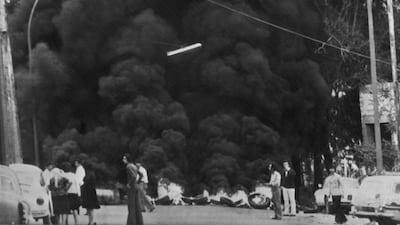
Smoke rises during clashes between Palestinian fighters and members of a Lebanese Christian militia in Beirut, on April 15, 1975. -
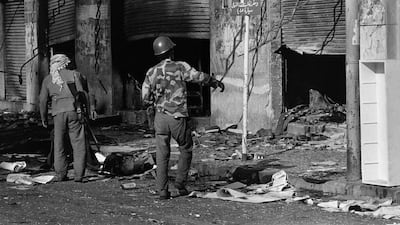
An armed man stands in a street in Lebanon's northern city of Tripoli, on October 21, 1975. The military had taken up positions in the buffer zone between Sunni-majority Tripoli and Zgharta, with orders to keep fighters from the cities apart. -
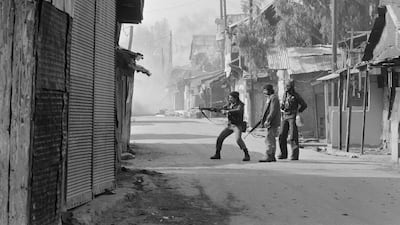
Fighters from Lebanon's Christian Kataeb or Phalangist militia patrol the Christian Palestinian camp of Dbayeh, north of Beirut, on January 28, 1976. -

Children play among the ruins of a destroyed building in Beirut on January 28, 1976, as the blockade of the two main Palestinian camps was lifted. -

Palestinian fighters unfurl a Lebanese flag in Beirut's Holiday Inn on March 24, 1976, after Palestinian commando units dislodged Lebanese Christian forces from the hotel. -
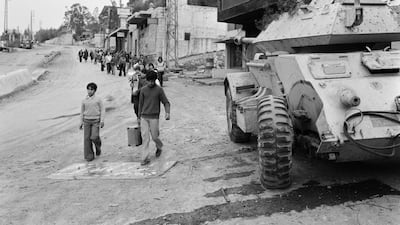
Students leave the Lebanese village of Kahaleh on April 3, 1976, the day after a 10-day truce began. This followed a blockade imposed by Palestinian and Lebanese left-wing fighters on the Christian stronghold in Mount Lebanon. -

Members of the Beirut-based Sunni-majority Nasserist militia al-Murabitoun – Sentinels – take position in the capital, on April 12, 1976. -
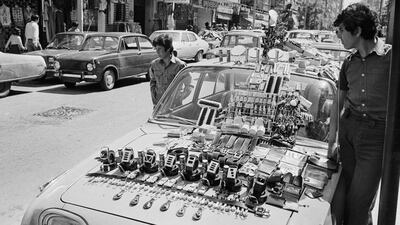
A Beirut street vendor selling goods on April 21, 1976, as some semblance of normal life resumed following a truce. -

A Phalangist militiaman in the village of Kahaleh, a Christian stronghold in Mount Lebanon, near Beirut, on April 4, 1976, after an assault at the end of March by Palestinian and allied Lebanese fighters. -

Loading flour on to vehicles in a food convoy travelling from the eastern neighbourhoods of Beirut, controlled by Christian conservatives, to western areas controlled by progressive and Palestinian forces, after the lifting of the food blockade. -

The food convoy – laden with 35 tonnes of flour – enters western neighbourhoods of Beirut, after the lifting of the food blockade. -

A Christian militia member poses amid the ruins of the Palestinian refugee camp of Tel Al Zaatar, on August 13, 1976, after right-wing forces launched an attack the previous day, following a 52-day siege. -
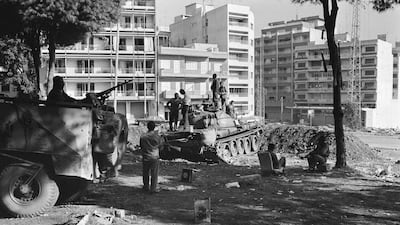
Soldiers from the Syrian contingent of the Arab deterrent force in Lebanon – known as the Green Helmets – take position in Beirut, on November 15, 1976. -

Soldiers from the Syrian contingent of the Green Helmets Arab deterrent force arrive in Beirut, on November 15, 1976. -
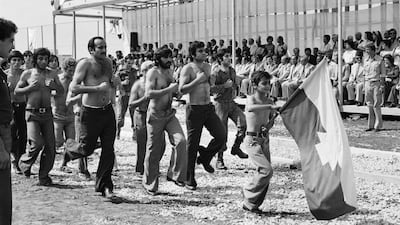
A parade at the swearing-in ceremony of young supporters of Camille Chamoun, leader of the right-wing Christian NLP, at Hadath, in the Beirut suburbs, close to Baabda presidential palace, on October 14, 1977. -
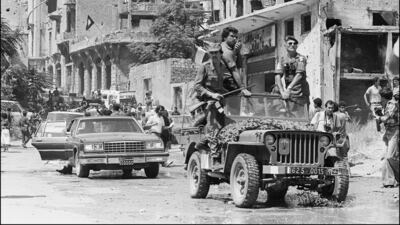
Palestinian fighters travel ahead of the motorcade of Palestine Liberation Organisation chairman Yasser Arafat, as he leaves Israeli-occupied Beirut for Tunis, on August 30 1982. -

Lebanese army soldiers patrol the streets of the mountain village of Souk Al Gharb, south-east of Beirut, on September 26, 1983, after a ceasefire was established throughout Lebanon.


Most popular today

