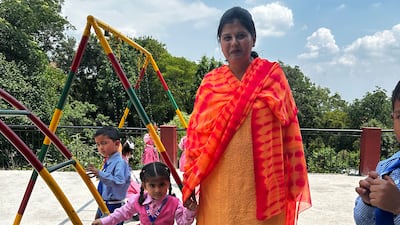
The former Sailana dynasty princess, Tikarani Shailja Katoch. Photo: Tikarani Shailja Katoch

Tikarani Shailja Katoch on her royal legacy of philanthropy and hospitality


  • English
  • Arabic

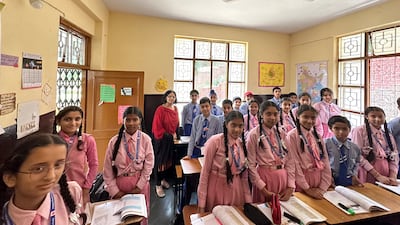
As the school bell rings, its chime reverberating through labyrinthine corridors, dozens of neatly attired pupils in their pink and blue uniforms stream excitedly into the three-storey Happy Hours Public School.

But this is no ordinary school. Nestled in the heart of Dharamsala, in the northern Indian state of Himachal Pradesh – famous as the site of the Dalai Lama’s home – the institution is run by Tikarani Shailja Katoch. She is the erstwhile princess of the Sailana dynasty of Madhya Pradesh.

Sailana’s history can be traced back to the seventh century, when reputed international travellers – including Chinese scholar Hsuan-tsang, who visited ancient India circa 602–664 – mentioned the family in their writings. The Sailana dynasty’s Rathore Rajput warriors were later famous for fighting valiantly against invading British armies.

Katoch’s ancestry links her to several leading Indian princely states. Her mother is the former princess of Jaisalmer, while her father is the former Maharaja of Sailana.

Married to Aishwarya Chandra Katoch, of the princely state of Kangra-Lambagraon in Himachal Pradesh, her mother-in-law is Chandresh Kumari, the sister of Maharaja Gaj Singh of Jodhpur.

As an entrepreneur-philanthropist, Katoch founded non-profit Ambika Educational Society under whose auspices Happy Hours was launched in 2000.

  • Children at Happy Hours Public School in Dharamshala, India. All photos: Tikarani Shailja Katoch
    Children at Happy Hours Public School in Dharamshala, India. All photos: Tikarani Shailja Katoch
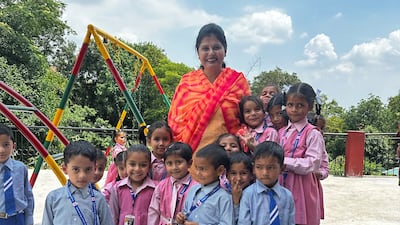
  • Two boys enjoy break time at the school, which caters for children from nursery age to 10th grade
    Two boys enjoy break time at the school, which caters for children from nursery age to 10th grade
  • The public school is in the northern Indian state of Himachal Pradesh
    The public school is in the northern Indian state of Himachal Pradesh
  • Tikarani Shailja Katoch founded non-profit Ambika Educational Society under whose auspices Happy Hours was launched in 2000
    Tikarani Shailja Katoch founded non-profit Ambika Educational Society under whose auspices Happy Hours was launched in 2000
  • 'Our initiative has helped many poor local families who couldn’t afford good education for their kids,' says Katoch
    'Our initiative has helped many poor local families who couldn’t afford good education for their kids,' says Katoch
  • Children at Happy Hours learn seven subjects including Yog Sanskrit, which teaches them about Indian art and culture.
    Children at Happy Hours learn seven subjects including Yog Sanskrit, which teaches them about Indian art and culture.
  • There are more than 350 boys and girls at the school, with 17 classrooms in the three-storey building
    There are more than 350 boys and girls at the school, with 17 classrooms in the three-storey building
  • 'We aim for the all-round development of our students and don’t just focus on academics,' says teacher Babita Kumari
    'We aim for the all-round development of our students and don’t just focus on academics,' says teacher Babita Kumari

“Our initiative has helped many poor local families who couldn’t afford good education for their kids. Over 350 such kids are studying in classes from nursery to 10th [grade] in our school, many of them first-generation learners,” she says.

Much of Katoch's interest in education, she says, stems from her young impressionable years spent in boarding schools in India.

“I’ve great memories of my childhood years,” Katoch says. “However, as there were no good schools in Sailana at that time, young members of royal families were packed off to boarding schools at a tender age. I loved it there.

"We had amazing teachers and they took care of us like family. During vacations, I’d be very excited to visit Sailana, where time was spent with cousins and aunts. Frolicking in our sprawling rose and cactus gardens and gorging on delicious local food rustled up by our chefs made me feel like the luckiest girl in the world.”

A keen student, despite her privileged background she dreamt of opening her own school one day to teach underprivileged members of the community. The dream came to fruition with the launch of Happy Hours, where gender empowerment is also practised.

“About 30 local women work at the school as teachers. I personally interview all the teachers before they’re hired and have often had to reject men candidates simply because it’s the women who deserve a fair chance. They’re offered few opportunities and in our region they also have less literacy then the men,” says Katoch, who makes it a point to be in school every day.

“I like to interact closely with the teachers and students. I learn every day from these interactions. We celebrate all festivals together at the school as well Father’s and Mother’s Day. We encourage our students to participate in inter-school plays, debates and elocution contests. Talented athletes are given incentives.

"Our students regularly top regional academic rankings. In fact ours is more a well-knit community than an academic institution.”

Tikarani Shailja Katoch is a former princess of the Sailana dynasty of Madhya Pradesh. Photo: Tikarani Shailja Katoch

As director of the Kangra Group (headed by her husband), Katoch is also involved in several social and philanthropic activities.

“Earlier we had volunteers from the UK come to our school and teach English and related subjects to the students. But now we’ve pivoted to focus on involving only locals in our initiative so that the whole community can benefit.”

Happy Hours has more than a dozen differently enabled children in its pupil population. Efforts have also been made to build state-of-the-art infrastructure. All the 17 classrooms are spacious, well ventilated and fitted with surveillance cameras. A well-equipped laboratory, a well-stocked library with more than 2,000 books and a computer lab add to the school’s modern infrastructure.

The students are taught in English and learn seven subjects including Yog Sanskrit, which teaches them about Indian art and culture.

“We aim for the all-round development of our students and don’t just focus on academics,” says Babita Kumari, a primary teacher at Happy Hours.

“This allows the children to develop the skills a sound education provides, as well as the competencies essential for success and leadership in the emerging creative economy. We also train them in theoretical knowledge that enables them to better understand our world and improve conditions for local and global communities.”

Apart from running Happy Hours, Katoch says she is also involved in promoting her family’s culinary legacy, which has been handed down through three generations of master chefs.

“I’ve had the privilege to be born in a family where food has always been a way of life. My father – also an author and gourmand – has even written a cookbook, Cooking Delights of the Maharajas, based on Sailana’s rich gastronomy.”

The book’s recipes, Katoch says, were curated by her father during his peripatetic youth, when he visited more than 500 Indian royal families. His cooks travelled with him carrying their own spice boxes while gaining access to the hosts’ kitchens to see how their own special dishes were crafted.

Katoch, however, admits that her culinary guru was her great-aunt from Nepal. “She patiently taught me everything that I know, the spices, the condiments, the measures and which flavours to combine or avoid. In fact, my husband is so fond of Sailana’s food that he wants one dish from our cuisine for every meal.”

Apart from philanthropy, the Sailana royals were well known for their hospitality. To preserve this legacy, Katoch’s family has painstakingly restored the Kangra Palace, which is now open to visitors. The family is also the custodian of thousands of rare artefacts displayed at the palace museum. Conservation and upkeep of the famous Sailana cactus garden, the oldest in India, is also under the Katoch family’s charge.

Under Katoch’s ancestor – Maharaja Sansar Chandra of Kangra – more than 40,000 Kangra miniature paintings were commissioned to empower local artists, she adds. The tradition continues today, as multi-generational artisan families still earn a livelihood by practising the old art of Kangra painting patronised by Katoch’s family. Some of their children are enrolled at Happy Hours.


Martin Sabbagh profile

Job: CEO JCDecaux Middle East

In the role: Since January 2015

Lives: In the UAE

Background: M&A, investment banking

Studied: Corporate finance

ENGLAND%20SQUAD
%3Cp%3E%3Cstrong%3EGoalkeepers%3C%2Fstrong%3E%20Pickford%20(Everton)%2C%20Pope%20(Newcastle)%2C%20Ramsdale%20(Arsenal)%3C%2Fp%3E%0A%3Cp%3E%3Cstrong%3EDefenders%3C%2Fstrong%3E%20Chilwell%20(Chelsea)%2C%20Dier%20(Tottenham)%2C%20Guehi%20(Crystal%20Palace)%2C%20James%20(Chelsea)%2C%20Maguire%20(Man%20United)%2C%20Shaw%20(Man%20United)%2C%20Stones%20(Man%20City)%2C%20Trippier%20(Newcastle)%2C%20Walker%20(Man%20City)%3Cbr%3E%3Cbr%3E%3Cstrong%3EMidfielders%20%3C%2Fstrong%3EBellingham%20(Dortmund)%2C%20Gallagher%20(Chelsea)%2C%20Henderson%20(Liverpool)%2C%20Maddison%20(Leicester)%2C%20Mount%20(Chelsea)%2C%20Phillips%20(Man%20City)%2C%20Declan%20Rice%20(West%20Ham)%3Cbr%3E%3Cbr%3E%3Cstrong%3EForwards%20%3C%2Fstrong%3EFoden%20(Man%20City)%2C%20Grealish%20(Man%20City)%2C%20Kane%20(Tottenham)%2C%20Rashford%20(Man%20United)%2C%20Saka%20(Arsenal)%2C%20Toney%20(Brentford)%3C%2Fp%3E%0A
Ferrari 12Cilindri specs

Engine: naturally aspirated 6.5-liter V12

Power: 819hp

Torque: 678Nm at 7,250rpm

Price: From Dh1,700,000

Available: Now

Common%20symptoms%20of%20MS
%3Cul%3E%0A%3Cli%3EFatigue%3C%2Fli%3E%0A%3Cli%3Enumbness%20and%20tingling%3C%2Fli%3E%0A%3Cli%3ELoss%20of%20balance%20and%20dizziness%3C%2Fli%3E%0A%3Cli%3EStiffness%20or%20spasms%3C%2Fli%3E%0A%3Cli%3ETremor%3C%2Fli%3E%0A%3Cli%3EPain%3C%2Fli%3E%0A%3Cli%3EBladder%20problems%3C%2Fli%3E%0A%3Cli%3EBowel%20trouble%3C%2Fli%3E%0A%3Cli%3EVision%20problems%3C%2Fli%3E%0A%3Cli%3EProblems%20with%20memory%20and%20thinking%3C%2Fli%3E%0A%3C%2Ful%3E%0A
Ten tax points to be aware of in 2026

1. Domestic VAT refund amendments: request your refund within five years

If a business does not apply for the refund on time, they lose their credit.

2. E-invoicing in the UAE

Businesses should continue preparing for the implementation of e-invoicing in the UAE, with 2026 a preparation and transition period ahead of phased mandatory adoption. 

3. More tax audits

Tax authorities are increasingly using data already available across multiple filings to identify audit risks. 

4. More beneficial VAT and excise tax penalty regime

Tax disputes are expected to become more frequent and more structured, with clearer administrative objection and appeal processes. The UAE has adopted a new penalty regime for VAT and excise disputes, which now mirrors the penalty regime for corporate tax.

5. Greater emphasis on statutory audit

There is a greater need for the accuracy of financial statements. The International Financial Reporting Standards standards need to be strictly adhered to and, as a result, the quality of the audits will need to increase.

6. Further transfer pricing enforcement

Transfer pricing enforcement, which refers to the practice of establishing prices for internal transactions between related entities, is expected to broaden in scope. The UAE will shortly open the possibility to negotiate advance pricing agreements, or essentially rulings for transfer pricing purposes. 

7. Limited time periods for audits

Recent amendments also introduce a default five-year limitation period for tax audits and assessments, subject to specific statutory exceptions. While the standard audit and assessment period is five years, this may be extended to up to 15 years in cases involving fraud or tax evasion. 

8. Pillar 2 implementation 

Many multinational groups will begin to feel the practical effect of the Domestic Minimum Top-Up Tax (DMTT), the UAE's implementation of the OECD’s global minimum tax under Pillar 2. While the rules apply for financial years starting on or after January 1, 2025, it is 2026 that marks the transition to an operational phase.

9. Reduced compliance obligations for imported goods and services

Businesses that apply the reverse-charge mechanism for VAT purposes in the UAE may benefit from reduced compliance obligations. 

10. Substance and CbC reporting focus

Tax authorities are expected to continue strengthening the enforcement of economic substance and Country-by-Country (CbC) reporting frameworks. In the UAE, these regimes are increasingly being used as risk-assessment tools, providing tax authorities with a comprehensive view of multinational groups’ global footprints and enabling them to assess whether profits are aligned with real economic activity. 

Contributed by Thomas Vanhee and Hend Rashwan, Aurifer

The%20Hunger%20Games%3A%20The%20Ballad%20of%20Songbirds%20%26%20Snakes
%3Cp%3E%3Cstrong%3EDirector%3A%3C%2Fstrong%3E%C2%A0Francis%20Lawrence%3C%2Fp%3E%0A%3Cp%3E%3Cstrong%3EStars%3A%C2%A0%3C%2Fstrong%3ERachel%20Zegler%2C%20Peter%20Dinklage%2C%20Viola%20Davis%2C%20Tom%20Blyth%3C%2Fp%3E%0A%3Cp%3E%3Cstrong%3ERating%3A%20%3C%2Fstrong%3E3%2F5%3C%2Fp%3E%0A
What went into the film

25 visual effects (VFX) studios

2,150 VFX shots in a film with 2,500 shots

1,000 VFX artists

3,000 technicians

10 Concept artists, 25 3D designers

New sound technology, named 4D SRL


Results

5pm: Al Maha Stables – Maiden (PA) Dh80,000 (Turf) 1,600m; Winner: Reem Baynounah, Fernando Jara (jockey), Mohamed Daggash (trainer)

5.30pm: Wathba Stallions Cup – Maiden (PA) Dh70,000 (T) 1,600m; Winner: AF Afham, Tadhg O’Shea, Ernst Oertel

6pm: Emirates Fillies Classic – Prestige (PA) Dh100,000 (T) 1,600m; Winner: Ghallieah, Sebastien Martino, Jean-Claude Pecout

6.30pm: Emirates Colts Classic – Prestige (PA) Dh100,000 (T) 1,600m; Winner: Yas Xmnsor, Saif Al Balushi, Khalifa Al Neyadi

7pm: The President’s Cup – Group 1 (PA) Dh2,500,000 (T) 2,200m; Winner: Somoud, Adrie de Vries, Jean de Roualle

7.30pm: The President’s Cup – Listed (TB) Dh380,000 (T) 1,400m; Winner: Haqeeqy, Dane O’Neill, John Hyde.

HOW TO WATCH

Facebook: TheNationalNews  

Twitter: @thenationalnews  

Instagram: @thenationalnews.com  

TikTok: @thenationalnews 

Updated: July 26, 2023, 8:15 AM