


Central to tackling global warming is a move from an economy based on fossil fuels, but recent years have shown that progress is far behind what scientists say is necessary.
The aim of the Paris Agreement on climate change – to limit temperature increases to 1.5°C above pre-industrial levels – is now widely seen as extremely difficult to achieve, putting the spotlight on alternative ways to keep the climate cool.
Geoengineering – large-scale efforts to manipulate processes that affect the climate – is chief among these other approaches.
Deflecting sunlight
The Centre for Climate Repair at the University of Cambridge is promoting a plan that is ambitious in scale and that makes for a memorable soundbite: it wants to refreeze the Arctic.
This would involve sending hundreds or even thousands of ships to the Arctic to create a seawater mist, which would improve cloud cover and deflect more sunlight.
If this was done, sea ice in the Arctic could increase year on year and glaciers on the Greenland land mass could be protected, limiting sea-level rises.
-
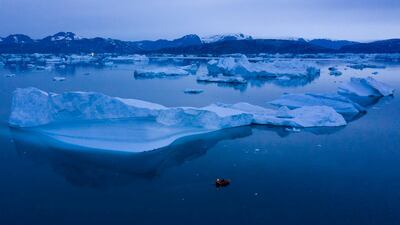
A boat navigates at night next to large icebergs near the town of Kulusuk, in eastern Greenland. All photos by AP -
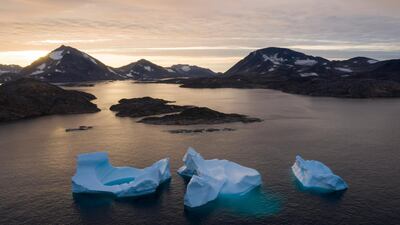
Large Icebergs float away as the sun rises near Kulusuk. -
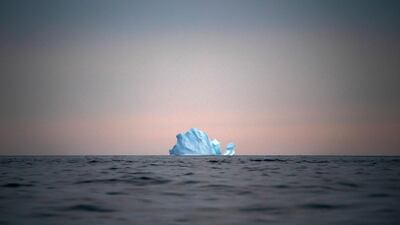
A large Iceberg floats away as the sun sets. -
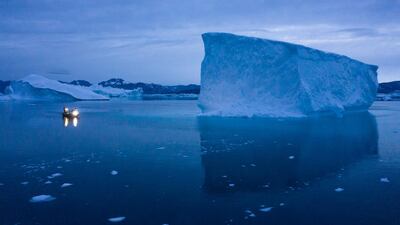
A boat navigates at night next to large icebergs in eastern Greenland. -

A woman stands next to an antenna at an NYU base camp at the Helheim glacier. -
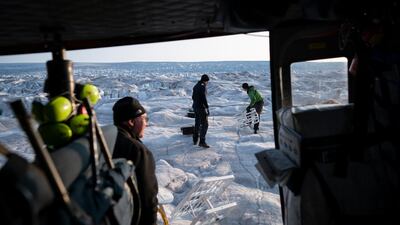
New York University air and ocean scientist David Holland, left, and field safety officer Brian Rougeux, right, are helped by pilot Martin Norregaard as they carry antennas out of a helicopter to be installed at the Helheim glacier. -

A helicopter flies over hundreds of icebergs floating near the Helheim glacier. -

A boat navigates at night next to a large iceberg in eastern Greenland. -
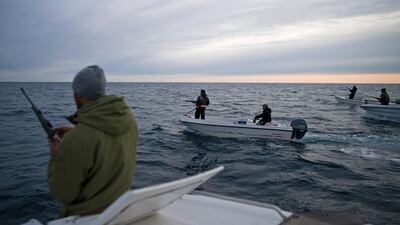
Mugu Utuaq, left, reloads his rifle as he rides with other boats hunting whales near Kulusuk. -
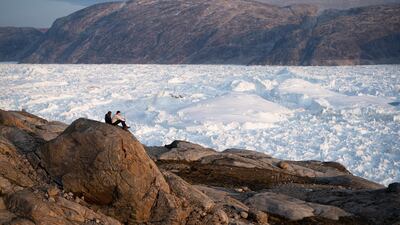
NYU student researchers sit on top of a rock overlooking the Helheim glacier. -

Crosses stand in a cemetery as an iceberg floats in the distance during a foggy morning. -
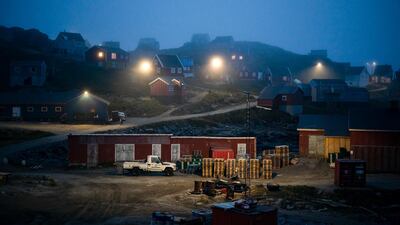
Early morning fog shrouds homes in Kulusuk. -

A helicopter carrying NYU air and ocean scientist David Holland and his team sits on the ice as they install a radar and GPS at the Helheim glacier.


The measure could also reduce the thawing of permafrost in the region, something that otherwise risks releasing large quantities of methane – a potent greenhouse gas.
Dr Shaun Fitzgerald, director of the centre, says that if geoengineering can be shown to work without unacceptable adverse effects then it could buy the world time to get greenhouse gas levels down while preserving Arctic ecosystems
"The timescales involved, because of the inertia of the Earth and, frankly, that of our society, means that without some form of band aid such as geoengineering we’re going to see catastrophic losses in places like the Arctic," he says.
"What goes on in the Arctic doesn’t stay in the Arctic … while you’ve got extensive ice in the Arctic, it provides a buffering and stabilising effect on the whole of the Earth’s climate. If we let that go, it’s going to be absolutely terrible."
The stabilising effect of the Arctic ice comes from the fact that it reflects sunlight and because the melting of ice uses up energy that would otherwise lead to warming.
This can be better understood by thinking of a glass of water containing ice cubes. If the water is heated, its temperature will not rise much above 0°C while there is still ice in the glass.
Once that ice has melted, however, the water will warm much more quickly, something that could happen to seawater if it lost its ice cover.

Wide climatic consequences
The centre’s deputy director, Hugh Hunt, of the university’s department of engineering, describes the Arctic as the air conditioner for the northern hemisphere, drawing air north and cooling it before it moves south again.
"If the Arctic is not so cold, then that circulation is weaker," he says. "And the weakness of that circulation is affecting our weather patterns.
"We’re already seeing that a warmer Arctic is disrupting the jet stream, disrupting the Polar vortex, disrupting weather patterns so that the extremes are becoming more frequent and more extreme. That’s the impact that the warming Arctic is having."
This warming is eroding the glaciers in the Greenland ice shelf, creating meltwater measured in the hundreds of cubic kilometres per year.
"If we lose 10 per cent of the Greenland ice shelf in the next century, that’s the best part of a metre sea-level rise, which means most coastal cities around the world will be seriously hampered. You can’t live in a city which regularly floods," Prof Hunt says.
The task now is to develop the technology so that it could be tested and implemented at scale.
Researchers in Cambridge are among those engaged in this, studying such things as droplet generation for brightening clouds.
Enhancing cloud cover
In the Arctic, the seawater mist created by the ships would dry to leave tiny salt crystals suspended in the air. These salt crystals are swept up to higher altitudes, where they enhance cloud cover and reflect sunlight. This enhances the natural process of cloud formation, where wind and waves create the salt-water mist.
Similar work is being carried out in Australia, where researchers from Southern Cross University are spraying water off a ship to generate clouds that may reduce the heating of the Great Barrier Reef.
Prof Stephen Salter, of the University of Edinburgh in the UK, has designed a ship that could be used in the Arctic to generate mist.

The vessels, which could be operated remotely, would pick up energy from the water and the wind, so their operation would not generate significant carbon emissions.
But with projects of the kind being envisaged there could be unintended consequences and Prof Hunt acknowledges that any scheme to increase cloud cover and reflect more of the sunlight that hits the Arctic is "not without risk".
He also says that the work of the centre, which was founded three years ago by Sir David King, a South African-born chemist who was the British government’s chief scientific adviser and special representative for climate change, remains at an early stage and is being done "on a shoe string".
"The technology isn’t ready yet, the research hasn’t been done, the actual practical hardware research is still in its infancy," Prof Hunt says.
"If you compare where we’re at with driverless cars or AI or lots of other controversial things, the technologies for geoengineering are just beginning. If you’re asking can we do it, I’m pretty sure we can, but we’re way behind in actual technology."
Billions of dollars of investment needed
The centre is hoping to secure additional funding to complement its current supporters, who include philanthropists, trusts and foundations.
Millions of dollars is needed to further develop the methods, while the cost of running the scheme would probably run into billions of dollars.
But the costs to the world in not acting are estimated by the centre to run into the trillions, ranging from spending on sea defences to losses in agricultural productivity and the costs of mass climate-induced migration.
"If we can, for example, halt the loss of ice on Greenland and Antarctica we’re going to be saving a huge amount of money," Dr Fitzgerald says.

