

Never on the metro, or in a restaurant, and certainly not at a funeral — the fog may eventually have cleared on the rules of vaping in polite society.
There are now more e-cigarette users — or vapers — in the UAE than ever, with associated revenue set to reach $59.38 million (Dh218.1 million) this year, according to online data platform Statista.
Yet many still do not know when or where to vape, posing a social minefield for smokers in group situations — until now.
Abu Dhabi social manners experts the Modern Etiquette Consultancy has compiled a list of guidelines for acceptable vaping, identifying the use of e-cigarettes in offices, lifts and hospitals as among the biggest faux pas.
Other unacceptable behaviour includes blowing vapour directly at others, vaping on public transport and having a sneaky puff at the cinema, while having a smoke in a school or at a funeral is deemed wholly unacceptable
“I cannot stress the importance of respect and consideration when vaping in public,” says etiquette consultant Samira Hammadi. “It is essential to remember these key elements of good manners and etiquette, even when vaping.”
Last year, the Ministry of Health and Prevention banned smoking e-cigarettes in offices and enclosed spaces, as well as in a car while a child is present and in places of worship, educational institutions, health and sports facilities.
Yet some bad behaviour seems to have slipped through the net, causing tension in work and social circles across the region.
The office worker: 'People in Dubai need to chill out'
Keen vaper and former Dubai resident Bilal Muhammad, 25, has noticed a dramatic shift in vaping culture since moving back to England last year.
“In London, smoking is more of a social thing,” he said. “People leave the office for a vape or stand outside bars, whereas in Dubai many do it at their desks.”
Despite finding vaping more acceptable in the region, he has had his fair share of run-ins with colleagues in UAE offices, where he worked as a social media manager.

“People are so easily offended these days, it’s almost as though they are looking for something to pick on,” he said.
“I’ve had people bellow across the office at me — one guy aggressively demanded that I go outside. I just ignored him and carried on vaping.
“I appreciate vaping indoors isn’t for everyone and I usually open a window if the room isn’t well-ventilated, but there are definitely worse things you can do to offend your colleagues.”
For Mr Muhammad, the convenience, stress relief and pleasant scent make vaping in public worthwhile, though he is willing to curb his habit when people “ask nicely”.
“I once had an asthmatic colleague ask me to stop and that’s no problem,” he says. “I draw the line at vaping around people who can’t consent, like children or the elderly
“At the end of the day, it’s my own choice to do it. People just need to chill out and stop causing aggro.”
The social smoker: 'My daughter tries to copy me'
Father of one Khalid Laghari, 33, who lives in Dubai, regularly smokes his e-cigarette in public and calls for more acceptance, however, he doesn’t agree with smoking around children and regrets doing it around his own toddler in the past.
“My daughter noticed me vaping once and when she saw the smoke being exhaled, she stared in awe for a minute and then ran to me to take the vape, wanting to do it too,” he said.
“My first instinct was to hide it and distract her. Usually, I try not to do it when she’s around so that she doesn’t notice it.”
Now, Mr Laghari is more mindful of smoking etiquette but thinks workplaces should be more tolerant of vapers.
“Vaping in the office should be fine, just like it is at home,” he said. “It’s convenient and we wouldn’t have to worry about stinking up the office like we would if we smoked a cigarette.”
The business owner: 'The Mad Men days are over'

Natasha Hatherall, founder and chief executive of Tish Tash Communications, employs more than 40 people at her Dubai office, where she has a zero-tolerance policy on vaping.
“I treat vaping and e-cigarettes as I do regular cigarettes and using them in an office environment is a total no-no for me, both personally and professionally,” she said. “The Mad Men days of smoking at the desk are long gone and thankfully they can stay that way.
“What people do in public is far harder to police, but I feel people should keep vaping to designated areas and socially acceptable situations.”
For Ms Hatherall, not only is smoking at work antisocial, but it also poses unknown health dangers.
“The reality is there are still so many unknowns when it comes to vaping and there is no firm data on the associated risks,” she said.
“I run a company that promotes health and well-being brands and this comes from my personal passions. I have to make sure my company brand aligns with our values and vaping most certainly does not. Ultimately, it is my office and my rules.”
So far, Ms Hatherall hasn’t experienced any bad vaping behaviour in the office, but if she were to catch a whiff of bubblegum mist in Tish Tash HQ, the message is simple.
“We have a zero-vaping policy in our office as part of our company handbook and this is very clear,” she said. “If an employee chose to vape, it would be treated the same as any other non-permitted activity.
“What someone chooses to do outside of the office and work environment is their choice of course, but not in the office environment.”
The etiquette coach: 'Consideration is key'

For Ms Hammadi, being discreet is vital when vaping in public and she urges vapers to assess the situation before firing up their e-cigarette.
“Because vaping is easy and often odourless, it can be easy to forget that it is still a form of smoking and there are rules to follow if we want to be good citizens,” she said.
“It is important to remember that vaping is still a relatively new phenomenon and the rules and etiquette surrounding it may differ in different places. Always be aware of your surroundings and the people around you and err on the side of caution when in doubt.”
“By following these guidelines, you can be a responsible and respectful vaper and help make public spaces more pleasant for everyone.”
Steps to avoid seven vaping sins
1. Do not use excessive amounts of vapour or blow vapour directly at others.
2. Avoid vaping in places considered disrespectful or offensive, such as hospitals, schools, government buildings, religious institutions and at funerals.
3. Refrain from vaping in restaurants, bars and on public transport. If you are at a restaurant, put your vape away until you have left the establishment.
4. Be courteous and ask permission before vaping in shared spaces, such as offices or apartments.
5. Avoid vaping where it may be disruptive or disturbing, such as in cinemas, libraries or museums.
6. Avoid vaping in places where the smell can disturb others, such as lifts, cars and other confined spaces.
7. Avoid vaping in the presence of children or people with respiratory issues.
Vaping in the UAE — in pictures
-
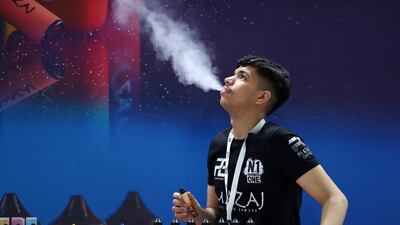
A sales representative trying a new vape at the World Vape Show held last week at Dubai World Trade Centre in Dubai. The exhibition is a platform where manufacturers can show their products. All photos: Pawan Singh / The National -
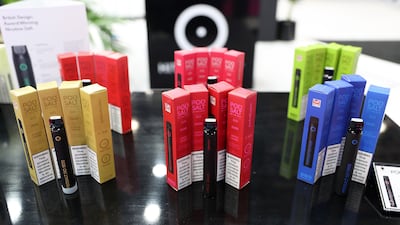
Various products on display at the World Vape Show -
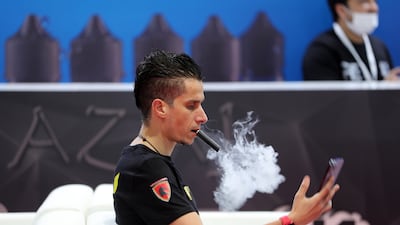
A visitor tries a vape at the exhibition -
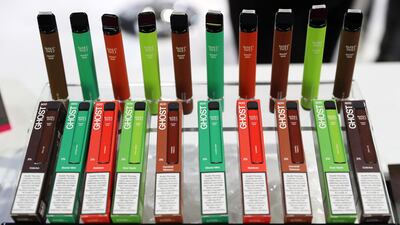
Different types of vapes on display at the World Vape Show -

The World Vape Show is a leading B2B event for e-cigarette users -

Supporters of vaping say the practice is a less-harmful alternative to traditional cigarettes and can help those who want to quit smoking



