


One of the most important questions on the minds of many people is how much to save for retirement and how to achieve this goal.
“Everyone’s circumstances are different, depending on when you want to retire, where and what retirement looks like for you,” says George Howard, chartered financial planner at The Fry Group.
“If you have built up savings, pensions from other countries, gratuity payments at the end of service or rental income from properties, these should all be factored in.”
Pension income rarely sustains the lifestyles that employees and their families have grown accustomed to, according to Abdulmohsin Al Omran, founder and chief executive of The Family Office, a GCC wealth management company.
Unless retired employees have other sources of income, they will face financial difficulties and may be forced to make many compromises and sacrifices, he says.
An October survey of 2,312 people by financial services company Bankrate found that about 55 per cent of US adults felt their retirement savings were not where they need to be, with nearly 35 per cent saying they were “significantly behind” and another 20 per cent saying they were “somewhat behind” their goals.
Similarly, a 2020 survey by global consulting company Mercer found that almost half of all UAE residents often delayed preparing for their retirement until they had reached their late 40s and 50s.
It also found that about 45 per cent had no plans to ensure an adequate standard of living after they retire, or planned to work beyond their retirement age to ensure a steady income.
The first step to retirement planning is finding out how much money you will need to live comfortably. This is influenced by your current salary, the retirement lifestyle you want and can afford, and the estimated length of your retirement life, among other factors, says Vijay Valecha, chief investment officer at Century Financial.
Knowing how much money you need to save depending on your current age will set you on the right path to achieving your retirement objectives, he adds.
We asked personal finance experts for their advice on how people can save for a comfortable retirement.
Top 10 global cities for retirement — in pictures
-

Tokyo ranked as the best global city to retire in a new retirement index compiled by Veolar. Ryo Yoshitake/ Unsplash -
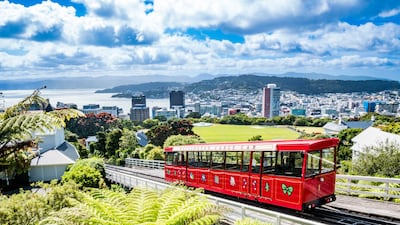
Wellington, New Zealand, was ranked as the second best global city to retire. Leyvaine Davids/ Unsplash -
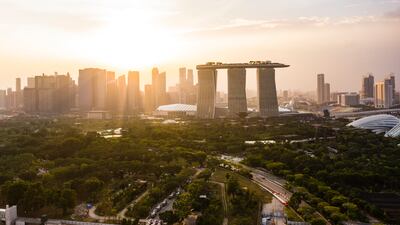
Singapore ranked third and scored well in the categories of legacy management and quality of public transport. Kirill Petropavlov/ Unsplash -

Paris is the fourth best city to retire and scored well in the liveability sub-index, driven by its museums and restaurants. Leonard Cotte/ Unsplash -

Vienna ranked fifth globally for offering the best retirement living standards for senior people. Jacek Dylag/ Unsplash -
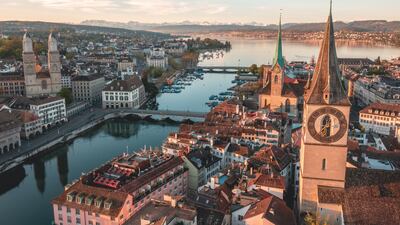
Zurich, in sixth position, ranked high for safety and quality of health care. Henrique Ferreira/ Unsplash -
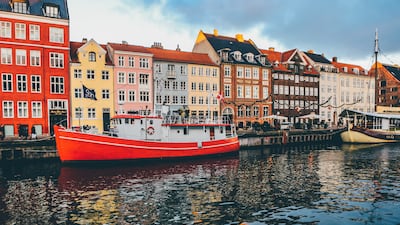
Copenhagen was ranked seventh, driven by its safety, mobility and accessibility to health care. Nick Karvounis/ Unsplash -
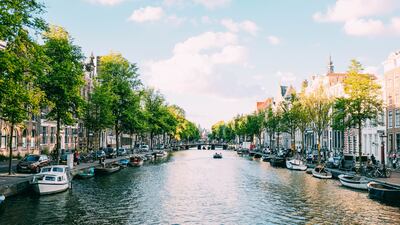
Amsterdam is the eighth best city to retire globally, Veolar said. Adrien Olichon/ Unsplash -

Osaka in Japan placed ninth, earning high scores in the quality and accessibility of health care and health longevity sub-indices. Ramon Kagie/ Unsplash -

Lausanne in Switzerland is the 10th best city globally in terms of retirement living standards, the index showed. Mark de Jong/ Unsplash


Decide on your monthly savings rate
As a rule of thumb, you should aim to save 20 per cent of your income towards your future. However, even if you start with a smaller amount and increase it as your income rises, that is better than doing nothing at all, Ms Howard says.
“Retirement planning can often be left until the later years as a consideration for many people when, in fact, it is important to start saving as soon as possible to give the best outcome in retirement,” she adds.
Start investing early. For instance, if you decided to invest $1,000 a month at a six per cent rate of return from the age of 20, it will have turned into $2 million at 60. On the other hand, even if you saved $2,000 per month from the age of 40, you would only have $925,633 on hand at the same age, according to Mr Valecha.
Early and frequent investments, followed by consistent returns, can have a big impact on your finances when you approach retirement, he adds.
Questions to ask for retirement planning
When planning for your retirement, you should ask yourself a few questions, Mr Al Omran says.
These include:
- Do I have any financial obligations or debt that I must repay during retirement?
- Do I have dependents who require financial support?
- What lifestyle do I want to ensure for myself and my family during retirement?
The answers to the above will determine the investment goals and the portfolio needed to support the financial needs of the retiree, he says.
Other factors to consider include expected expenses during retirement, time to retirement, desired retirement age, risk tolerance and the long-term effect of inflation on spending power during retirement, Mr Al Omran says.
How to calculate nest-egg value?
Calculate your current expenses to provide a benchmark for your future requirements, Mr Valecha says. For example, if your annual income is Dh250,000 and you manage to save Dh50,000 every year, your current expenses are Dh200,000.
Now work backwards and filter out the expenses that will not be there when you retire, such as mortgage payments and childcare support. However, you’ll incur other costs such as out-of-pocket prescription and medical costs, travel and hobbies.
“Let’s assume the amount that is needed comes down to Dh120,000,” he says.
“Account for inflation, which is the biggest factor you need to consider for calculating your retirement amount. Assuming you retire after 25 years at the age of 60, instead of Dh120,000, you will need close to Dh251,000 [at 3 per cent inflation] a year to maintain your lifestyle.”
Also consider life expectancy. Assuming a lifespan of 85 years, then the Dh251,000 needed at retirement will increase to Dh510,000 a year (at 3 per cent inflation) by the time you are 85 years, Mr Valecha estimates.
“Multiply your current annual spending of Dh250,000 by 25. That’s what your savings will have to be in retirement to allow you to safely withdraw the amount you need every year to live on comfortably for 30 years,” he says.
“This sum allows you to withdraw 4 per cent in your first year of retirement, and then keep withdrawing the same dollar amount adjusted for inflation every year going forward to prevent running through your savings early.”
Post-retirement financial planning requires a realistic mindset, a disciplined lifestyle and prioritisation of spending and savings to achieve the desired goal, Mr Al Omran says.
chief investment officer, Century Financial
Where to invest?
The ideal approach to retirement planning is to start saving a portion of the salary at an early age, commit capital gradually to an investment portfolio and reinvest the returns to benefit from the magic of compounding, finance experts say.
However, it is important to think beyond a savings account, Mr Valecha says.
“Investors always have this notion that keeping their money in a savings or fixed deposit account is equivalent to creating an investment plan. But, a regular fixed deposit account will generate an annual interest of about 4 per cent to 5 per cent, while inflation worldwide is running above 7 per cent, which indicates one would be eroding their purchasing power by letting their savings sit in FDs,” he says.
“Thus, it is vital to go beyond the savings account and invest the money as a portfolio of different asset classes that align with your goals and needs.”
In an inflationary environment, staying invested is extremely important to preserve purchasing power, Mr Al Omran says.
“A diversified investment strategy helps nurture wealth, preserve the lifestyle and transfer wealth to the next generation.”
Use an investment account that can be flexible to your changing needs, Ms Howard from The Fry Group says.
For example, if you lose your job, you can stop payments with no penalty, restart payments, add bonuses or lump sums, draw money out with no penalty if an unexpected emergency arises, she says.
If you go to a country where a different form of savings is more tax-efficient, your investments need to move easily with you, with no penalties, she adds.
“Always invest in a well-diversified portfolio of liquid assets, using different asset classes such as equities, bonds and commodities, using different geographical locations. Spend time thinking about the risk you are willing to take with your money,” Ms Howard says.
Individuals should consider a mix of different asset classes, such as savings accounts, fixed deposits, onshore and offshore investment schemes, and equities — via systematic investment plans, property and annuities, Mr Valecha adds.
Regular investments made using the systematic investment plan, or SIP, approach will promote financial discipline and do away with the need for market and investment timing, he says.
Not only does this offer the benefits of dollar-cost averaging, but it also prevents you from spending money you’d rather save.
It’s also important to look at the long-term picture.
“When you’re investing for long-term goals like retirement, it’s important to remember that, after extended periods of negative performance, the stock market has usually recovered its losses and edged higher,” Mr Valecha says.
“Therefore, don’t let the performance of your retirement portfolio from day to day, or even from month to month or year to year, get you too worked up.”

