

In a corner of a bookshop facing the historic Jama Masjid in bustling Old Delhi, Mohammad "Katib" Ghalib sits immersed in his work, patiently moving his hollow wooden pen, making striking curves and strokes on posters and wedding cards.
A bunch of wooden dip pens, banded together with elastic, a set of ink — black, white and red — and a small box containing other tools sit next to him.
The spectacled artist wields the pen masterfully, dipping its nib in the ink to imprint names, couplets, Quranic verses and invitations in different styles.
He might have only a handful of assignments but the work can stretch for hours.
Mr Ghalib, 60, is the last known "katib", or calligrapher, in the Indian capital's old quarter, which was once a centre of the art form.
“I was born Mohammad Ghalib but 'Katib' was added to my name by people," he says.
"This has become my identity now because they say I am the last remaining calligrapher here."
-

Mohammad ‘Katib’ Ghalib, 60, is the last known calligrapher working in the old quarter of Delhi, India's capital, an area that was once a flourishing centre for the art form. All photos: Taniya Dutta for The National -
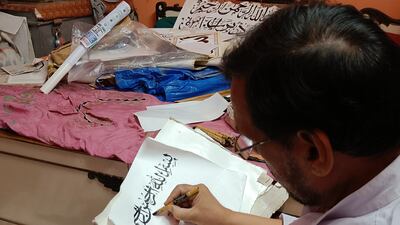
Mr Ghalib works from a corner of a bookshop facing the Jama Masjid, a mosque in Old Delhi. -
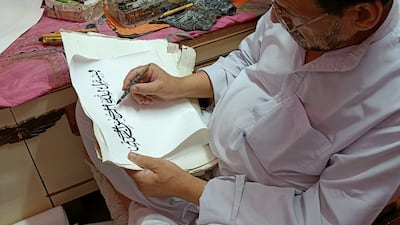
The calligrapher keeps his wooden dip pens, a set of inks and a small box containing other tools next to him as he works. -

The work is painstaking and keeps Mr Ghalib occupied for hours even though the demand for calligraphy has dropped. -
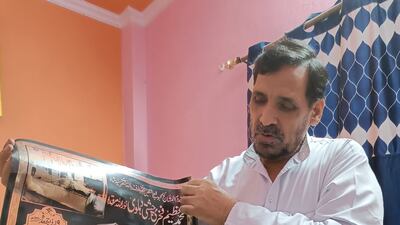
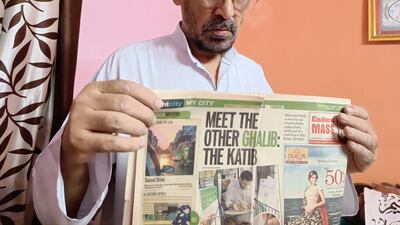
Mr Ghalib displays a poster he worked on. Other jobs regularly given to calligraphers in the past included writing script for newspapers, magazines and books. -
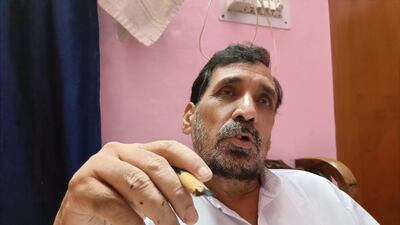
Mr Ghalib says many calligraphers gave up after computer publishing technology reduced demand for their work. -

A poster Mr Ghalib worked on. -
As the last remaining katib, Mr Ghalib is widely known in and around Delhi and even gets clients from faraway states and other countries. -

Mr Ghalib says a challenge to keeping his art alive is the unavailability of tools and pens, because the companies that made them have closed. -

Mr Ghalib feels the future is bleak because of the lack of economic incentives and the gradual decline of Urdu — the preferred language for India's calligraphers.


The art of calligraphy, and particularly Islamic calligraphy, is said to have been introduced in the country in the 12th century during Muslim rule.
It was called the “royal art” and used for creating documents, books, posters for festivals and wedding invitations in Arabic, Persian and Urdu — a language with Persian script.
The languages were widely used in the capital even after Mughal rule ended in the 19th century.
Before the advent of computers, calligraphers like Mr Ghalib were in great demand, scripting daily newspapers for mass printing as well as magazines and books. Some jobs could take up to a year.
They were paid well for their work.
calligrapher
“It was the art of royals … it was hugely respected because only people who could read and write could do it," Mr Ghalib says. "It was a work related to publishers, educated people."
But the occupation went into decline after the use of computer technology in printing became widespread in India about three decades ago.
As Urdu fonts were eventually introduced and the use of Arabic and Farsi — modern Persian — diminished in India, work started drying up for the artists of Old Delhi’s Urdu Bazar, once a vibrant centre of katibs.
Over the years, the number of calligraphers dwindled, with most passing away and the rest switching to more economically viable occupations.
But Mr Ghalib has kept the dying art alive because of his love and passion for it.
“I am continuing the craft because people still value handwritten messages but struggle to find a calligrapher," he says.
"Most have died. I feel responsible to keep this tradition alive as long as I can."
Named after Mirza Ghalib, the famous 19th-century Urdu poet, he was born in Uttar Pradesh’s Saharanpur district where he trained at an Islamic seminary as a calligrapher, also called “khushkhati”.
After mastering the art of writing over three years, he moved to Delhi about four decades ago in search of work.
Mr Ghalib's style of writing, passion and patience meant there was no lack of work.
From writing the text of election and political posters for former prime minister Rajiv Gandhi’s government and banners for Eid and Diwali festivals, to traditional wedding invitations and epitaphs, he always had work.
There were also special assignments from book publishers.
“Money might not have been good but there was so much work that we often divided it among other artists," Mr Ghalib says.
"We worked day and night ... I made enough to raise my two children and run the kitchen."
Although times have changed, his popularity has not.
As the last remaining katib, he is widely known in and around the city and people from faraway states and even countries including Japan visit him with atypical requests, such as writing couplets for wall hangings and people's names for gold pendants.
“Things have changed in the last 15 years ... I don’t get offers for book-writing or newspapers," Mr Ghalib says.
"Only those who are fond of calligraphy now come to me with requests to write wedding invitations, couplets or their names.
“But they pay handsome money because handwriting is always better than computer … it is more designer and fancy, unlike firm fonts of computer language.”
Another challenge to keeping the art alive is the unavailability of tools and pens, because the companies that made them have closed, Mr Ghalib says.
“I use the pens carefully but they have started leaking. I even use flutes as pens.”
For many years, education institutions and Delhi governments have been trying to save the art by offering special courses.
But Mr Ghalib feels the future is bleak because of the lack of economic incentives and the gradual decline of Urdu — the preferred language for the artists.
“We learnt the art as it was a means to earn bread," he says. "It gave us work, but why would youngsters learn it now?
"Even my children did not learn it. Art can thrive if only it gives job opportunities.
“Urdu language is also dying because people don’t speak it any more.
"A lot of youngsters come to me to learn [calligraphy] but how can we teach if they don’t know the language?”

