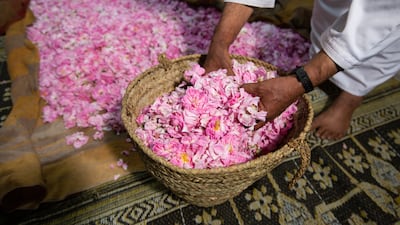
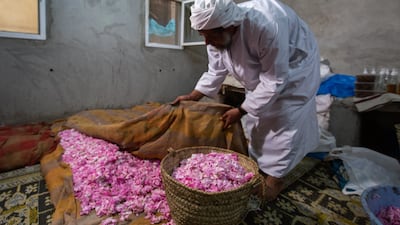
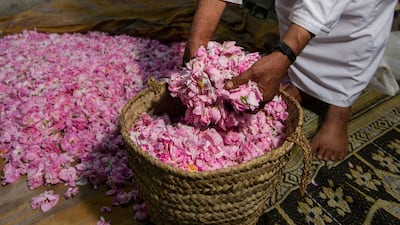
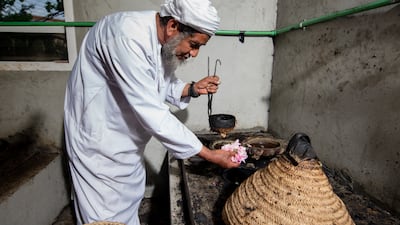
Abdullah Salim Al-Thani from Al Shuraigah village in Jebel Akhdar covers rose petals to keep them moist before being processed. Photo: Tara Atkinson

How Oman's rosewater harvesters are keeping a century-old tradition alive


  • English
  • Arabic

Every year, during the harvest season of March and April, the mountains of Jebel Akhdar in Oman come alive with the scent of roses. The roses, which begin blooming in March, are harvested in April, and are widely used in fragrances, food flavouring and herbal remedies in Oman and across the Middle East.

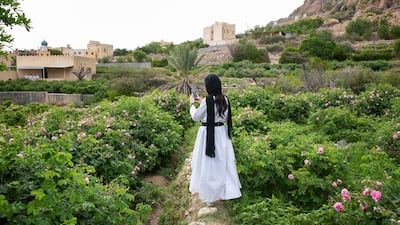
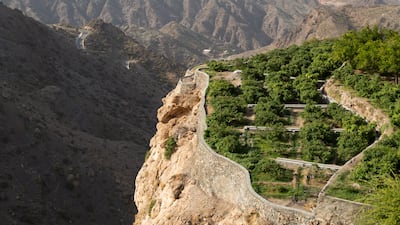
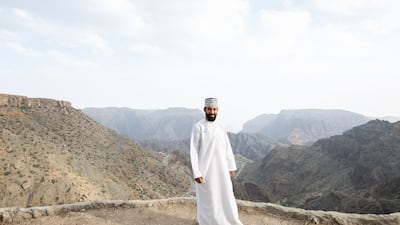
Watered by traditional irrigation channels known as falaj, from natural sources, there are about 4,000 individual rose bushes spread across Jebel Akhdar, also known as the green mountain, in the steep terraced villages of Al Aqer, Al Ayn, Saiq and Al Shuraijah.

At 2,000 metres to 3,000 metres above sea level, the temperature for farming in the Jebel Akhdar mountain range remains cool for the summer, peaking at 30ºC and falling to freezing during the winter months, even snowing occasionally.

The three most famous villages in Jebel Akhdar are Al Aqer, Al Ayn and Al Shuraigah. They, along with Saiq, are producers of roses during March and April. During the rest of the year they grow everything from olives, grapes and figs to apricots, pears, apples, peaches, pomegranates, walnuts and almonds.

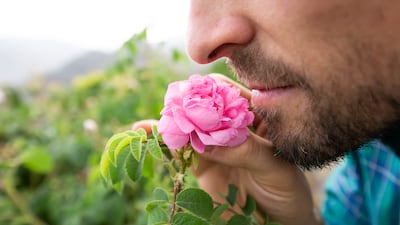
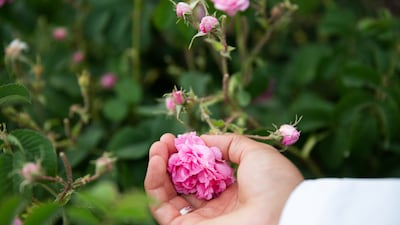
The star of the March and April season is the fragrant pink Al Muhammadi rose, also known as Damask rose, and which can also be found in Iran.

In April, pickers work in the early morning or late afternoon to harvest the flowers. The freshly picked roses are then taken to distillation centres so they can be processed. The centres are usually found in the larger homes of farmers living outside the terraced villages.

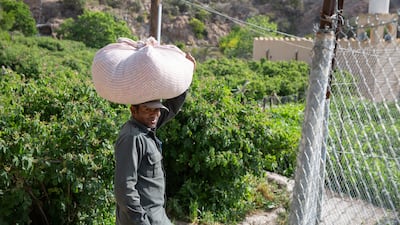
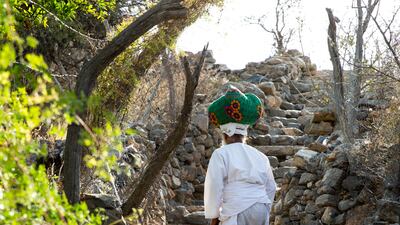
Picked roses are placed in a cloth or a scarf and often carried on the heads of pickers. Bilal Hussain, a picker from Bangladesh who works in one of the rose gardens, is carrying a bunch of flowers weighing almost 11 kilograms.

Harvesting roses is still largely carried out by the ageing population in the villages. Omani villager Nasser, 80, walks up a stone stairway with freshly picked roses wrapped in a cloth on his head in Al Ayn village. Nasser has his own rose garden and factory where he processes the flowers.

Picking the roses requires special care. The flowers have to be plucked in a way that preserves the petals until they are used for distillation.

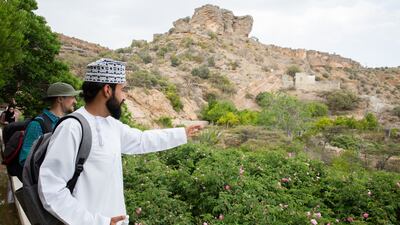
Tour guide Marwan Suqri, 25, a resident of Saiq village, demonstrates below how roses are picked by holding it at the base and using the thumb nail to cleanly cut the stalk.

Suqri, who was born in Jebel Akhdar, works as a guide for Al Fawah Speciality Perfumes in his spare time. Cultural tourism is evident in the villages with perfume companies organising tours for tourists to help them understand how their products are made. The tours usually include hiking as well as picking roses, and a visit to the local distillation plant. Tour packages can range from five Omani riyals ($13) to 30 Omani riyals, depending on the type of tour.

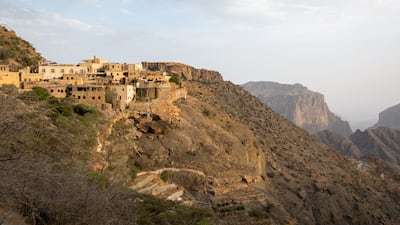
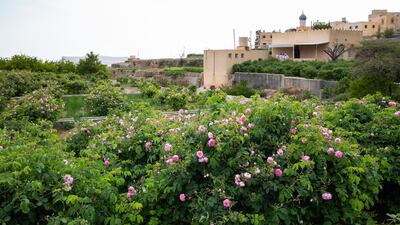
Tourists park and walk through the ancient village of Al Aqer, pictured here with Alila Jabal Akhdar hotel behind it, to see the rose gardens. Many of the buildings in the village have been renovated and renewed in recent years, with some now converted as guesthouses, cafes and even a museum.

Once the roses are picked, they are transported to the distillation factories to be processes into the fragrant water or oils using traditional and modern methods. About 18 farming families in Jebel Akhdar operate the growing, picking, as well as the processing of the roses. The products are then sold to tourists, businesses, herbal shops, supermarkets and hotels.

It takes about 1.5kg of rose petals to create 700 millilitres of traditional rose water.

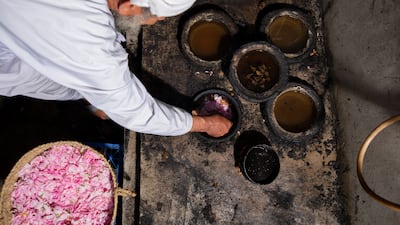
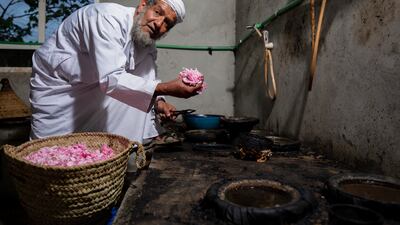
Below, Abdullah Salim Al-Thani from Jebel Akhdar covers the rose petals to keep them moist before processing in his factory behind his house. Rose petals are stored with moisture under a cloth before being processed so they do not dry out.

Al-Thani, 60, who is originally from Al Shuraigah village, now lives in Seeh Qatanah, where his factory and home are.

His factory still uses a traditional rosewater processing system. A gas-fuelled ground fire first steams the rose petals. As the steam rises, cold water is added into the round dish tops, which causes the steam inside the compartments to condensate. The condensation drips down an inverted cone into a steel bowl, which is how the rosewater is produced. This system is a simple gradual distillation technique that creates smoky brown distilled rosewater.

Al-Thani has been harvesting roses for more than 50 years, having first worked with his father in the rose factory when he was a child.

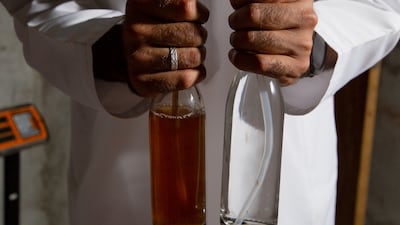
The traditional distillation system creates a smoky rosewater, while clear rosewater is extracted from it by using a similar technique but with a modern distillation process that removes all impurities.

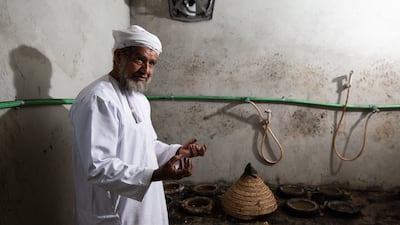
Tour guide Suqri holds the two different types of rose water below.

Al Fawah Speciality Perfumes, the company for which Suqri works as tour guide, is owned by Al-Thani's brother, Ghanim, and his business partners Hamdan Al-Suqri and Saleh Al-Subaihi.

They started the company in 2017, after inheriting the profession from their families. The three partners, who studied engineering in college, were able to develop a more scientific process of extraction of pure aromatic waters and essential oils. By working with traditional producers such as Al-Thani, they are able to share their unique history of rosewater manufacturing and also keep the century-old traditional alive.

Scroll through the gallery for more pictures from the rose petal harvest in Jebel Akhdar, Oman:

  • Maryam Al Saleh, 31, from Muscat takes a picture on a tour of the rose gardens of Al Ayn village in Jebel Akhdar in Oman. March and April are harvest season for roses in the picturesque mountains. All photos: Tara Atkinson
    Maryam Al Saleh, 31, from Muscat takes a picture on a tour of the rose gardens of Al Ayn village in Jebel Akhdar in Oman. March and April are harvest season for roses in the picturesque mountains. All photos: Tara Atkinson
  • Watered from natural sources using traditional irrigation channels known as falaj, approximately 4,000 individual rose bushes thrive in Jebel Akhdar, also known as the green mountain, in the steep terraced villages of Al Aqer, Al Ayn, Saiq and Al Shuraijah.
    Watered from natural sources using traditional irrigation channels known as falaj, approximately 4,000 individual rose bushes thrive in Jebel Akhdar, also known as the green mountain, in the steep terraced villages of Al Aqer, Al Ayn, Saiq and Al Shuraijah.
  • The pink fragrant rose is known as Al Muhammadi Rose (or Damask rose) and is widely used in fragrances, flavouring and herbal remedies in Oman.
    The pink fragrant rose is known as Al Muhammadi Rose (or Damask rose) and is widely used in fragrances, flavouring and herbal remedies in Oman.
  • The ancient village of Al Aqer with the Alila Jabal Akhdar hotel behind it.
    The ancient village of Al Aqer with the Alila Jabal Akhdar hotel behind it.
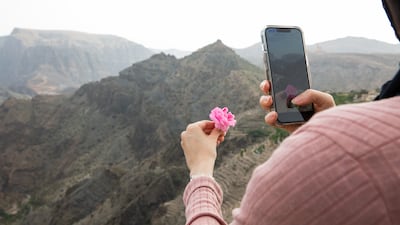
  • A tourist from Muscat holds up a rose against the mountain range for an Instagram picture.
    A tourist from Muscat holds up a rose against the mountain range for an Instagram picture.
  • A tourist during a tour of the rose farms in Al Ayn village.
    A tourist during a tour of the rose farms in Al Ayn village.
  • A rose garden in Al Ayn village.
    A rose garden in Al Ayn village.
  • Bilal Hussain, a picker from Bangladesh, works in one of the rose gardens in Jebel Akhdar. Picked roses are placed in a cloth or a scarf and often carried on the heads of pickers. The one Bilal is carrying weighs about 11 kilograms.
    Bilal Hussain, a picker from Bangladesh, works in one of the rose gardens in Jebel Akhdar. Picked roses are placed in a cloth or a scarf and often carried on the heads of pickers. The one Bilal is carrying weighs about 11 kilograms.
  • A tour guide demonstrates how roses are picked, by holding the bloom at the base and using the thumbnail to cleanly cut the stalk. Picking the roses like this preserves the petals until they are used for distillation.
    A tour guide demonstrates how roses are picked, by holding the bloom at the base and using the thumbnail to cleanly cut the stalk. Picking the roses like this preserves the petals until they are used for distillation.
  • An Omani villager, Nasser, 80, with freshly-picked roses wrapped up in a cloth on his head in Al Ayn Village. Nasser has his own rose garden and factory where he processes the flowers.
    An Omani villager, Nasser, 80, with freshly-picked roses wrapped up in a cloth on his head in Al Ayn Village. Nasser has his own rose garden and factory where he processes the flowers.
  • Once the roses are picked they are taken to the distillation factories to process the flowers into fragrant water or oils using traditional and modern methods.
    Once the roses are picked they are taken to the distillation factories to process the flowers into fragrant water or oils using traditional and modern methods.
  • Farmer Abdullah Salim Al-Thani from Al Shuraigah village in Jebel Akhdar covers the rose petals to keep them moist before processing them in his factory behind his house.
    Farmer Abdullah Salim Al-Thani from Al Shuraigah village in Jebel Akhdar covers the rose petals to keep them moist before processing them in his factory behind his house.
  • Al-Thani, 60, who is originally from Al Shuraigah village now lives in Seeh Qatanah where his factory and home are located.
    Al-Thani, 60, who is originally from Al Shuraigah village now lives in Seeh Qatanah where his factory and home are located.
  • Al-Thani with a traditional distillation unit at his home.
    Al-Thani with a traditional distillation unit at his home.
  • Al-Thani's system uses a bowl heated by a central gas fire. The condensation produces smoky rosewater.
    Al-Thani's system uses a bowl heated by a central gas fire. The condensation produces smoky rosewater.
  • Since he was a child, Al-Thani has worked with his father in the rose factory.
    Since he was a child, Al-Thani has worked with his father in the rose factory.
  • Al-Thani uses a traditional method to extract rosewater from the harvest.
    Al-Thani uses a traditional method to extract rosewater from the harvest.
  • Tour guide Marwan Al Suqri on one of the rose terrace gardens in Al Ayn village.
    Tour guide Marwan Al Suqri on one of the rose terrace gardens in Al Ayn village.
  • Al Suqri works as a tour guide for a perfume company in his spare time.
    Al Suqri works as a tour guide for a perfume company in his spare time.
  • Two types of rosewater are produced in the region. The smoky rosewater is produced by using traditional methods while the clear rosewater uses a similar technique but with a modern distillation process that removes all impurities.
    Two types of rosewater are produced in the region. The smoky rosewater is produced by using traditional methods while the clear rosewater uses a similar technique but with a modern distillation process that removes all impurities.
COMPANY PROFILE
Company name: BorrowMe (BorrowMe.com)

Date started: August 2021

Founder: Nour Sabri

Based: Dubai, UAE

Sector: E-commerce / Marketplace

Size: Two employees

Funding stage: Seed investment

Initial investment: $200,000

Investors: Amr Manaa (director, PwC Middle East) 

RESULTS

Dubai Kahayla Classic – Group 1 (PA) $750,000 (Dirt) 2,000m
Winner: Deryan, Ioritz Mendizabal (jockey), Didier Guillemin (trainer).
Godolphin Mile – Group 2 (TB) $750,000 (D) 1,600m
Winner: Secret Ambition, Tadhg O’Shea, Satish Seemar
Dubai Gold Cup – Group 2 (TB) $750,000 (Turf) 3,200m
Winner: Subjectivist, Joe Fanning, Mark Johnston
Al Quoz Sprint – Group 1 (TB) $1million (T) 1,200m
Winner: Extravagant Kid, Ryan Moore, Brendan Walsh
UAE Derby – Group 2 (TB) $750,000 (D) 1,900m
Winner: Rebel’s Romance, William Buick, Charlie Appleby
Dubai Golden Shaheen – Group 1 (TB) $1.5million (D) 1,200m
Winner: Zenden, Antonio Fresu, Carlos David
Dubai Turf – Group 1 (TB) $4million (T) 1,800m
Winner: Lord North, Frankie Dettori, John Gosden
Dubai Sheema Classic – Group 1 (TB) $5million (T) 2,410m
Winner: Mishriff, John Egan, John Gosden

Desert Warrior

Starring: Anthony Mackie, Aiysha Hart, Ben Kingsley

Director: Rupert Wyatt

Rating: 3/5

The Details

Kabir Singh

Produced by: Cinestaan Studios, T-Series

Directed by: Sandeep Reddy Vanga

Starring: Shahid Kapoor, Kiara Advani, Suresh Oberoi, Soham Majumdar, Arjun Pahwa

Rating: 2.5/5 

Russia's Muslim Heartlands

Dominic Rubin, Oxford

KLOPP%20AT%20LIVERPOOL
%3Cp%3EYears%3A%20October%202015%20-%20June%202024%3Cbr%3ETotal%20games%3A%20491%3Cbr%3EWin%20percentage%3A%2060.9%25%3Cbr%3EMajor%20trophies%3A%206%20(Premier%20League%20x%201%2C%20Champions%20League%20x%201%2C%20FA%20Cup%20x%201%2C%20League%20Cup%20x%202%2C%20Fifa%20Club%20World%20Cup%20x1)%3C%2Fp%3E%0A
MATCH INFO

Manchester City 1 (Gundogan 56')

Shakhtar Donetsk 1 (Solomon 69')

Living in...

This article is part of a guide on where to live in the UAE. Our reporters will profile some of the country’s most desirable districts, provide an estimate of rental prices and introduce you to some of the residents who call each area home.

Volvo ES90 Specs

Engine: Electric single motor (96kW), twin motor (106kW) and twin motor performance (106kW)

Power: 333hp, 449hp, 680hp

Torque: 480Nm, 670Nm, 870Nm

On sale: Later in 2025 or early 2026, depending on region

Price: Exact regional pricing TBA

At a glance

- 20,000 new jobs for Emiratis over three years

- Dh300 million set aside to train 18,000 jobseekers in new skills

- Managerial jobs in government restricted to Emiratis

- Emiratis to get priority for 160 types of job in private sector

- Portion of VAT revenues will fund more graduate programmes

- 8,000 Emirati graduates to do 6-12 month replacements in public or private sector on a Dh10,000 monthly wage - 40 per cent of which will be paid by government

COMPANY%20PROFILE
%3Cp%3E%3Cstrong%3ECompany%20name%3A%3C%2Fstrong%3E%20Switch%20Foods%3Cbr%3E%3Cstrong%3EStarted%3A%3C%2Fstrong%3E%202022%3Cbr%3E%3Cstrong%3EFounder%3A%3C%2Fstrong%3E%20Edward%20Hamod%3Cbr%3E%3Cstrong%3EBased%3A%3C%2Fstrong%3E%20Abu%20Dhabi%2C%20UAE%3Cbr%3E%3Cstrong%3EIndustry%3A%3C%2Fstrong%3E%20Plant-based%20meat%20production%3Cbr%3E%3Cstrong%3ENumber%20of%20employees%3A%3C%2Fstrong%3E%2034%3Cbr%3E%3Cstrong%3EFunding%3A%3C%2Fstrong%3E%20%246.5%20million%3Cbr%3E%3Cstrong%3EFunding%20round%3A%3C%2Fstrong%3E%20Seed%3Cbr%3E%3Cstrong%3EInvestors%3A%3C%2Fstrong%3E%20Based%20in%20US%20and%20across%20Middle%20East%3C%2Fp%3E%0A
Who was Alfred Nobel?

The Nobel Prize was created by wealthy Swedish chemist and entrepreneur Alfred Nobel.

  • In his will he dictated that the bulk of his estate should be used to fund "prizes to those who, during the preceding year, have conferred the greatest benefit to humankind".
  • Nobel is best known as the inventor of dynamite, but also wrote poetry and drama and could speak Russian, French, English and German by the age of 17. The five original prize categories reflect the interests closest to his heart.
  • Nobel died in 1896 but it took until 1901, following a legal battle over his will, before the first prizes were awarded.
Civil%20War
%3Cp%3E%3Cstrong%3EDirector%3A%3C%2Fstrong%3E%20Alex%20Garland%C2%A0%3C%2Fp%3E%0A%3Cp%3E%3Cstrong%3EStarring%3A%3C%2Fstrong%3E%20Kirsten%20Dunst%2C%20Cailee%20Spaeny%2C%20Wagner%20Moura%2C%20Nick%20Offerman%3C%2Fp%3E%0A%3Cp%3E%3Cstrong%3ERating%3A%3C%2Fstrong%3E%204%2F5%3C%2Fp%3E%0A
BULKWHIZ PROFILE

Date started: February 2017

Founders: Amira Rashad (CEO), Yusuf Saber (CTO), Mahmoud Sayedahmed (adviser), Reda Bouraoui (adviser)

Based: Dubai, UAE

Sector: E-commerce 

Size: 50 employees

Funding: approximately $6m

Investors: Beco Capital, Enabling Future and Wain in the UAE; China's MSA Capital; 500 Startups; Faith Capital and Savour Ventures in Kuwait

TOURNAMENT INFO

2018 ICC World Twenty20 Asian Western Regional Qualifier
The top three teams progress to the Asia Qualifier

Thursday results
UAE beat Kuwait by 86 runs
Qatar beat Bahrain by five wickets
Saudi Arabia beat Maldives by 35 runs

Friday fixtures
10am, third-place playoff – Saudi Arabia v Kuwait
3pm, final – UAE v Qatar

Hamilton profile

Age 32

Country United Kingdom

Grands Prix entered 198

Pole positions 67

Wins 57

Podiums 110

Points 2,423

World Championships 3

UK’s AI plan
  • AI ambassadors such as MIT economist Simon Johnson, Monzo cofounder Tom Blomfield and Google DeepMind’s Raia Hadsell
  • £10bn AI growth zone in South Wales to create 5,000 jobs
  • £100m of government support for startups building AI hardware products
  • £250m to train new AI models
Pharaoh's curse

British aristocrat Lord Carnarvon, who funded the expedition to find the Tutankhamun tomb, died in a Cairo hotel four months after the crypt was opened.
He had been in poor health for many years after a car crash, and a mosquito bite made worse by a shaving cut led to blood poisoning and pneumonia.
Reports at the time said Lord Carnarvon suffered from “pain as the inflammation affected the nasal passages and eyes”.
Decades later, scientists contended he had died of aspergillosis after inhaling spores of the fungus aspergillus in the tomb, which can lie dormant for months. The fact several others who entered were also found dead withiin a short time led to the myth of the curse.

In numbers: China in Dubai

The number of Chinese people living in Dubai: An estimated 200,000

Number of Chinese people in International City: Almost 50,000

Daily visitors to Dragon Mart in 2018/19: 120,000

Daily visitors to Dragon Mart in 2010: 20,000

Percentage increase in visitors in eight years: 500 per cent

What are the GCSE grade equivalents?
 
  • Grade 9 = above an A*
  • Grade 8 = between grades A* and A
  • Grade 7 = grade A
  • Grade 6 = just above a grade B
  • Grade 5 = between grades B and C
  • Grade 4 = grade C
  • Grade 3 = between grades D and E
  • Grade 2 = between grades E and F
  • Grade 1 = between grades F and G
What is cyberbullying?

Cyberbullying or online bullying could take many forms such as sending unkind or rude messages to someone, socially isolating people from groups, sharing embarrassing pictures of them, or spreading rumors about them.

Cyberbullying can take place on various platforms such as messages, on social media, on group chats, or games.

Parents should watch out for behavioural changes in their children.

When children are being bullied they they may be feel embarrassed and isolated, so parents should watch out for signs of signs of depression and anxiety

Updated: April 29, 2022, 6:01 PM