


No completion date has officially been announced for the project. But by the end of the decade, trains travelling at up to 200 kilometres an hour are expected to carry 36.5 million people and millions of tonnes of freight every year, taking thousands of cars and trucks off the UAE's roads.
Sheikh Mohammed bin Rashid, Vice President and Ruler of Dubai, has described the roughly $13 billion railway programme as the largest project to consolidate the strength of the union for the next 50 years. The government is certainly putting a lot of faith in the railway as an engine of economic diversification.
But it is not alone. In fact, the world has entered what many have described as a "railway renaissance".
The growth in affordability of the automobile in the mid-20th century resulted in the closure of a significant proportion of the world's colonial-era railways. However, concerns about the environment and congestion, as well as rail's higher speeds and large carrying capacity, have sparked a remarkable turnaround. National governments and city administrations, increasingly supported by the private sector, are spending billions of dollars every year to build new railway infrastructure and upgrade existing networks to carry more people and goods.
The UAE's railway is a key link in the Gulf Railway, which is expected to connect networks in Oman, Saudi Arabia, Kuwait, Bahrain and Qatar. Momentum behind the project has admittedly stalled in recent years, but the ambition remains.
Elsewhere, countries as diverse as Egypt, Costa Rica and Brazil have announced major investments in new rail infrastructure in recent months. Europe has set ambitious targets to shift passenger and freight road traffic to rail to reduce emissions from transport, which will require huge spending on new infrastructure. North America's private transcontinental freight railways remain the backbone of the country's economy, carrying millions of tonnes of goods and raw materials every year.
However, for sheer scale of investment, China is out in front.
The Chinese government placed railway construction at the core of the country's transport policy in the mid-2000s and has since overseen a remarkable expansion. Japan might have pioneered high-speed operation with the famous bullet train or Shinkansen in 1964, followed by France with its TGV in 1981, but China has taken high-speed railways into a new dimension. A 40,000km fully electrified high-speed network has been constructed in just 15 years and there are plans to expand the network to 50,000km by 2025. This is more than the rest of the world combined; Spain possesses the next largest high-speed network at 3,100km.
Trains travelling at 350kph have slashed journey times between major Chinese cities, helping to bring the vast country much closer together and providing a transport infrastructure backbone for the next 100 years and beyond. This is a significant improvement on the inaugural 210kph Shinkansen between Tokyo and Osaka. Indeed, rail has continually pushed the speed envelope over the past six decades, helping to deliver ever faster journey times. This compares with aviation where speeds have remained largely the same since the advent of the jumbo jet and have actually fallen back following the withdrawal of Concorde and supersonic passenger flight in 2003.
It is a similar story for the sector's heavyweight champions.

Heavy-haul railways in Australia, South Africa, the US, Canada, Russia, Sweden and Brazil, which transport various commodities from mine to port, push the boundaries of what is possible. Some Australian railways have a maximum axle load weight of more than 40 tonnes, helping them to carry ever higher volumes of iron ore, a remarkable testament to the ingenuity of track and rolling stock engineers.
Much of the current focus of research and development is on maximising the productivity of existing assets.
Building railways is expensive and takes a long time. But advanced signalling technology is opening the door to fitting more trains onto the same section of track. Due to the large stopping distances required, trains have to run kilometres apart. But work is under way to introduce networks of smart trains, equipped with artificial intelligence, which can respond to what is happening around them and immediately communicate to trains running behind and further up the track to slow down or speed up, reducing the safety margin and boosting line capacity.
Etihad Rail's new passenger rail service – in pictures
-

A rendering of a train to be used on the UAE’s new passenger rail service. All Photos: Etihad Rail -

Passenger cabins are spacious, allowing people to travel in comfort. -
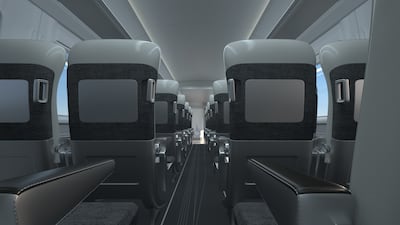
The commercial benefits of moving cargo meant the initial focus was on freight. -

Now the focus has turned to the passenger network. -
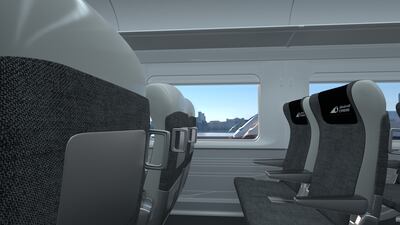
The service will offer a reliable, safe, efficient, comfortable and environmentally friendly way to travel across the region. -

Etihad Rail is working closely with the Federal Transport Authority and transport authorities throughout the country to develop existing networks to improve passenger connections. -
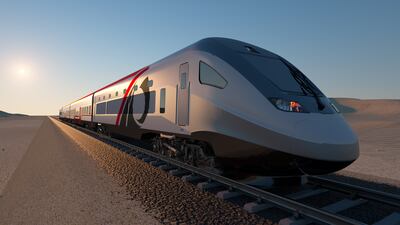
Eventually, population centres across the UAE will be connected to neighbouring GCC countries. -

Passenger carriages will feature sleek, well-equipped cabins. -
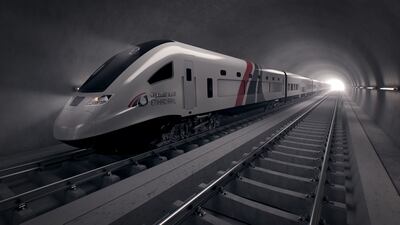
Work on Etihad Rail began in 2009. -
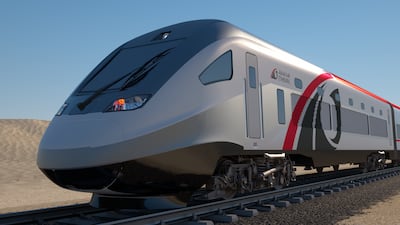
Greenhouse gases will be slashed by more than 2.2 million tonnes a year once the network is fully operational. -
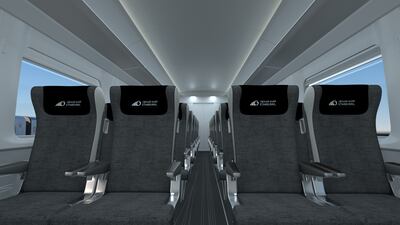
The new passenger rail service is expected to significantly reduce road congestion and the number of traffic accidents.


Rio Tinto is leading the way with its "autohaul programme". Described as the world's largest robot, the mining company's 1,500km network operates completely automatically. There are no drivers. Operators oversee up to fifty 2.4km-long trains operating simultaneously from a control centre in Perth, more than 1,000km away. Autohaul has helped to increase overall speeds by more than 5 per cent and optimised operations planning, reducing costs for Rio Tinto significantly. Other freight and passenger railways in Europe, Russia and the US are now seeking to replicate this success.
While rail is by far the most sustainable mode of transport, the railway sector is also working hard to improve its green credentials: from reducing noise in urban areas to sourcing electricity from renewables. Where electrification is not economical, work is under way to replace diesel trains with those powered by batteries or hydrogen. Germany operated the world's first hydrogen train with passengers in 2018 and projects have since been announced in France, the US, UK, Austria, South Korea, Japan, Italy, Spain and Canada.
While new transport modes such as the hyperloop might steal much of the headlines, they are not yet a reality. Japan and China are building the world’s first "maglev" lines, but on the whole trains equipped with steel wheels and running on steel rails remain the most effective way of moving large quantities of goods and passengers quickly and safely.
Through Etihad Rail, the UAE is playing a relatively small but very noticeable role in this global railway revival.

