



Nora Al Matrooshi, the Arab world’s first female astronaut, has encouraged young people to "never give up", after revealing she was rejected by the nation’s space programme in 2018.
The 28-year-old was speaking on the first day of the Space Week at Expo 2020 Dubai. American and Japanese astronauts were also in attendance.
Ms Al Matrooshi, who has a background in mechanical engineering, became part of the nation’s astronaut corps earlier this year, along with Dubai Police helicopter pilot Mohammed Al Mulla.
“I actually did apply to the first batch, but unfortunately I didn’t make it. The second batch was my second chance. It was my opportunity to achieve the dream that I wanted since I was a child,” she said.
“I’m sure you know how powerful the imagination of a child is and that power inspired me to want to become an astronaut. As I grew up, that dream started to build and I started to think how I can do it.
“I did some research and what I needed to do. At that time in the UAE, there was no astronaut programme, but children tend not to look at boundaries, they believe all is achievable.
"So, on December 6, 2019, it was announced that the UAE was looking for the second batch of astronauts.”
Hazza Al Mansouri became the first Emirati in space in 2019, after flying to the International Space Station on a Russian rocket for an eight-day trip. Sultan Al Neyadi was his backup.
Both of them have completed their year-long training at Nasa’s Johnson Space Centre in Houston this month.
Ms Al Matrooshi and Mr Al Mulla will begin their training in Houston in January, including learning the Russian language, learning how to perform spacewalks and mastering the systems of the space station.
Ms Al Matrooshi also revealed some of the challenges she faced during the selection process.
“First, there were the online interviews. I think I got a bit unlucky on that part because the cameras were not working for the people interviewing me, so it was a bit awkward talking to a blank screen,” she said.
The second part involved general and advanced medical tests, where the candidates underwent colour blindness examinations and scans where Ms Al Matrooshi said she could hear blood pumping through her jugular vein.
“That was really interesting and very weird to hear at the same time,” she said.
The final interviews were her “favourite part” because she met Emirati and Nasa astronauts.
She said she was unaware that Maj Al Mansouri, Dr Al Neyadi, and US astronauts Jessica Meir and Anne McClain would interview her.
-
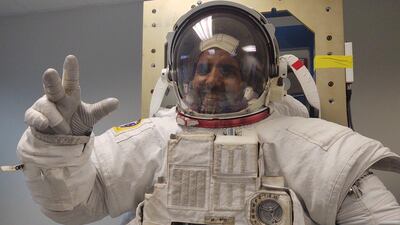
Hazza Al Mansouri, first Emirati man in space, wears a 130 kilogram-heavy extravehicular activities suit for spacewalk training. All photos courtesy of Mohammed bin Rashid Space Centre -
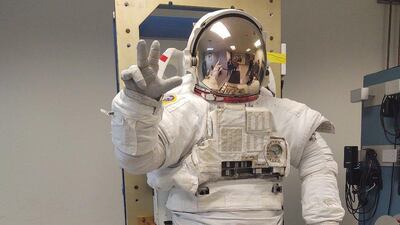
The suit is worn during spacewalks outside of the International Space Station and for training at the world's largest indoor pool at the Johnson Space Centre in Houston, Texas -
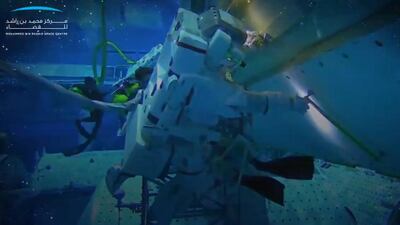
Located at the Neutral Buoyancy Lab (NBL), the indoor pool is 12-metres deep and has 2.4 million litres of water. It helps simulate microgravity and allows astronauts to work on a replica of the International Space Station placed underwater -
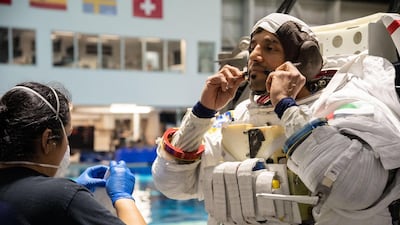
Sultan Al Neyadi, part of the UAE astronaut corps, wears his EVA suit for spacewalk training in the indoor pool -
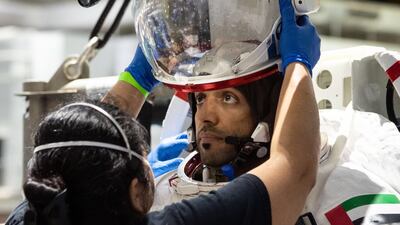
Sultan Al Neyadi puts his helmet on for spacewalk training under water. Mr Al Neyadi was one of two people selected from 4,022 candidates to become the first Emirati astronauts. Mbrsc -
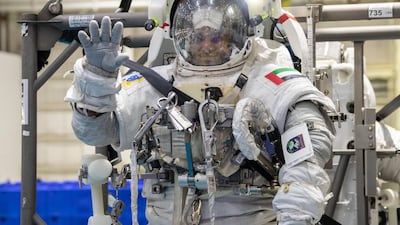
Mr Al Neyadi prepares to go underwater -
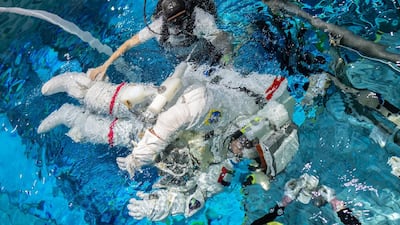
Mr Al Neyadi goes underwater with his EVA suit on for spacewalk training -
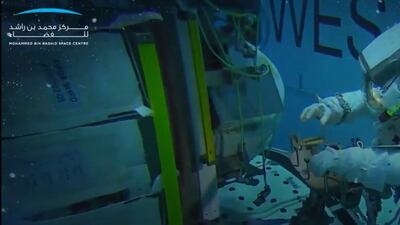
Astronauts can spend up to 10 hours per day at the bottom of the pool to practise maintenance work on the space station model and refine spacewalk techniques. -
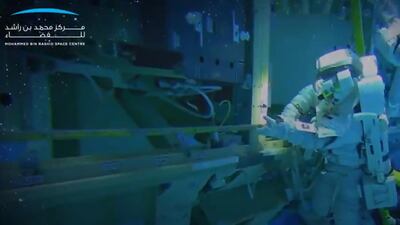
An Emirati astronaut underwater, refining his spacewalk technique. Performing a spacewalk is an extremely dangerous task and requires practise and skill. In 2013, Italian astronaut Luca Parmitano nearly drowned when water leaked into his helmet during a spacewalk. In 2019, Nasa astronaut Chris Cassidy’s wrist mirror broke off, releasing thousands of pieces of space junk -
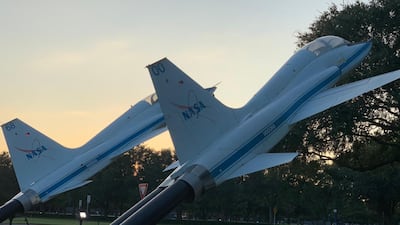
The Emirati astronauts are training for long-haul space missions at the Johnson Space Centre in Houston, Texas. They are also training on T-38 jets, which helps a pilot experience seven G-forces because of the speed. It can fly up to Mach 1.6 and 12,000 metres high – that is 3,000m higher than average airliners.


“I was star struck at that point because I really wanted to become like the astronauts in front of me," Ms Al Matrooshi said.
"I never thought that I'd actually get to meet them that soon.
"I couldn’t stop smiling throughout the interview."
After the interviews and fitness examinations, the two newest members of the UAE’s astronaut corps were finally selected.
“I was ecstatic. This was a dream I had since I was 5 or 6-years-old," Ms Al Matrooshi said.
"The team grew from two to four and all of us come from different backgrounds and all of us had different journeys, but we all managed to reach this point in our careers."
It is unclear when Ms Al Matrooshi will fly to space, but after she and Mr Mulla complete their 30-month training at Nasa, they would qualify for future missions.
If selected, the astronaut would have to complete mission-specific training, which could stretch up to a year.

