
Two airline passengers who escaped from Ireland's mandatory hotel quarantine handed themselves in after a day on the run.
The men fled the Crowne Plaza Hotel near Dublin airport during a cigarette break, which was supervised by security guards.
A third man who fled remained missing on Sunday.
State broadcaster RTE News said the men arrived on a flight from Dubai and checked in on Saturday morning.
It is understood that one is Irish and the second has a UK passport.
The Irish Independent said one of the men made it to Waterford, about 165km south of Dublin.
They were among the first batch of passengers required to stay at quarantine hotels in Ireland.
The new rule, which came into effect on Friday to curb the spread of Covid-19, states that people arriving from a list of 33 “high risk countries”, including Argentina, Brazil, South Africa and the UAE, must spend 14 days in hotel quarantine.
Foreign Minister Simon Coveney said the government did not want to turn hotels into "aggressive" detention centres but said that it was inevitable that frustrations would build over 14 days of quarantine.
"We are trying to create as normal an atmosphere as possible in these hotels, rather than some kind of military detention centre," he told RTE Radio One.
Residents or visitors who try to break the mandatory quarantine period could face a €2,000 (Dh8,500) fine, up to one month in prison, or both.
A 12-night stay in hotel quarantine costs €1,875 (Dh8,000) per adult, €625 for a second person over 12 who shares the room, and €36 for each child aged four to 12.
The Garda, Ireland's national police force, confirmed it was looking into an incident at a “designated quarantine facility in the Dublin area”, but declined to comment further.
The Department of Health said in a statement: "It is a criminal offence if you do not fulfil the legal requirement to present for mandatory hotel quarantine."
Ireland's lockdown – in pictures
-

Access to Salthill beach is closed amid the spread of coronavirus in Galway, Ireland. Reuters -

Emergency ambulances at a Dublin City Hospital. Ireland is currently witnessing a surge of Covid-19 cases after the Christmas season. EPA -
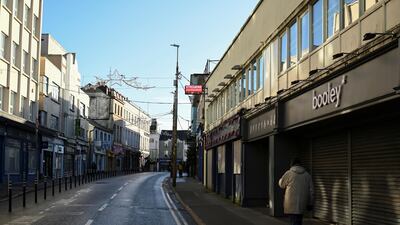
An empty city centre in Galway, Ireland. Reuters -
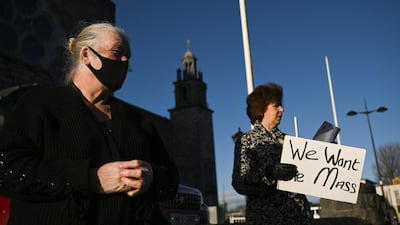
Catholic worshippers protest with prayer by participating in a rosary rally on New Year's Day outside Galway Cathedral asking for the return of public Mass. Reuters -
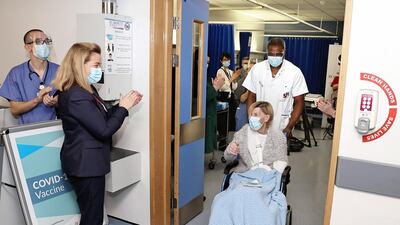
79 year old Annie Lynch from Dublin pictured after being the first person to receive the Pfizer BioNTech Covid-19 vaccine in Ireland, on 29 December 2020. EPA -

Pedestrians shop on December 31 in advance of a new coronavirus lockdown in Dublin. AFP -
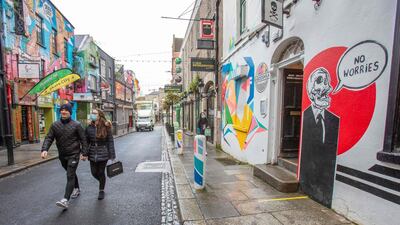
Members of the public walk down a quiet shopping street in Dublin on December 31. AFP -
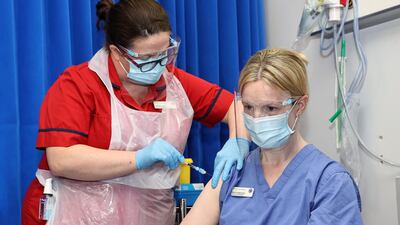
Deborah Cross gives an injection of the Pfizer-BioNTech Covid-19 vaccine to clinical nurse manager Bernie Waterhouse at St James's Hospital in Dublin. AFP



