


Dubai Metro started operating five years ago on September 9. Here are some fast facts for the public transport system.
-
-
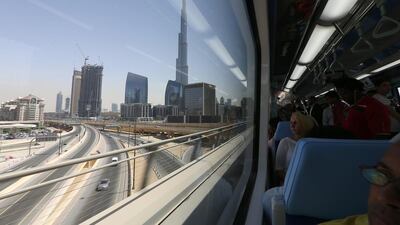
View from the Burj Khalifa Metro station in Dubai. During some peak months, the average number of metro passengers touches 360,000 per day at a rate of about 20,000 riders per hour per direction in both lines, which accounts for about 40 per cent of the designed capacity of metro. Pawan Singh / The National -
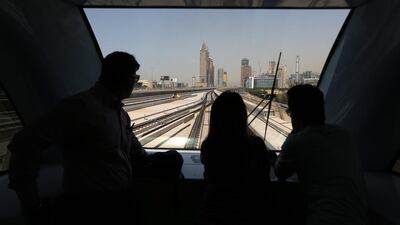
The Red Line stretches 52km and covers 29 stations — 4 underground stations, 24 elevated stations and one at ground level. Pawan Singh / The National -

Station no. 22 on the Green Line, Palm Deira. The Green Line spans 23km linking 18 stations — 6 underground and 12 elevated stations. Antonie Robertson / The National -
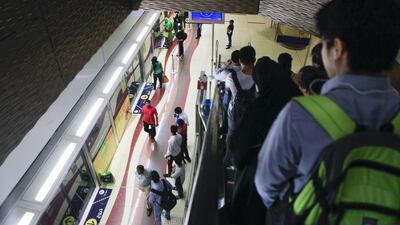
Both lines contain underground sections and the rest is an elevated track, with a limited part of the Red Line (3.3km) on ground level. Sarah Dea / The National -
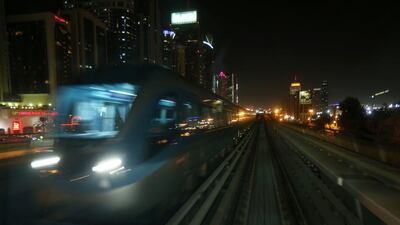
View of the Dubai Metro near Trade Centre in Dubai. The design and construction of the Dubai Metro project contract was awarded to Dubai Rapid Link (DURL) consortium. Pawan Singh / The National -
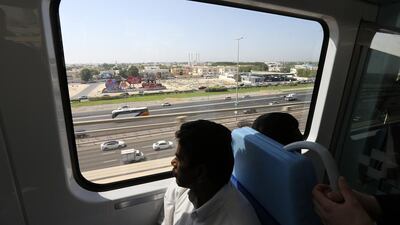
The designed capacity of the Dubai Metro network (both Red and Green lines) is 26,000 riders per hour per direction. Both lines are expected to carry 800,000 riders per day (about 292 million per year) in 2020. Pawan Singh / The National -
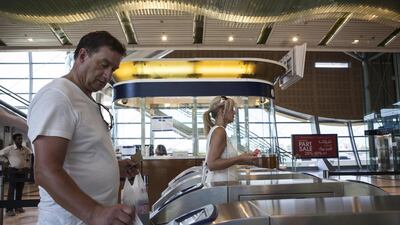
Three multilevel car parks have been built with an estimated capacity of more than 8,000 vehicles. Antonie Robertson / The National -

Each of the Dubai Metro driverless trains consists of five fully air-conditioned carriages and has a capacity to accommodate about 650 passengers. Pawan Singh / The National -
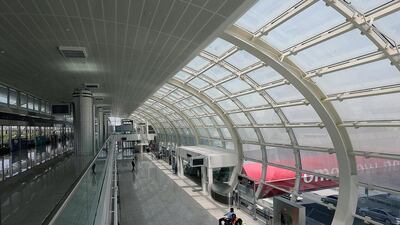
Terminal 3 Metro station in Dubai. 79 metro trains run on a daily basis. Satish Kumar / The National
In pictures: Dubai Metro anniversary facts
Most popular today

