

The first Emirati woman astronaut has a long and promising career ahead of her, the head of UAE’s space training programme said.
Nora Al Matrooshi, 27, was chosen as one of two new cadets.
Both will train for at least three years before possible selection for a mission.
Preparation includes learning to speak Russian, spacewalk and use systems on board the International Space Station.
Ms Al Matrooshi and her colleague, Mohammed Al Mulla, 33, will begin training in the UAE, then move to Houston, Texas, for a 30-month course at Nasa’s Johnson Space Centre this year.
The astronaut who is selected for the next space mission will then undergo dedicated training, which typically runs for six to 12 months.
“We would select the astronaut who matches the mission criteria,” said Salem Al Marri, head of the astronaut programme at Mohammed bin Rashid Space Centre.
“All of the four astronauts have a lot of skills and are accomplished professionals, but it would depend on the type of mission it will be.”
Hazza Al Mansouri, 37, the first Emirati in space, and reserve astronaut Sultan Al Neyadi, 39, have completed six months of training with Nasa.
Next space mission
Mr Al Marri told The National that the centre was in discussions with space agencies regarding the UAE's next mission.
“We are always in negotiations with all entities capable of launching humans into space but nothing has been signed yet,” he said.
“They would have to finish their training first and then go into a mission-specific training, whether that is with Russia or at Nasa.”
Russia’s Soyuz rocket carried Maj Al Mansouri to space in 2019, allowing him to spend eight days on the space station.
Since then, Nasa has also resumed launching humans to space through its commercial partner, SpaceX.
-
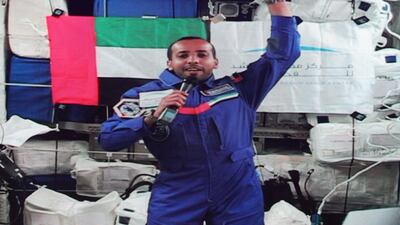
The UAE's first astronaut, Maj Hazza Al Mansouri, takes part in a Q&A session from the International Space Station with an audience at the Mohammed bin Rashid Space Centre, Dubai, in 2019. Chris Whiteoak / The National -
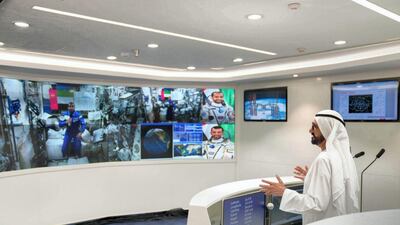
Sheikh Mohammed bin Rashid, Vice President and Ruler of Dubai, talks with Emirati astronaut Maj Hazza Al Mansouri, during a live satellite feed from the International Space Station. Courtesy: Dubai Media Office -
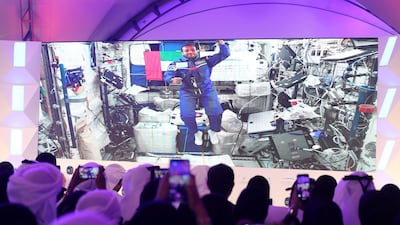
The Emirati astronaut takes questions from the audience gathered at the Mohammed bin Rashid Space Centre. Chris Whiteoak / The National -
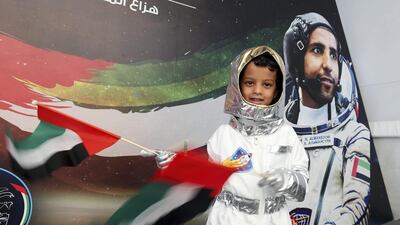
An aspiring young astronaut poses in front of a picture of the first Emirati in space, Maj Hazza Al Mansouri. Chris Whiteoak / The National -
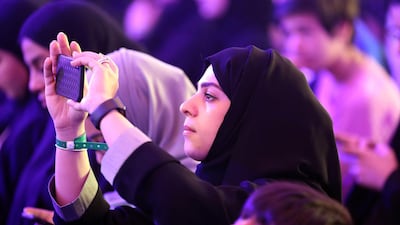
A woman films the Q&A session with Maj Hazza Al Mansouri from the International Space Station. Chris Whiteoak / The National -
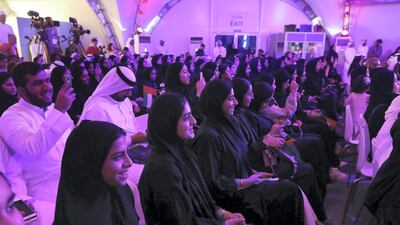
The audience at the Mohammed bin Rashid Space Centre are delighted to hear from Maj Hazza Al Mansouri. Chris Whiteoak / The National -
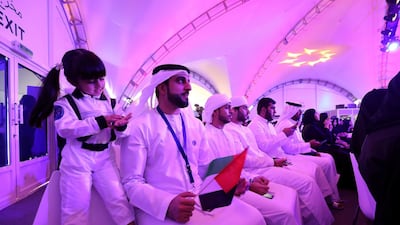
An aspiring young astronaut and her family at the Mohammed bin Rashid Space Centre event. Chris Whiteoak / The National -
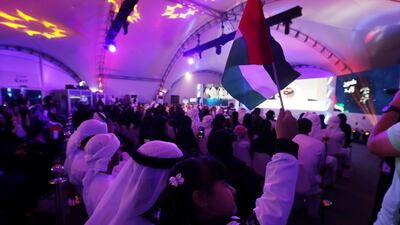
A young audience member celebrates the first Emirati in space. Chris Whiteoak / The National -
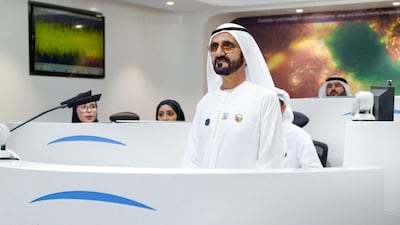
Sheikh Mohammed bin Rashid talks to Maj Hazza Al Mansouri. Courtesy Dubai Media Office -
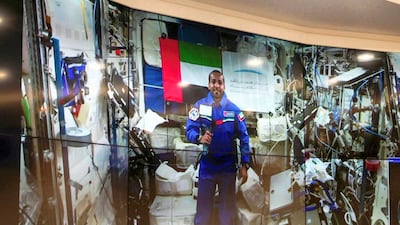
Emirati astronaut Hazza Al Mansouri, during a live satellite feed from the International Space Station. Courtesy Dubai Media Office -
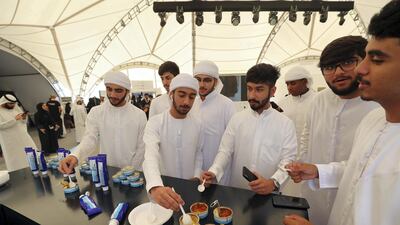
Audience members at the Mohammed bin Rashid Space Centre event sample space food. Chris Whiteoak / The National -
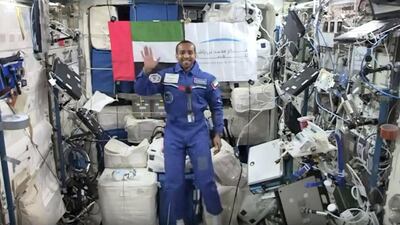
Emirati astronaut Maj Hazza Al Mansouri gives his audience on Earth a tour of the International Space Station. Screengrab via Youtube Live -
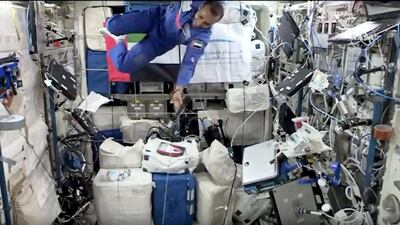
Maj Hazza Al Mansouri demonstrates the effects of weightlessness. Screengrab via Youtube Live -
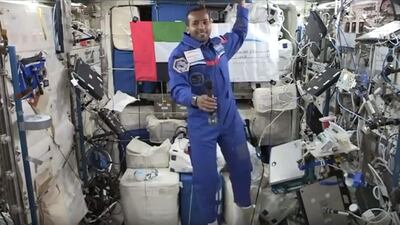
Hazza Al Mansouri takes a live Q&A from space. He spent eight days on the International Space Station, in a mission from September 25 to October 3, 2019. Screengrab via Youtube Live -
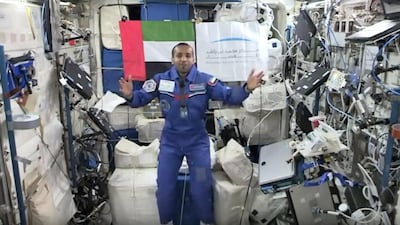
Emirati astronaut, Hazza Al Mansouri, takes live Q&A from space and gives a station tour. Screengrab via Youtube Live


Mr Al Marri said the astronauts’ youth would mean they can be part of several spaceflights, making the astronaut programme more sustainable.
“Having somebody in their late 20s also gives us a big advantage,” he said.
“Rather than recruiting somebody who is 40 or 45 years old today, we’d recruit someone [younger] who fits all of the criteria and meets the capabilities.”
International Space Station or Moon mission?
Mr Al Marri said the astronaut corps now consists of professionals who bring different and important skills.
Ms Al Matrooshi is a mechanical engineer and Mr Al Mulla is a helicopter pilot with more than 1,500 flight hours.
Maj Al Mansouri has one space mission to his name, and Mr Al Neyadi, an IT professional, speaks Russian and has completed intense astronaut training in Russia.
Their diverse skills could make them suitable for more Emirati space missions, whether to ISS or future Moon missions.
-
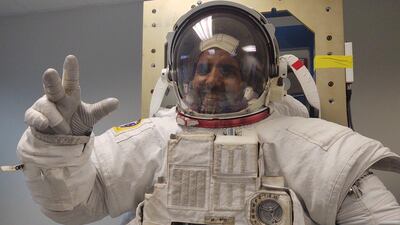
Hazza Al Mansouri, first Emirati man in space, wears a 130 kilogram-heavy extravehicular activities suit for spacewalk training. All photos courtesy of Mohammed bin Rashid Space Centre -
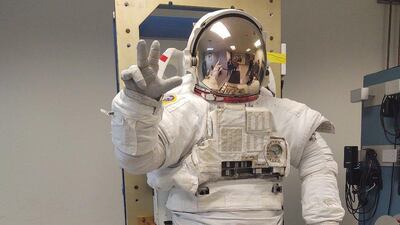
The suit is worn during spacewalks outside of the International Space Station and for training at the world's largest indoor pool at the Johnson Space Centre in Houston, Texas -
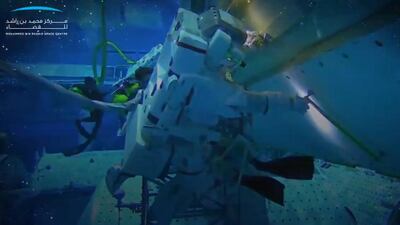
Located at the Neutral Buoyancy Lab (NBL), the indoor pool is 12-metres deep and has 2.4 million litres of water. It helps simulate microgravity and allows astronauts to work on a replica of the International Space Station placed underwater -
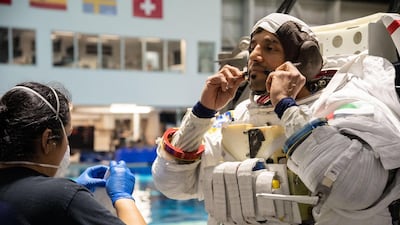
Sultan Al Neyadi, part of the UAE astronaut corps, wears his EVA suit for spacewalk training in the indoor pool -
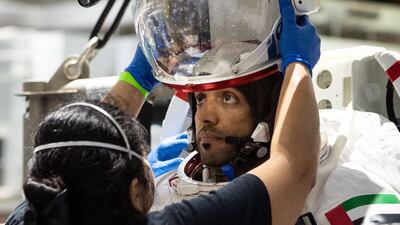
Sultan Al Neyadi puts his helmet on for spacewalk training under water. Mr Al Neyadi was one of two people selected from 4,022 candidates to become the first Emirati astronauts. Mbrsc -
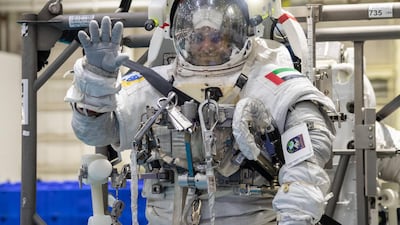
Mr Al Neyadi prepares to go underwater -
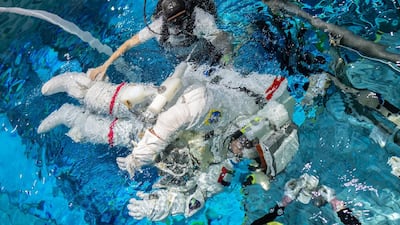
Mr Al Neyadi goes underwater with his EVA suit on for spacewalk training -
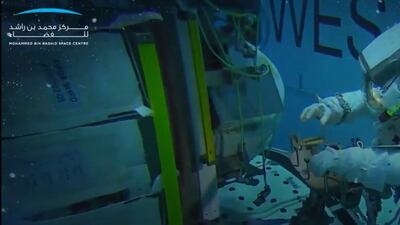
Astronauts can spend up to 10 hours per day at the bottom of the pool to practise maintenance work on the space station model and refine spacewalk techniques. -
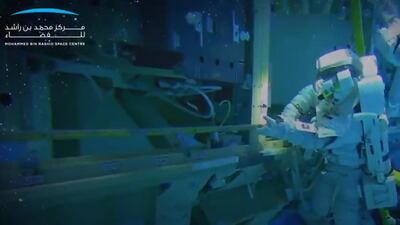
An Emirati astronaut underwater, refining his spacewalk technique. Performing a spacewalk is an extremely dangerous task and requires practise and skill. In 2013, Italian astronaut Luca Parmitano nearly drowned when water leaked into his helmet during a spacewalk. In 2019, Nasa astronaut Chris Cassidy’s wrist mirror broke off, releasing thousands of pieces of space junk -
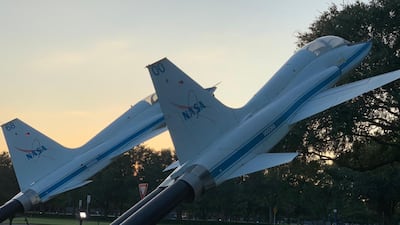
The Emirati astronauts are training for long-haul space missions at the Johnson Space Centre in Houston, Texas. They are also training on T-38 jets, which helps a pilot experience seven G-forces because of the speed. It can fly up to Mach 1.6 and 12,000 metres high – that is 3,000m higher than average airliners.


“Mohammed is a helicopter pilot and that is a different set of experience,” Mr Al Marri said.
"He comes from a police background and that’s different to what Hazza and Sultan had as a military background.
“That’s a really great addition that we have and he’s also in his early 30s, which gives us an edge of having different age groups.
“I would say he’s almost a generation younger than the first two astronauts.”
Mr Al Marri said Ms Al Matrooshi’s engineering background would also prove beneficial for the nation’s space programme.
She has worked for Abu Dhabi’s National Petroleum Construction Company, which builds oil and gas platforms for companies including Adnoc and Saudi Aramco.
Ms Al Matrooshi is a member of the American Society of Mechanical Engineers.
“Her skill set is very useful for different types of operations that astronauts conduct on the International Space Station, or even in the spacecraft itself,” Mr Al Marri said.
Johnson Space Centre congratulated the two new candidates.
“We look forward to training with you here in Houston,” the centre wrote on Twitter on Saturday.
The UAE has expanded its partnership with Nasa in the past few years. It signed the Artemis Accords for responsible lunar exploration and an agreement on training four Emirati astronauts on Nasa premises.
The Emirates is also continuing its collaboration with Russia.
It will sign an agreement to invest in modernising the Gagarin’s Start launch pad in Baikonur, Kazakhstan, to enable it to launch commercial space flights.

