

University professors who taught Nora Al Matrooshi said they are overjoyed after learning their former star student has become the Arab world's first female astronaut.
Ms Al Matrooshi, 27, has a bachelor’s degree in mechanical engineering from the UAE University in Al Ain.
She completed her higher education five years ago and had been working for a petroleum construction company, before Mohammed bin Rashid Space Centre in Dubai recruited her as an astronaut, along with Mohammed Al Mulla, a helicopter pilot at Dubai Police.
One of Ms Al Matrooshi's university professors told The National that "she was always a star".
“Nora always stood out from others,” said Dr Emad Elnajjar, associate professor of mechanical engineering and the aerospace minor coordinator at the university.

Dr Elnajjar, who has been teaching at the university for 14 years, taught Ms Al Matrooshi the ‘Introduction to Aerospace’ and ‘Heat Transfer’ classes.
He said she was a bright student, who was always enthusiastic about university projects. Ms Al Matrooshi completed both of his classes with an ‘A’.
“She was part of the aerospace club at the university and she was so passionate about it,” said Dr Elnajjar.
“I’m extremely happy for her. It’s always great to see our students doing well after they complete their studies. Now we can say one of our alumni is an astronaut and that’s really incredible.”
More than 550 astronauts have flown to space, but only 65 of them were women.
Ms Al Matrooshi's addition to the astronaut corps helps towards the efforts being made by space agencies to ensure gender equality in the sector. The field is known to be male-dominated since the early days of space exploration in the 1960s.
It is also a landmark move by the UAE to recruit an Arab female, paving the way for other Arab countries who are now either reviving their space programmes or establishing a new one.
Dr Khalifa Hamad Harib, who has been teaching at the university for 20 years, was the senior project advisor to Ms Al Matrooshi.
He said she and her teammates scored an ‘A’ on their senior project.
“I’m very happy about her success,” said Dr Khalifa.
“She is very intelligent and has great things coming her way. We are all very proud of her.”
The UAE University is one of the higher educational facilities in the country that is placing a greater focus on space studies.
A huge new satellite testing and integration facility has been launched on campus, where students will develop satellites.
The first pan-Arab satellite, called 813, is being built there by students from across the Middle East and North Africa region.
The university is also among one of the first in the country to introduce a master’s programme in space science.
Emirati astronauts learn how to spacewalk - in pictures
-
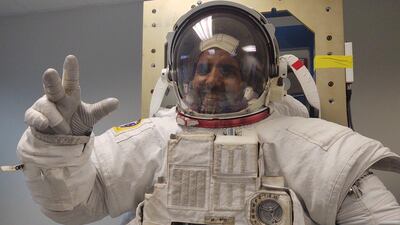
Hazza Al Mansouri, first Emirati man in space, wears a 130 kilogram-heavy extravehicular activities suit for spacewalk training. All photos courtesy of Mohammed bin Rashid Space Centre -
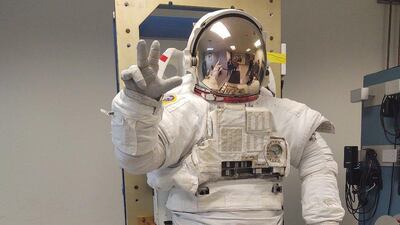
The suit is worn during spacewalks outside of the International Space Station and for training at the world's largest indoor pool at the Johnson Space Centre in Houston, Texas -
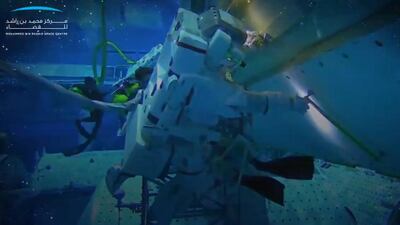
Located at the Neutral Buoyancy Lab (NBL), the indoor pool is 12-metres deep and has 2.4 million litres of water. It helps simulate microgravity and allows astronauts to work on a replica of the International Space Station placed underwater -
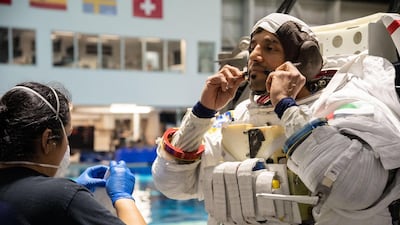
Sultan Al Neyadi, part of the UAE astronaut corps, wears his EVA suit for spacewalk training in the indoor pool -
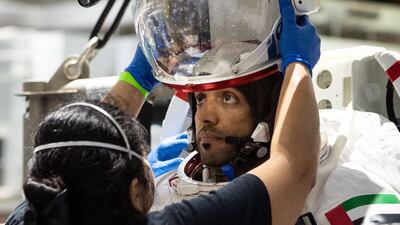
Sultan Al Neyadi puts his helmet on for spacewalk training under water. Mr Al Neyadi was one of two people selected from 4,022 candidates to become the first Emirati astronauts. Mbrsc -
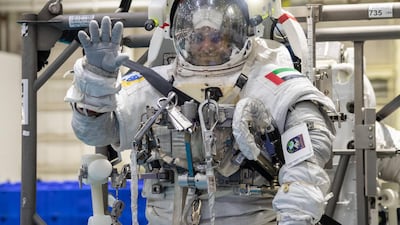
Mr Al Neyadi prepares to go underwater -
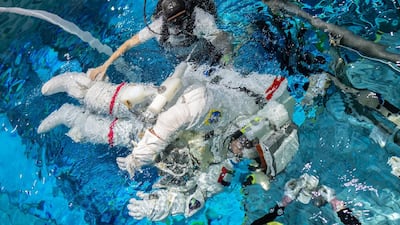
Mr Al Neyadi goes underwater with his EVA suit on for spacewalk training -
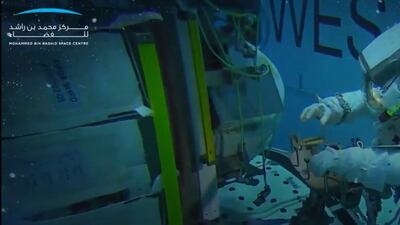
Astronauts can spend up to 10 hours per day at the bottom of the pool to practise maintenance work on the space station model and refine spacewalk techniques. -
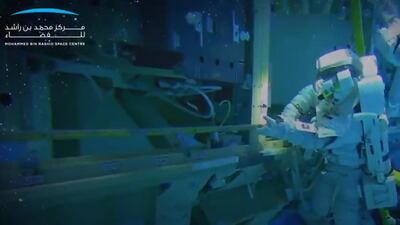
An Emirati astronaut underwater, refining his spacewalk technique. Performing a spacewalk is an extremely dangerous task and requires practise and skill. In 2013, Italian astronaut Luca Parmitano nearly drowned when water leaked into his helmet during a spacewalk. In 2019, Nasa astronaut Chris Cassidy’s wrist mirror broke off, releasing thousands of pieces of space junk -
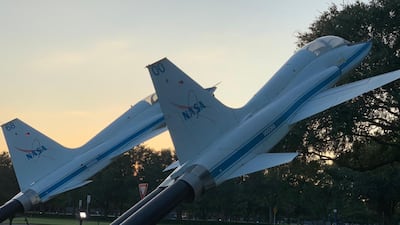
The Emirati astronauts are training for long-haul space missions at the Johnson Space Centre in Houston, Texas. They are also training on T-38 jets, which helps a pilot experience seven G-forces because of the speed. It can fly up to Mach 1.6 and 12,000 metres high – that is 3,000m higher than average airliners.



