• The James Webb telescope captured stunning images of Jupiter. Photo: NASA
    The James Webb telescope captured stunning images of Jupiter. Photo: NASA
  • Jupiter is the largest planet in the solar system. Photo: NASA
    Jupiter is the largest planet in the solar system. Photo: NASA
  • Experts were impressed by the quality of the images gathered by the state-of-the-art telescope. Photo: NASA
    Experts were impressed by the quality of the images gathered by the state-of-the-art telescope. Photo: NASA
  • The view shows Jupiter including its Great red Spot captured by Nasa's Juno spacecraft on April 1, 2018. Photo: Nasa
    The view shows Jupiter including its Great red Spot captured by Nasa's Juno spacecraft on April 1, 2018. Photo: Nasa
  • The temporary "crater" and debris left behind by the impact of a fragment of the Shoemaker-Levy 9 comet in 1994. Some of the impacts created fireballs the size of Earth. Photo: Nasa
    The temporary "crater" and debris left behind by the impact of a fragment of the Shoemaker-Levy 9 comet in 1994. Some of the impacts created fireballs the size of Earth. Photo: Nasa

James Webb space telescope captures remarkable views of Jupiter


Sarwat Nasir
  • English
  • Arabic

Nasa has released two stunning images of Jupiter captured by the James Webb Space Telescope.

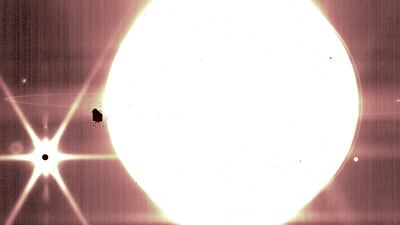
One of the photos shows the planet’s faint rings, two tiny moons called Amalthea and Adrastea, and striking views of its aurorae, with galaxies in the background.

The other displays its Great Red Spot, a storm so big it could swallow Earth.

The latest observations will give scientists a greater understanding of the largest planet in the solar system.

“We hadn’t really expected it to be this good,” said planetary astronomer Imke de Pater, who is also a professor emerita of the University of California, Berkeley.

“It’s really remarkable that we can see details on Jupiter together with its rings, tiny satellites, and even galaxies in one image."

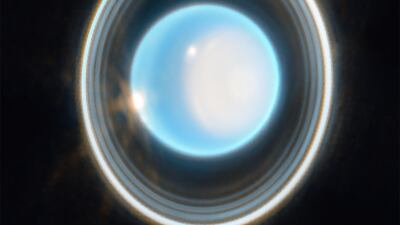
  • Uranus is surrounded by 13 rings and 27 small moons as it rotates at a nearly 90-degree angle from the plane of its orbit. Photo: Nasa
    Uranus is surrounded by 13 rings and 27 small moons as it rotates at a nearly 90-degree angle from the plane of its orbit. Photo: Nasa
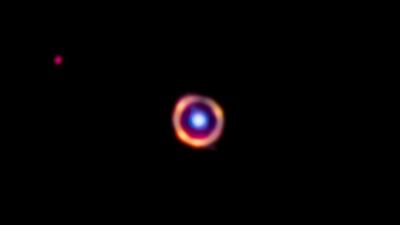
  • Complex organic molecules similar to smoke or smog in a galaxy more than 12 billion light-years from Earth. Photo: Nasa
    Complex organic molecules similar to smoke or smog in a galaxy more than 12 billion light-years from Earth. Photo: Nasa
  • A delicate image of dust structures and bright star clusters taken by the James Webb Space Telescope. Photo: Nasa
    A delicate image of dust structures and bright star clusters taken by the James Webb Space Telescope. Photo: Nasa
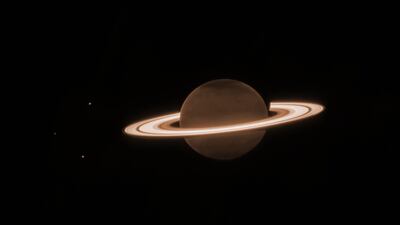
  • Saturn has seven rings with several gaps and divisions between them, as well as 53 known moons. Photo: Nasa
    Saturn has seven rings with several gaps and divisions between them, as well as 53 known moons. Photo: Nasa
  • Star cluster NGC 346, spiral galaxies NGC 1672 and Messier 74, and the Pillars of Creation, towering tendrils of cosmic dust and gas at the heart of the Eagle Nebula. Photo: Nasa
    Star cluster NGC 346, spiral galaxies NGC 1672 and Messier 74, and the Pillars of Creation, towering tendrils of cosmic dust and gas at the heart of the Eagle Nebula. Photo: Nasa
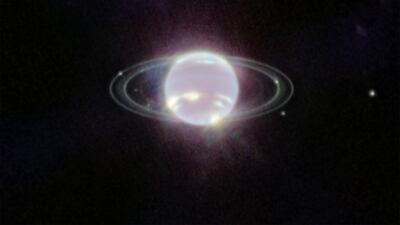
  • An infrared image of Neptune, the only planet in our solar system not visible to the naked eye. Photo: Nasa
    An infrared image of Neptune, the only planet in our solar system not visible to the naked eye. Photo: Nasa
  • Every eight years, the two stars in this image are brought together by their orbits – creating colliding streams of gas that, under the right conditions, form a new ring of dust. Photo: Nasa
    Every eight years, the two stars in this image are brought together by their orbits – creating colliding streams of gas that, under the right conditions, form a new ring of dust. Photo: Nasa
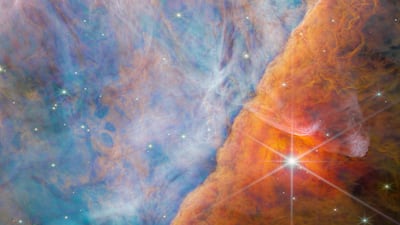
  • A part of the Orion Nebula known as the Orion Bar. Photo: Nasa
    A part of the Orion Nebula known as the Orion Bar. Photo: Nasa
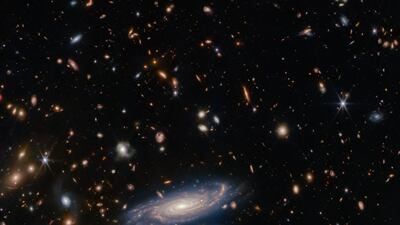
  • A crowded field of galaxies, along with stars crowned with the James Webb Space Telescope's signature six-pointed diffraction spikes. Photo: Nasa
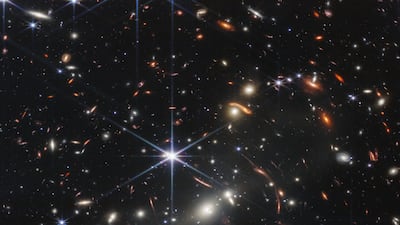
    A crowded field of galaxies, along with stars crowned with the James Webb Space Telescope's signature six-pointed diffraction spikes. Photo: Nasa
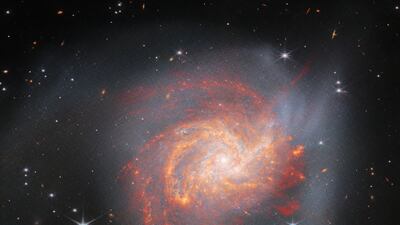
  • The NGC 3256 spiral galaxy was formed after a collision of two massive galaxies about 500 million years ago. Photo: Nasa
    The NGC 3256 spiral galaxy was formed after a collision of two massive galaxies about 500 million years ago. Photo: Nasa
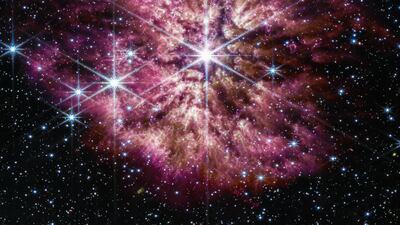
  • The Wolf-Rayet 124 star, featured in an image combining near-infrared and mid-infrared wavelengths of light. Photo: Nasa
    The Wolf-Rayet 124 star, featured in an image combining near-infrared and mid-infrared wavelengths of light. Photo: Nasa
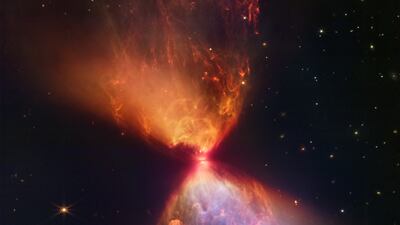
  • An hourglass-shaped cloud of dust and gas is illuminated by light from a protostar. Photo: Nasa
    An hourglass-shaped cloud of dust and gas is illuminated by light from a protostar. Photo: Nasa
  • Two views of the Southern Ring Nebula, which show the planetary nebula as a misshapen oval. Photo: Nasa
    Two views of the Southern Ring Nebula, which show the planetary nebula as a misshapen oval. Photo: Nasa
  • A composite image of the Cartwheel Galaxy captured by the James Webb Space Telescope in August 2022. AFP
    A composite image of the Cartwheel Galaxy captured by the James Webb Space Telescope in August 2022. AFP
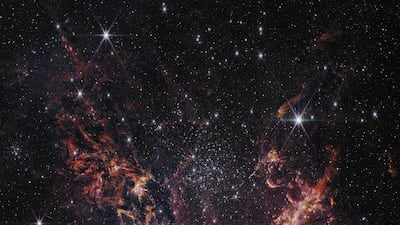
  • A cluster of stars in the Small Magellanic Cloud, near the Milky Way. Photo: JWST
    A cluster of stars in the Small Magellanic Cloud, near the Milky Way. Photo: JWST
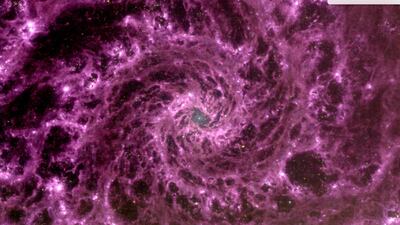
  • A colour composite image of the Messier 74 galaxy. Photo: JWST
    A colour composite image of the Messier 74 galaxy. Photo: JWST
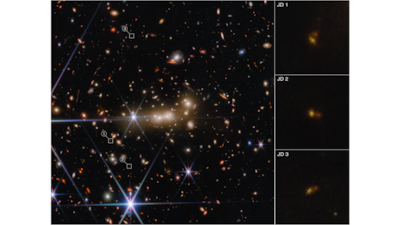
  • The gravity of galaxy cluster MACS0647 bends and magnifies light from the more distant MACS0647-JD. Photo: Nasa
    The gravity of galaxy cluster MACS0647 bends and magnifies light from the more distant MACS0647-JD. Photo: Nasa
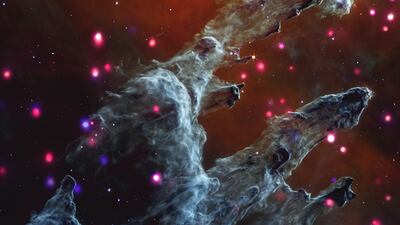
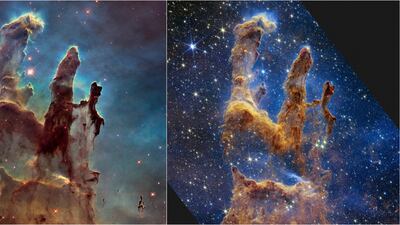
  • The 'Pillars of Creation' — clouds of hydrogen gas and dust 6,500 light years from Earth — captured by the Hubble Space Telescope, left, and James Webb Space Telescope. AP
    The 'Pillars of Creation' — clouds of hydrogen gas and dust 6,500 light years from Earth — captured by the Hubble Space Telescope, left, and James Webb Space Telescope. AP
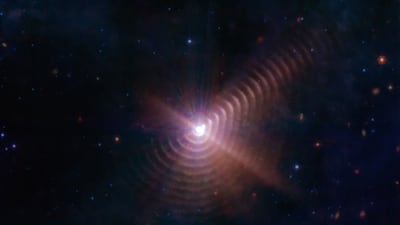
  • Dust rings resembling a fingerprint created by a rare type of star and its companion. PA
    Dust rings resembling a fingerprint created by a rare type of star and its companion. PA
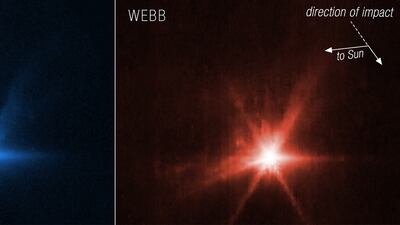
  • Images of the asteroid Dimorphos hours after Nasa crashed a spacecraft into it in September 2022. EPA
    Images of the asteroid Dimorphos hours after Nasa crashed a spacecraft into it in September 2022. EPA
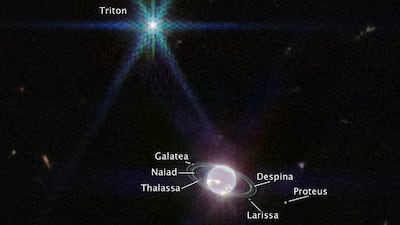
  • Neptune and seven of its 14 known moons. AFP
    Neptune and seven of its 14 known moons. AFP
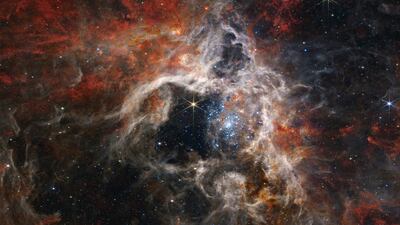
  • Thousands of young stars in a stellar nursery called the Tarantula Nebula. Photo: Nasa
    Thousands of young stars in a stellar nursery called the Tarantula Nebula. Photo: Nasa
  • A image of an exoplanet — a gas giant with no rocky surface. Photo: Nasa, ESA and CSA
    A image of an exoplanet — a gas giant with no rocky surface. Photo: Nasa, ESA and CSA
  • Glass-z13, the oldest galaxy to be detected, was formed about 300 million years after the Big Bang. Photo: JWST
    Glass-z13, the oldest galaxy to be detected, was formed about 300 million years after the Big Bang. Photo: JWST
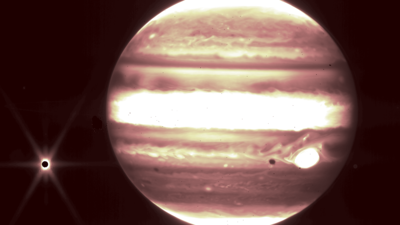
  • Jupiter and its moon Europa. Photo: Nasa
    Jupiter and its moon Europa. Photo: Nasa
  • Jupiter and its moons Europa, Thebe and Metis. Photo: Nasa
    Jupiter and its moons Europa, Thebe and Metis. Photo: Nasa
  • Another image of Jupiter and some of its 79 moons. Photo: Nasa
    Another image of Jupiter and some of its 79 moons. Photo: Nasa
  • An image of galaxy cluster Smacs 0723 taken by the James Webb telescope. Photo: Nasa
    An image of galaxy cluster Smacs 0723 taken by the James Webb telescope. Photo: Nasa
  • Stephan’s Quintet is an area in space that has five galaxies. Photo: JWST
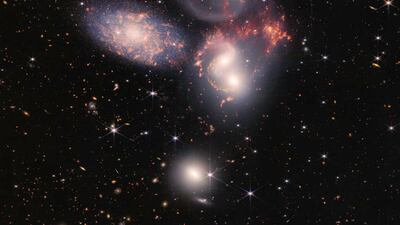
    Stephan’s Quintet is an area in space that has five galaxies. Photo: JWST
  • The 'Cosmic Cliffs' of the Carina Nebula. Photo: JWST
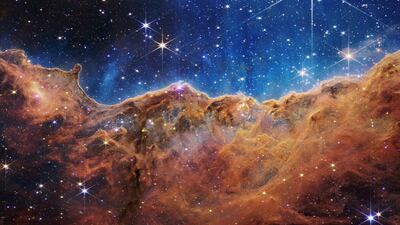
    The 'Cosmic Cliffs' of the Carina Nebula. Photo: JWST
  • An anniversary image shows the birth of a star in the Rho Ophiuchi cloud complex, the closest star-forming region to Earth. Photo: Nasa
    An anniversary image shows the birth of a star in the Rho Ophiuchi cloud complex, the closest star-forming region to Earth. Photo: Nasa

Dr de Pater led the observations of Jupiter with Thierry Fouchet, a professor at the Paris Observatory, as part of an international collaboration for Webb’s Early Release Science programme.

Scientists are interested in studying Jupiter because it could help them to learn more about the solar system.

The planet, which is believed to have 79 moons, has a unique composition and inner structure that researchers want to study more.

Its atmosphere is made up of mostly hydrogen gas and helium gas, just like the Sun.

The gas giant is covered in thick red, brown, yellow and white clouds, which make it look like the planet has stripes.

James Webb, the world’s most powerful space telescope, launched on Christmas Day and has since been sending back unique views of the universe.

These latest images of Jupiter were taken by the telescope’s near-infrared camera, which has three specialised filters that make details of the planet visible.

Infrared instruments help capture radiant energy that is invisible to the human eye but can be detected as heat.

The wide-field view of Jupiter, which shows its moons and aurora, also captures its rings that are a million times fainter than the planet.

“This one image sums up the science of our Jupiter system programme, which studies the dynamics and chemistry of Jupiter itself, its rings and its satellite system,” Dr Fouchet said.

The first image from the telescope was revealed by US President Joe Biden on July 11. It showed the galaxy cluster SMACS 0723 as it was 4.6 billion years ago.

On July 20, it detected the oldest known galaxy in the universe, called Glass-z13, which was formed about 300 million years after the Big Bang 13.8 billion years ago.

This breaks the record set by its predecessor, the Hubble Space Telescope, which spotted GN-z11, a galaxy that was formed 400 million years after the birth of the universe.


Dust and sand storms compared

Sand storm

  • Particle size: Larger, heavier sand grains
  • Visibility: Often dramatic with thick "walls" of sand
  • Duration: Short-lived, typically localised
  • Travel distance: Limited 
  • Source: Open desert areas with strong winds

Dust storm

  • Particle size: Much finer, lightweight particles
  • Visibility: Hazy skies but less intense
  • Duration: Can linger for days
  • Travel distance: Long-range, up to thousands of kilometres
  • Source: Can be carried from distant regions
UPI facts

More than 2.2 million Indian tourists arrived in UAE in 2023
More than 3.5 million Indians reside in UAE
Indian tourists can make purchases in UAE using rupee accounts in India through QR-code-based UPI real-time payment systems
Indian residents in UAE can use their non-resident NRO and NRE accounts held in Indian banks linked to a UAE mobile number for UPI transactions

Living in...

This article is part of a guide on where to live in the UAE. Our reporters will profile some of the country’s most desirable districts, provide an estimate of rental prices and introduce you to some of the residents who call each area home. 

EPL's youngest
  • Ethan Nwaneri (Arsenal)
    15 years, 181 days old
  • Max Dowman (Arsenal)
    15 years, 235 days old
  • Jeremy Monga (Leicester)
    15 years, 271 days old
  • Harvey Elliott (Fulham)
    16 years, 30 days old
  • Matthew Briggs (Fulham)
    16 years, 68 days old
Updated: August 23, 2022, 7:43 AM