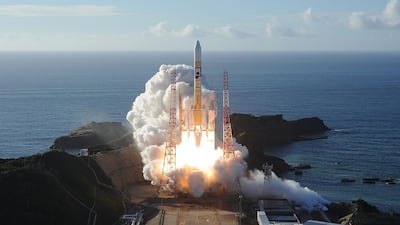
A professor at New York University Abu Dhabi has created an atlas of Mars using data from the UAE’s Hope probe.
The spacecraft has been orbiting the Red Planet for almost a year, making observations of the upper and lower atmosphere, and studying its dynamic weather system.
Dr Dimitra Atri, a research scientist at NYUAD, told The National that the initial version of the atlas would show details of the regions and features of the planet in high resolution.
A later, more detailed, version would show how Mars changes with time, including daily and seasonal variations, once more data from Hope is released.
It would be possible for us to show how Mars changes with time, which was not possible earlier
Dr Dimitra Atri,
NYU Abu Dhabi
Other researchers have created maps but none have been able to illustrate the weather changes the planet experiences at different times of the day and during different seasons.
“Since the Emirates Mars Mission provides a synoptic view of the planet, it would be possible for us to show how Mars changes with time, which was not possible earlier," said Dr Atri, who leads the Mars Research Group at NYUAD’s Centre for Space Science.
"We plan to show this for the entire planet.”
The Hope probe is circling the planet in an elliptical orbit that allows it to observe from much further away than any other spacecraft.
Its strategic position will help researchers create a global image of the planet.
Last month, the Emirati team behind the mission released data that showed water ice clouds engulfing Mars at different times of the day.
The previous spacecraft were much closer to the surface and could record weather at specific times of the day only.
“The idea is to produce an atlas which will be of use both for the global scientific community and the public at large,” Dr Atri said.
“Having followed this mission for a very long time, it gives me great satisfaction to not only study the planet to solve research problems but to share it with the wider community.”
The atlas highlights key regions, including the Tharsis area that is home to the largest volcanoes in the solar system.
Once the atlas is published on NYUAD’s website later this month, it will be updated regularly with the new data sets that will be released by the Hope team every three months.
A second edition of the atlas will show the auroras, variations of cloud cover, dust, ozone and polar ice caps on the planet.
Dr Atri said they have produced a high-resolution composite colour map of Mars by combining more than 50 images taken by the Emirates Exploration Imager – a high-resolution camera on board the Hope probe.
The atlas also has a co-ordinate system like most Earth maps.
“We have a set of images showing the entire disk of the planet and we highlight all the regions of Mars. We then focus on individual features and describe them in detail,” he said.
Dr Atri’s students have helped with the project. They include Ahmed Al Hantoobi, Katerina Fialova, Shamsheer Singh and postdoctoral fellow Dattaraj Dhuri.
Mr Al Hantoobi, a 22-year-old Emirati, said the intention was to create an atlas with the highest definition.
“Usually, researchers use Mola (Mars Orbiter Laser Altimeter) topography for georeferencing, but we wanted to help create a visual data set that can be generated in various resolutions to match that of any current or previous data set.
“Yes, there have been atlases before, but this one would be of exceptional resolution and detail.”
Apart from the science community, Mr Al Hantoobi believes the project will also benefit young people, helping inspire them into pursuing science and engineering careers.
He said open access to the atlas will help school pupils and university students learn more about Mars.
“When I was growing up about 10 to 15 years ago, I wasn’t exposed to such a career option because there wasn’t such a thriving space sector,” he said.
“Now, the youth have that option to pursue a career path in science and engineering. The atlas could help stimulate young minds and inspire them to become experts in the field.”
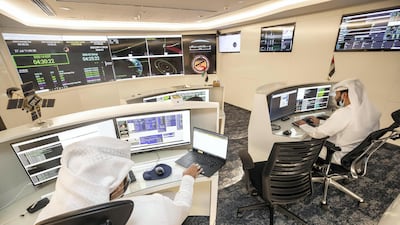
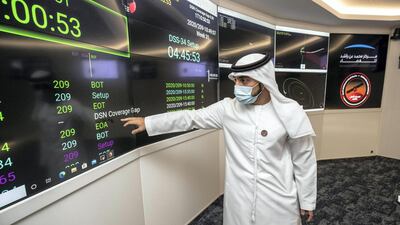
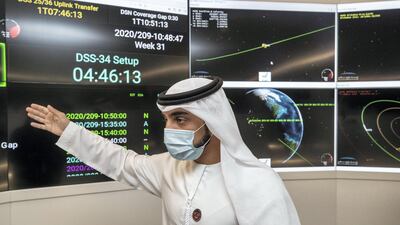
Inside Dubai's ground control where the Hope probe is tracked - in pictures
What vitamins do we know are beneficial for living in the UAE
Vitamin D: Highly relevant in the UAE due to limited sun exposure; supports bone health, immunity and mood.
Vitamin B12: Important for nerve health and energy production, especially for vegetarians, vegans and individuals with absorption issues.
Iron: Useful only when deficiency or anaemia is confirmed; helps reduce fatigue and support immunity.
Omega-3 (EPA/DHA): Supports heart health and reduces inflammation, especially for those who consume little fish.
Navdeep Suri, India's Ambassador to the UAE
There has been a longstanding need from the Indian community to have a religious premises where they can practise their beliefs. Currently there is a very, very small temple in Bur Dubai and the community has outgrown this. So this will be a major temple and open to all denominations and a place should reflect India’s diversity.
It fits so well into the UAE’s own commitment to tolerance and pluralism and coming in the year of tolerance gives it that extra dimension.
What we will see on April 20 is the foundation ceremony and we expect a pretty broad cross section of the Indian community to be present, both from the UAE and abroad. The Hindu group that is building the temple will have their holiest leader attending – and we expect very senior representation from the leadership of the UAE.
When the designs were taken to the leadership, there were two clear options. There was a New Jersey model with a rectangular structure with the temple recessed inside so it was not too visible from the outside and another was the Neasden temple in London with the spires in its classical shape. And they said: look we said we wanted a temple so it should look like a temple. So this should be a classical style temple in all its glory.
It is beautifully located - 30 minutes outside of Abu Dhabi and barely 45 minutes to Dubai so it serves the needs of both communities.
This is going to be the big temple where I expect people to come from across the country at major festivals and occasions.
It is hugely important – it will take a couple of years to complete given the scale. It is going to be remarkable and will contribute something not just to the landscape in terms of visual architecture but also to the ethos. Here will be a real representation of UAE’s pluralism.
Director: Laxman Utekar
Cast: Vicky Kaushal, Akshaye Khanna, Diana Penty, Vineet Kumar Singh, Rashmika Mandanna
Rating: 1/5
Mercer, the investment consulting arm of US services company Marsh & McLennan, expects its wealth division to at least double its assets under management (AUM) in the Middle East as wealth in the region continues to grow despite economic headwinds, a company official said.
Mercer Wealth, which globally has $160 billion in AUM, plans to boost its AUM in the region to $2-$3bn in the next 2-3 years from the present $1bn, said Yasir AbuShaban, a Dubai-based principal with Mercer Wealth.
“Within the next two to three years, we are looking at reaching $2 to $3 billion as a conservative estimate and we do see an opportunity to do so,” said Mr AbuShaban.
Mercer does not directly make investments, but allocates clients’ money they have discretion to, to professional asset managers. They also provide advice to clients.
“We have buying power. We can negotiate on their (client’s) behalf with asset managers to provide them lower fees than they otherwise would have to get on their own,” he added.
Mercer Wealth’s clients include sovereign wealth funds, family offices, and insurance companies among others.
From its office in Dubai, Mercer also looks after Africa, India and Turkey, where they also see opportunity for growth.
Wealth creation in Middle East and Africa (MEA) grew 8.5 per cent to $8.1 trillion last year from $7.5tn in 2015, higher than last year’s global average of 6 per cent and the second-highest growth in a region after Asia-Pacific which grew 9.9 per cent, according to consultancy Boston Consulting Group (BCG). In the region, where wealth grew just 1.9 per cent in 2015 compared with 2014, a pickup in oil prices has helped in wealth generation.
BCG is forecasting MEA wealth will rise to $12tn by 2021, growing at an annual average of 8 per cent.
Drivers of wealth generation in the region will be split evenly between new wealth creation and growth of performance of existing assets, according to BCG.
Another general trend in the region is clients’ looking for a comprehensive approach to investing, according to Mr AbuShaban.
“Institutional investors or some of the families are seeing a slowdown in the available capital they have to invest and in that sense they are looking at optimizing the way they manage their portfolios and making sure they are not investing haphazardly and different parts of their investment are working together,” said Mr AbuShaban.
Some clients also have a higher appetite for risk, given the low interest-rate environment that does not provide enough yield for some institutional investors. These clients are keen to invest in illiquid assets, such as private equity and infrastructure.
“What we have seen is a desire for higher returns in what has been a low-return environment specifically in various fixed income or bonds,” he said.
“In this environment, we have seen a de facto increase in the risk that clients are taking in things like illiquid investments, private equity investments, infrastructure and private debt, those kind of investments were higher illiquidity results in incrementally higher returns.”
The Abu Dhabi Investment Authority, one of the largest sovereign wealth funds, said in its 2016 report that has gradually increased its exposure in direct private equity and private credit transactions, mainly in Asian markets and especially in China and India. The authority’s private equity department focused on structured equities owing to “their defensive characteristics.”
KILLING OF QASSEM SULEIMANI
The specs
Engine: 6.2-litre V8
Transmission: ten-speed
Power: 420bhp
Torque: 624Nm
Price: Dh325,125
On sale: Now
In numbers: PKK’s money network in Europe
Germany: PKK collectors typically bring in $18 million in cash a year – amount has trebled since 2010
Revolutionary tax: Investigators say about $2 million a year raised from ‘tax collection’ around Marseille
Extortion: Gunman convicted in 2023 of demanding $10,000 from Kurdish businessman in Stockholm
Drug trade: PKK income claimed by Turkish anti-drugs force in 2024 to be as high as $500 million a year
Denmark: PKK one of two terrorist groups along with Iranian separatists ASMLA to raise “two-digit million amounts”
Contributions: Hundreds of euros expected from typical Kurdish families and thousands from business owners
TV channel: Kurdish Roj TV accounts frozen and went bankrupt after Denmark fined it more than $1 million over PKK links in 2013