


Nasa plans to launch a spacecraft this month that will crash into an asteroid. The experiment is a test against cosmic threats that one day might collide with the Earth.
The Double Asteroid Redirection Test (Dart) mission will involve an asteroid that is not a threat to Earth.
Nasa hopes the force of the impact will change its course.
If successful, the mission could help the agency secure technology to be used against asteroids that are found to pose a real threat to the planet.
The spacecraft is scheduled for launch on board a SpaceX Falcon 9 rocket on November 23. It will take off from the Vandenberg Space Launch Complex in California and take just under a year to reach its target.
Didymos and Dimorphos, a binary asteroid system about 11 million kilometres from Earth, are the targets of the mission. Dimorphos will be struck by the spacecraft between September and October next year with the aim of changing its path.
“This asteroid system is a perfect testing ground to see if intentionally crashing a spacecraft into an asteroid is an effective way to change its course, should an Earth-threatening asteroid be discovered in the future,” Nasa said.
“While no known asteroid larger than 140 metres in size has a significant chance to hit Earth for the next 100 years, only about 40 per cent of those asteroids have been found as of October 2021.

“The binary near-Earth asteroid Didymos is the target for the Dart demonstration. While the Didymos primary body is approximately 780 metres across, its secondary body is about 160 metres in size, which is more typical of the size of asteroids that could pose the most likely significant threat to Earth.”
The spacecraft will be travelling at 6.6 kilometres a second when it crashes into Dimorphos, helping push it closer to Didymos.
Dart will use a cubesat to capture images of the event.
Johns Hopkins University has developed the key space project.
Are asteroids a threat?
-
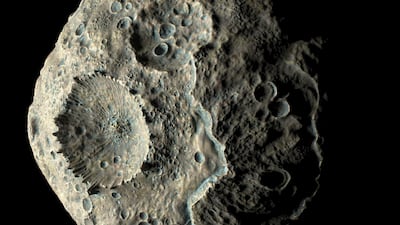
A rendering of the Psyche asteroid -

Hills are covered with fallen and burnt trees after a meteorite hit in 1908. Getty -
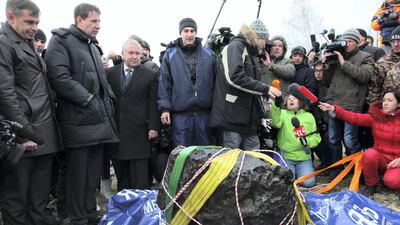
People look at what scientists believe to be a chunk of the Chelyabinsk meteor in 2013. AP -
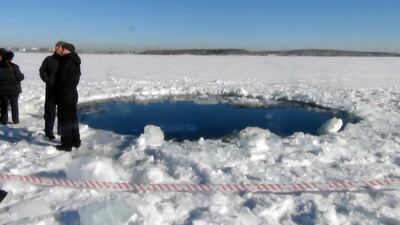
People standing near a six-metre hole in the ice of a frozen lake, reportedly the site of a meteor fall, outside the town of Chebakul in central Russia. AFP -
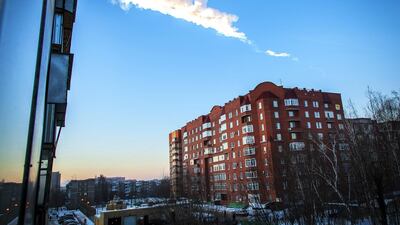
A meteorite trail is seen above a residential apartment block in the Urals city of Chelyabinsk in 2013. AFP -
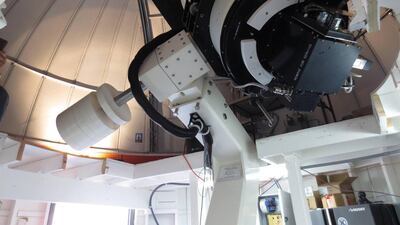
The Asteroid Terrestrial-impact Last Alert System (Atlas), pictured in Hawaii. -
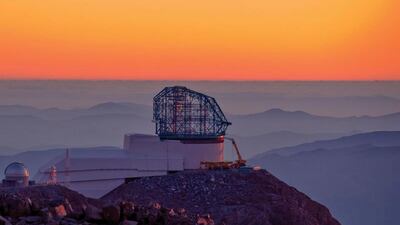
The Vera C. Rubin Observatory, under construction in 2019, promises to reveal more objects faster than any previous telescope. Photo: LSST -
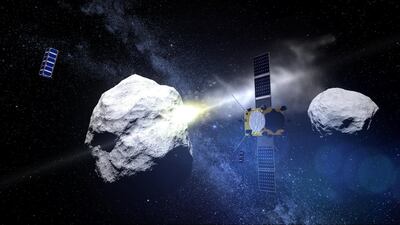
A computer-generated image shows the impact of the Dart projectile on the binary asteroid system, Didymos. ESA/AFP -
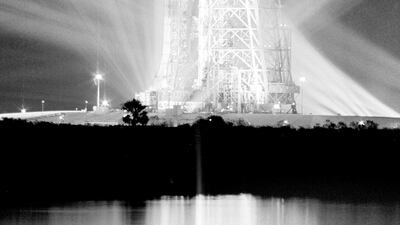
Spotlights illuminate the Saturn V booster rocket on the launch pad at the Kennedy Space Centre in Florida carrying the Apollo 8 spacecraft and its crew of three astronauts, on December 19, 1968. AP


Astronomers have been tracking near-Earth objects for decades to ensure none are on a collision course with the planet.
About 65 million years ago, an asteroid crashed on Earth and killed 70 per cent of all species, including the dinosaurs.
Researchers believe the collision, known as the Chicxulub Impact Event, created devastating tsunamis, earthquakes, volcanic eruptions and wildfires.
In 2013, an asteroid crashed into the Russian city of Chelyabinsk. The asteroid exploded after entering Earth’s atmosphere and released energy equivalent to 500 kilotonnes of TNT.
The incident caused more than 3,600 apartment windows to shatter, injuring more than 1,000 people.
Astronomers have also been tracking the Apophis asteroid, which could hit Earth.
The asteroid was at risk of hitting the planet in 2068, but researchers have since found the planet is safe for another century.
Apophis was discovered in 2004 and is expected to make an extremely close approach to Earth in 2029, passing about 32,000 kilometres above the planet’s surface.
It measures 340 metres in diameter, the equivalent of about seven Olympic-sized swimming pools.
Nasa said it was “important to find asteroids before they find us”.
“An asteroid impact is the only natural disaster that could be prevented,” the agency said.
“The first order of business for planetary defence is to find the asteroids. If an asteroid impact threat is discovered years or decades in advance, then a deflection mission might be possible.
“Nasa’s Dart is a carefully planned demonstration that will help determine if kinetic impactor technology – impacting an asteroid to adjust its speed and path – can serve as a possible method of asteroid deflection in the event that Earth ever faces such a hazard.”

