

Today, life in the Emirates moves in the fast lane. In a regular series to mark the 50th anniversary of the UAE, 'The National' takes a trip back in time to examine how much the country has changed.
Known everywhere simply as the “coin building”, the Aldar headquarters in Abu Dhabi is one of the most instantly recognisable in the country, indeed the world.
Perfectly circular, it is ideally located as a statement of intent by the company that built the Yas Marina F1 circuit and Ferrari World; impossible to ignore by anyone who travels between Abu Dhabi and Dubai.
The building was designed by Marwan Zgheib, the Lebanese architect, whose company has built several eye-catching buildings in the Middle East and Africa, including Doha’s Al Dana Tower, Abu Dhabi’s Wing or Youth Hub, and the under-construction Al Qana leisure district in the capital.
One face of the building overlooks the E10 motorway in Al Raha Beach, another Aldar project, while the other faces the sea.
Built by the engineers Arup, the building was completed in just 30 months, in time for the first Abu Dhabi Grand Prix in 2009.

The 121-metre-high, 23-storey structure has a framework that removes most internal columns, and was the first of its kind in the UAE.
To speed construction, many of the internal elements, including stairs and toilet modules, were pre-assembled, while a rethink of the glass exterior by Arup reduced the number of individual shapes for the panes from more than 10,000 to just 10.
The building’s east-west alignment allows its exterior to catch both the rising and setting sun, while also reducing its exposure in the hottest hours of the day.
Cleaning the 62,000 square metres of glass is almost continuous, using a specially designed cradle. It takes place four times a year and takes up to three months to complete each cycle.
For those who might be wondering, the circular design does not continue underground.
But it exactly adopts the principle of the “golden ratio”, a mathematical formula first developed in Ancient Greece, which imagines a pentangle inside a circle as a human figure, where the feet – or in this case the ground floor – are placed firmly on the ground.
Landmark buildings of the UAE — in pictures
-

Sheikh Zayed Grand Mosque seen from Wahat Al Karama on a cloudy day in Abu Dhabi. Victor Besa / The National -
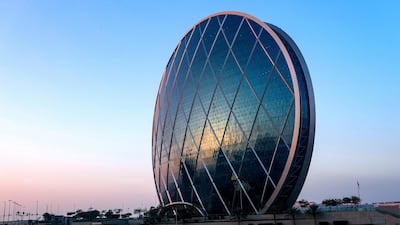
Real estate company Aldar's headquarters in Abu Dhabi. It is the first circular building of its kind in the Middle East. Victor Besa / The National -

Capital Gate tower, developed in Abu Dhabi by Adnec, is more than 160 metres tall. Photo: Adnec -

Emirates Palace, pictured at sunset, in Abu Dhabi. The luxury hotel opened in 2005. Khushnum Bhandari / The National -

Adnoc Headquarters in Abu Dhabi. The building was completed in 2014 and is 342 metres tall. Reuters -

Hazy weather at Louvre Abu Dhabi. Designed by architect Jean Nouvel, the art museum is the largest in the Gulf. Victor Besa / The National -

Despite not yet being open to the public, the Museum of the Future is already a major Dubai landmark. The exterior displays an Arabic poem by Sheikh Mohammed bin Rashid, Vice President and Ruler of Dubai, about the emirate's future. Antonie Robertson / The National -
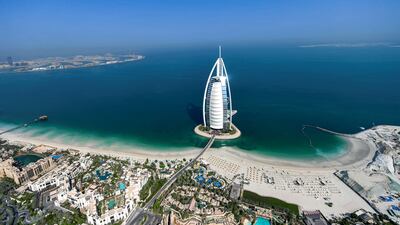
Before Burj Khalifa, there was Burj Al Arab. Designed to look like a billowing sail, the luxury hotel opened in 1999. AFP -

At a height of 829.8 metres, Burj Khalifa has held the record as the world's tallest building since opening in 2010. Chris Whiteoak / The National -

Dubai Frame became the largest frame in the world when it opened in 2018. It is positioned to represent a window between Dubai's past and future. Pawan Singh / The National -

The 2,000-seat Dubai Opera was designed by Janus Rostock and opened in 2016 as a multi-format performing arts centre. Alamy -

Located at the apex of the Palm Jumeirah, Dubai, Atlantis, The Palm was the first resort to be built on the artificial island. It opened in 2008 and contains 1,548 rooms – some of which are underwater. AFP -
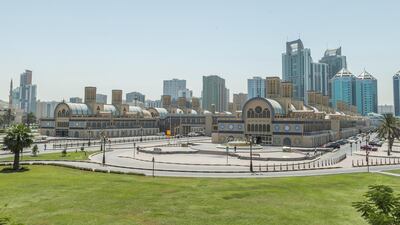
One of Sharjah's most photographed landmarks, the Blue Souk is featured on the five dirham note. Antonie Robertson / The National -

The Khorfakkan Amphitheatre is a relatively new addition to Sharjah, having been inaugurated in December 2020. It can accommodate 3,600 people and sits beside a 45-metre tall waterfall. Pawan Singh / The National -

The design of Sharjah's Al Noor Mosque was influenced by an Ottoman-style mosque in Turkey. It can accommodate 2,600 worshippers and opened in 2005. Victor Besa / The National



