
There is a dire need of funds to protect vulnerable populations who are already coping with the impacts of humanitarian crises.
Houssam Chahine, the UNHCR’s head of private-sector partnerships in the Middle East and North Africa, said the pandemic has left tens of millions of refugees across the world more exposed than ever.
The appeal has urged people to help ease the plight by making donations through the Refugee Zakat Fund or offering financial aid through its website.
Zakat, which is one of the five pillars of Islam, is a form of alms giving that is treated as a tax or religious obligation.
The UNHCR’s original Zakat programme had collected almost Dh53 million between 2016 and 2018.
Mr Chahine said the situation of refugees could have a severe impact on the region’s economy and they needed more support than ever.

“Every donation counts and you can make so much of a difference just from home,” he said.
“There is a serious challenge to protect refugees who are not allowed to work right now, or even to go out.
“A family of five could survive on Dh1,800 a month.”
The UNHCR has released a video to promote the campaign. It asks viewers to imagine iftar without food or cities without people.
Mr Chahine said the Covid-19 pandemic has affected everyone and has raised public awareness of just how vulnerable people are.
“Even very rich countries are struggling to cope with the impact of this pandemic,” he said.
“We don’t know how long this will continue for.
“But what this pandemic has shown is the importance of looking after everyone. If just one person is not safe then nobody is.”
He said the UNHCR campaign was not focusing only on making cash donations to refugee families who were struggling to cope.
The organisation is also working with local governments to invest in water, sanitation, hygiene and healthcare.
It also raises awareness in refugee camps to prevent the spread of the virus and helps in building isolation units in case of infections.
“There are more than 70 million who are displaced across the world and more than 60 per cent are in the Mena region,” Mr Chahine said.
“Those numbers are rising all the time. In 2018 alone, there were 2.3 million added to the figure.”
Mr Chahine said that millions of displaced people were in quarantine during the holy month without any income.
Helping refugees was not just about helping individuals as donations help boost the economies of the countries hosting them, he said.
“More than 80 per cent of the world’s displaced are being hosted in countries with low to middle incomes,” he said.
“The healthcare is not strong in those nations but the refugees will spend their money in the countries they are in which will boost the economies.
“We are also putting a focus on the host communities.”
People who wish to support the campaign can do so on zakat.unhcr.org or giving.unhcr.org/Ramadan
-
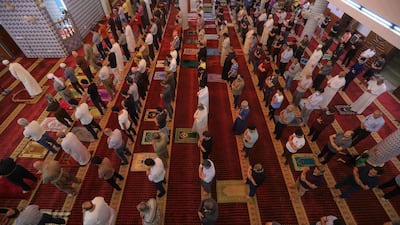
Worshippers prayer at a mosque in Erbil, the capital of the autonomous Kurdish region of northern Iraq. AFP -
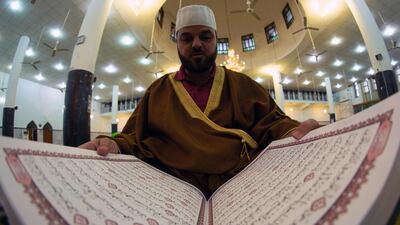
The muezzin of the grand mosque of Basra, closed down due to the coronavirus pandemic, reads the Quran. AFP -
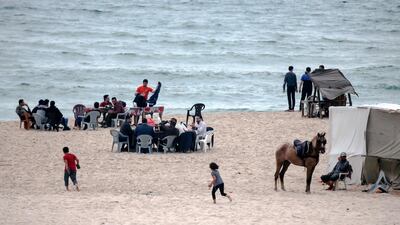
Palestinians gather for iftar along the shore of Gaza City. AFP -
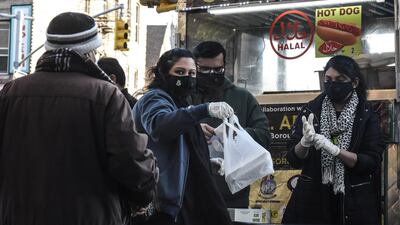
Members of the Pakistani Youth Society distribute free meals in the Flatbush neighbourhood of Brooklyn in New York City. AFP -

Shiite cleric Ali Al Atabi reads from the Quran in the vicinity of Imam Ali shrine in Iraq's central city of Najaf. AFP -
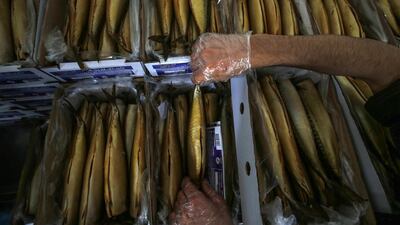
A Palestinian man packs smoked mackerel before selling them in Rafah, Gaza Strip. AFP -
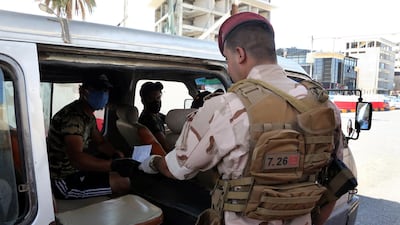
Iraqi soldiers control motorists at a checkpoint in Baghdad's Mansur district, Iraq. EPA -
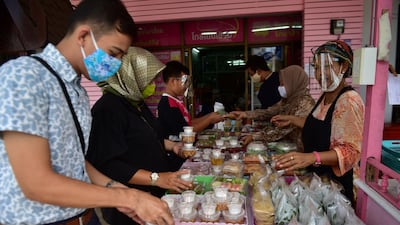
People wearing face masks buy food at a market in Thailand's southern Narathiwat province. AFP -
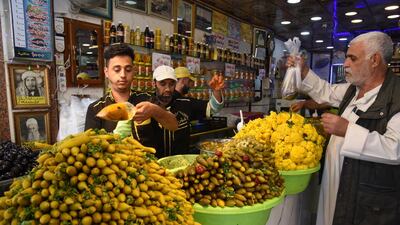
An Iraqi man buys pickles in Mosul, northern Iraq. EPA -
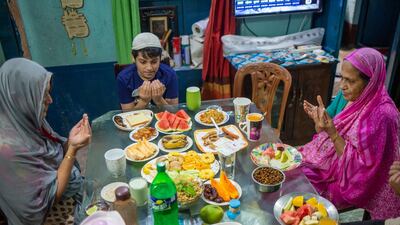
Bangladeshi family members eat iftar in Dhaka, Bangladesh. EPA -
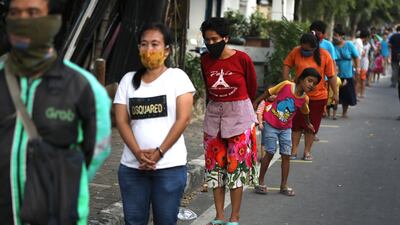
People stand on marked spots to practice social distancing in Jakarta, Indonesia. AP Photo -
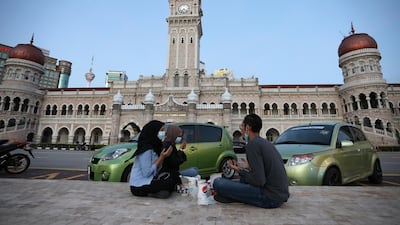
Muslims pray before breaking their fast in Kuala Lumpur, Malaysia. REUTERS -
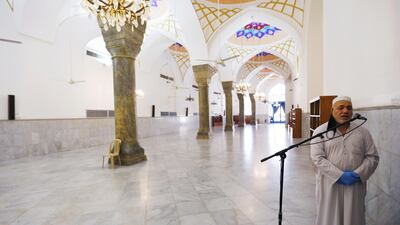
A muezzin at a mosque close to shrine of Sheikh Abdul Qadir Jeelani calls for prayer in Baghdad, Iraq. Reuters -
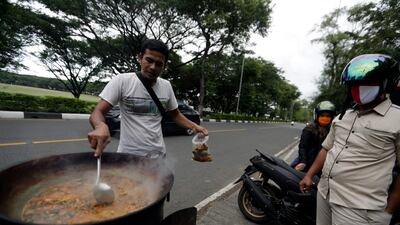
A street food vendor sells 'kari kambing', a goat curry. in Banda Aceh, Indonesia. EPA



