


Latest: Live updates as coronavirus cases rise
The UAE has joined the front line of the global fight against Covid-19 after approving a nationwide rollout of China’s Sinopharm vaccine.
But how does the vaccine compare to others now set for for wider public use – and can it end the pandemic?
How does the Sinopharm vaccine work ?
Developed by scientists at China’s state-owned pharmaceutical enterprise, the vaccine follows the tried-and-tested route of training the body’s immune system to detect and destroy viruses using injections of deactivated virus.
For the Covid-19 coronavirus, researchers used a compound which stops the virus from replicating, but still allow it to trigger a response from the immune system.
The deactivated virus method has been safely used for decades to create vaccines against viruses ranging from influenza and polio to rabies.
How is it given ?
By injection into a muscle – usually in the upper arm. Because the virus has been deactivated, the body’s response is relatively weak, so two injections are needed over 28 days.
How do we know it’s safe and effective ?
In April, Chinese officials approved small trials in volunteers to check that the vaccine triggered an immune response without serious side-effects. The results – published in the respected medical journal The Lancet – led to approval for a far larger "Phase III" study in collaboration with the UAE.
Since September, 31,000 volunteers from 125 nations in the age-range 18 to 60 have been given the vaccine.
While the results have not been formally published, according to the UAE health ministry the vaccine is 86 per cent effective in preventing Covid-19, and 100 per cent effective in preventing moderate or severe cases of the disease.
But on December 30, 2020, Sinopharm announced that phase three trials of the vaccine showed that it was 79 per cent effective.
The results also showed that the vaccine successfully triggered an immune system response in 99 per cent of patients – but without any serious side-effects.
Further studies are continuing in the UAE and elsewhere, including Jordan, Brazil, Morocco and Serbia.
Why was it not tested in China ?
Ironically, because of China’s success in combating the virus through the rapid introduction of lockdowns. This has led to rates of infection dropping so low it is hard to test whether a vaccine protects against Covid-19.
Even so, in July Chinese officials authorised the emergency use of the vaccine, which has now been given to almost one million people. This is expected to give valuable insights into the rate of side-effects.
How does it compare to other approved Covid vaccines ?
-
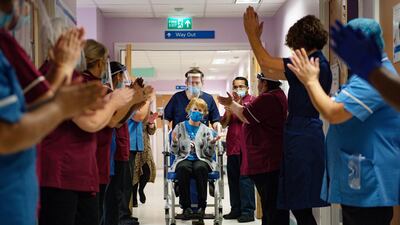
Margaret Keenan, 90, is applauded by staff as she returns to her ward after becoming the first person in the United Kingdom to receive the Pfizer-BioNtech Covid-19 vaccine at University Hospital, Coventry. EPA -
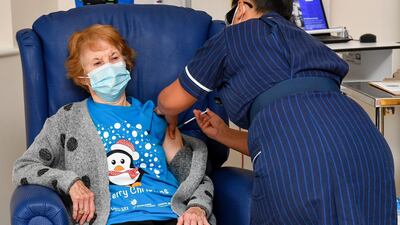
Margaret Keenan receives the vaccine, administered by nurse May Parson. EPA -
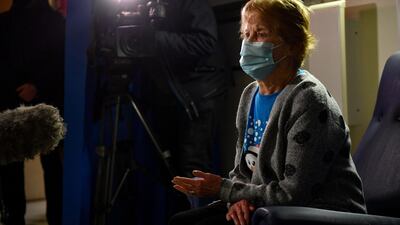
Margaret Keenan speaks to the media at University Hospital in Coventry. AFP -
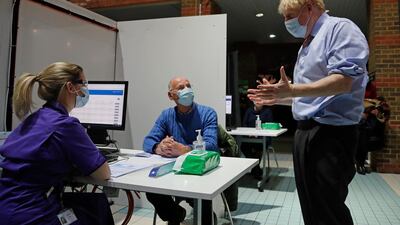
British Prime Minister Boris Johnson gestures as he speaks to staff at Guy's Hospital in London. AP Photo -
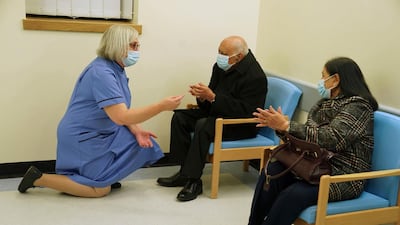
Retired nurse Suzanne Medows speaks to race relations campaigner Dr Hari Shukla, 87, and his wife Ranju, before he receives the Pfizer-BioNTech Covid-19 vaccine at the Royal Victoria Infirmary in Newcastle. AP Photo -
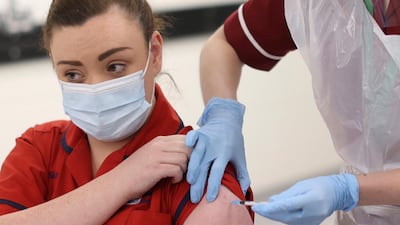
Sister Joanna Sloan receives the Pfizer-BioNTech Covid-19 vaccine, as the first person in Northern Ireland at the Royal Victoria Hospital, in Belfast. AP Photo -
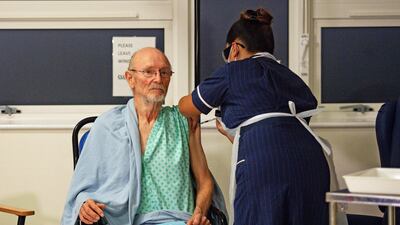
"Bill" William Shakespeare, 81, receives the Pfizer-BioNTech Covid-19 vaccine, at University Hospital, Coventry. AP Photo -
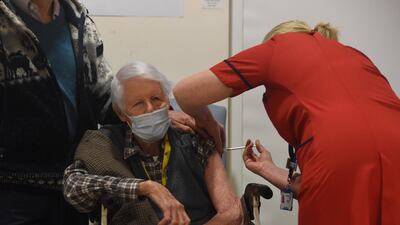
Michael Tibbs, 99 is given the Pfizer-BioNtech Covid-19 vaccine at Queen Alexandra Hospital in Portsmouth. Getty Images -

Michael Tibbs and his son Philip enjoy a cup of tea after Michael received the Pfizer-BioNtech Covid-19 vaccine at Queen Alexandra Hospital. Getty Images -
"I've had my covid vaccination" stickers at the Royal Victoria Infirmary in Newcastle. Getty Images -

A nurse holds a phial of the Pfizer-BioNTech Covid-19 vaccine at Guy's Hospital in London. Reuters -
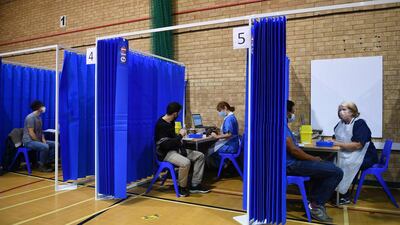
Medical personnel prepare to administer the Pfizer-BioNTech Covid-19 vaccine to recipients at a health centre in Cardiff. AFP -

A woman walks past graffiti with the words Victory to the NHS on a wall at the Royal Victoria Hospital in West Belfast, Northern Ireland. AP Photo


Earlier this month, a vaccine developed by Pfizer and the German biotech company BioNTech became the first to announce positive early results from a Phase III study. Involving over 43,000 volunteers, the results showed a 95 per cent success in preventing Covid-19 after two doses, and no serious safety concerns.
It has become the first to be approved by independent regulators, following sign-off by officials in the UK. Approval in the US and European Union is expected to follow within weeks.
However, the vaccine is based on a radically different from that used in the Sinopharm vaccine. Instead of using deactivated virus, the Pfizer/BioNTech vaccine reprogrammes the body’s own cells to create fragments of the virus themselves.
This is done via two injections of genetic instructions in the form of mRNA, which the cells use to make a part of the virus which trains the immune system to detect the full virus if infection occurs.
While the idea of “re-programming” healthy cells in this way has been around for many years, it has never been successfully used before. Attempts to use it to combat other diseases have led to serious side-effects, but experts point out that the Pfizer/BioNTech vaccine involves much lower doses.
Even so, reports of side-effects among three healthcare workers have led UK regulators to advise that those with a history of serious allergic reactions should not be given the vaccine.
In Dubai, the Pfizer-BioNTech vaccine is initially available to people aged over 60, those with chronic diseases, people with disabilities, frontline workers and people in essential sectors.
It is available at seven healthcare centres in the emirate.
From April, the vaccine will be given to all age groups, officials said earlier this month.
Officials hope to vaccinate 70 per cent of the population by later this year as part of efforts to achieve 'herd immunity'.
The vaccine, which was found to be 95 per cent effective in late-stage trials, is administered for free on a voluntary basis.
UAE residents can register and book appointments for the vaccination through the DHA app or the DHA’s free number 800 342.
The Sinopharm vaccine is available across all health centres.
What other vaccines are available ?
According to the World Health Organization, more than 300 vaccines are currently under development. The next to win independent approval is expected to be the vaccine developed at Oxford University in collaboration with AstraZeneca.
This involves injecting a harmless, deactivated virus that has been modified to carry a part of the Covid virus on its surface. This triggers a reaction from the immune system, which is then primed to attack the real virus if infection occurs.
According to results based on 11,000 volunteers published in The Lancet earlier this month, the vaccine is 70 per cent effective at preventing symptomatic infections, with no serious side-effects.
Meanwhile, the Sputnik V vaccine developed in Russia uses a similar approach, but with two different viruses. It is claimed to be 95 per cent effective, with around a quarter of volunteers experiencing mild side-effects.
So are we close to bringing the pandemic under control ?
Despite the hoopla over the approval of the first vaccines, serious questions and challenges remain. While attention has focused on the effectiveness of the vaccines, the impressive figures relate only to prevention of Covid-19 – not protection against infection. It remains unclear whether vaccinated people can still carry the virus and thus inadvertently spread it to others.
Even if the vaccines are effective against infection, they will still fail to stop the pandemic unless enough people are vaccinated. Experts calculate that around 70 per cent of the population need to be treated to achieve so-called herd immunity, where so many people are protected that the virus can no longer thrive.
The logistics of making and delivering vast quantities of the vaccine around the world are daunting. Some of the vaccines – such as the mRNA types – have to be kept at very low temperatures until injected. The reluctance of people to be vaccinated – so-called vaccine hesitancy – may also prove to be a major barrier to ending the pandemic.
Robert Matthews is Visiting Professor of Science at Aston University, Birmingham, UK

