


Scientists could be moving closer to understanding why the Oxford-AstraZeneca Covid-19 vaccine causes a risk of blood clots in some people.
A German researcher has suggested that an ingredient in the vaccine may cause blood vessels to leak, sparking a chain reaction in the immune system.
There are, however, competing theories to the proposal put forward by Dr Andreas Greinacher, of the University of Greifswald, which follows studies in mice.
Finding the cause could offer multiple benefits, according to experts. It could allow researchers to amend the vaccine to prevent the clotting risk, and help doctors to treat affected individuals.
Dr Greinacher's hypothesis has generated headlines across the world after vaccine campaigns were suspended because some recipients suffered blood clots, some of which were fatal.
Certain European nations, notably Denmark and Norway, and the Canadian province of Ontario, halted their use of the vaccine, while others have restricted it to older people, where the risks from coronavirus are greater and the chances of a blood clot after vaccination are lower.
Estimates from the UK suggest about one in 100,000 people in their 40s developed a blood clot after having the vaccine, with about one fifth of these proving fatal. The risk of death from vaccination is roughly twice as high among people in their 30s.
According to Dr Greinacher, an ingredient called ethylenediaminetetraacetic acid (EDTA), sometimes used as a preservative in vaccines, could play a role in the rare blood clots.
His tests on mice found that the vaccine made blood vessels more prone to leak – with EDTA potentially responsible for this effect – and this may cause human proteins present in the vaccine, which is grown in cultured human cells, to encounter and react with cell fragments in the blood called platelets.
This causes the platelets to release a substance called platelet factor 4, or PF4, which leads to components of the blood clumping together.
In a further reaction affecting a small proportion of people, the immune system may produce antibodies against PF4, leading in a fraction of these cases to the formation of the blood clots.
In some cases these have affected veins from the brain in a condition called cerebral venous sinus thrombosis, but the lungs or abdomen have also been involved.
Despite the concerns over blood clots, Prof John Oxford, professor emeritus at the University of London and co-author of the textbook Human Virology, said it was likely the Oxford-AstraZeneca vaccine would continue to be used widely in the years to come.
“It seems to be fairly cheap to produce and relatively easy to transport around, and people have had a lot of experience of growing adenoviruses for different things,” he said.
He said experience with polio, against which two types of vaccine have been effectively used, showed the benefit of having a diversity of vaccines useful in different contexts.
Not all scientists are convinced by Dr Greinacher's hypothesis, not least because there have also been reports of blood clots linked to the Johnson & Johnson Covid-19 vaccine, also branded as Janssen, which does not list EDTA as an additive.
The US Centres for Disease Control and Prevention identified 28 cases among more than 8.7 million recipients of the Johnson & Johnson vaccine, which Dr Greinacher has yet to carry out tests on.
Both the Oxford-AstraZeneca and Johnson & Johnson vaccines create an immune response to the coronavirus by using non-replicating versions of adenoviruses.
Another idea discussed in specialist media is that PF4 binds to the adenovirus, which would explain why both the Oxford-AstraZeneca and Johnson & Johnson vaccines have been affected by the blood clots issue. A small proportion of vaccinated people are vulnerable because they have higher PF4 levels, according to this hypothesis.
Two other adenoviral vector vaccines against the coronavirus, Sputnik V from Russia’s Gamaleya Institute and a vaccine from China’s CanSino, have not been linked to the rare blood clots.
According to the latest World Health Organisation figures, there are 99 Covid-19 vaccines in clinical stages of development, including those already being administered, along with 184 in pre-clinical development.
With virologists not expecting the coronavirus to be eradicated, it is likely that vaccines will have to be administered for years to come.
Covid-19 vaccination campaign in the UAE - in pictures
-
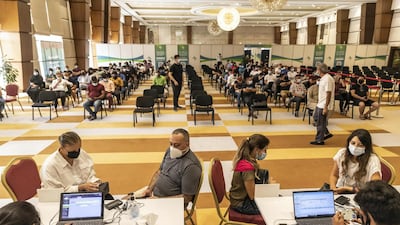
People wait to get vaccinated at Barsha Hall in Barsha, a suburb of Dubai. -
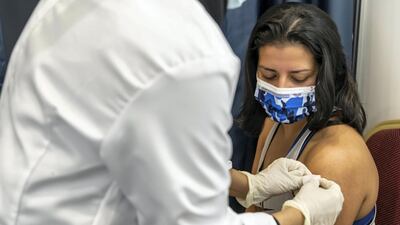
Irum Fatima Tapal gets vaccinated against Covid-19 at Barsha Hall in Dubai -
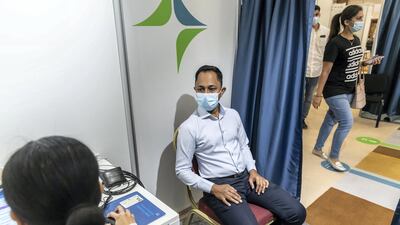
Lateef Painat receives the Pfizer BioNTech shot -
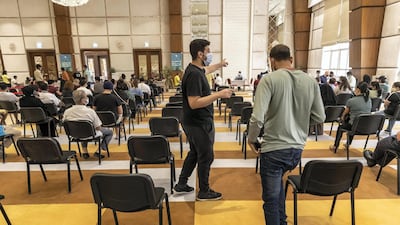
It was a busy first week at Barsha Hall, where 4,000 people can be vaccinated in a day -
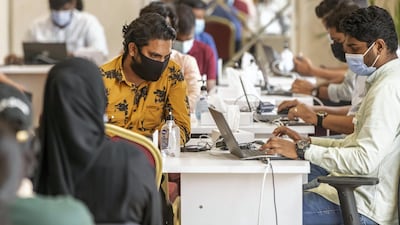
Barsha Hall has 20 check-in counters, 50 vaccination booths and five observation rooms -
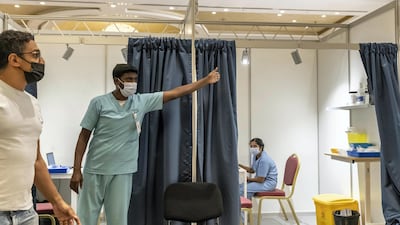
About 80 healthcare staff work at the site -
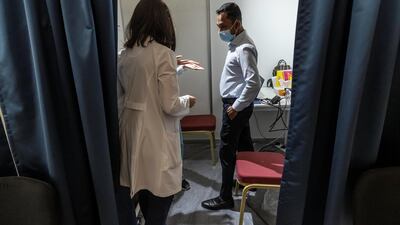
Lateef Painat, a Dubai resident, gets ready to be vaccinated at the newly opened Barsha Hall



