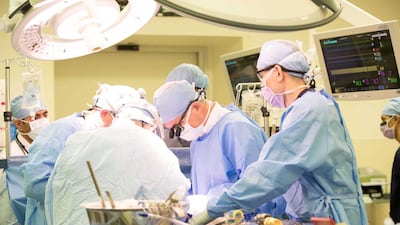
A team at Cleveland Clinic Abu Dhabi performed the complex and rarely performed surgery. Courtesy Cleveland Clinic Abu Dhabi

Abu Dhabi surgeons complete rare 11-hour procedure to reattach Emirati man's kidney after tumour removal


  • English
  • Arabic

An Emirati man, 64, had his only kidney removed and then transplanted back into his body in a rare 11-hour procedure.

Born with one kidney, retiree Ali Al Shamsi was told last year that this kidney had a tumour and that surgery was essential for his survival.

A regular kidney transplant was not an option for the father of one from Al Ain, who would have had to wait around three years and receive strong medication before eventually being eligible.

Dr Hassen and the team truly saved my life and I owe them the world for that

Instead, a team of doctors at Cleveland Clinic Abu Dhabi decided to perform what is known as a renal bench reconstruction, which first involved the removal of Mr Al Shamsi's kidney.

Once outside the body, the kidney was placed in a slush solution – an iced saline mixture of solids and liquid – to keep it cool, while a surgical oncologist and microsurgeon worked together to carefully dissect and remove the tumour.

When the tumour was removed, the kidney was placed back into the body.

The surgery was performed by oncologist Dr Waleed Hassen, Department Chair of Urology at Cleveland Clinic Abu Dhabi.

After surgery, it was expected that Mr Al Shamsi would be on dialysis for at least two years, but three weeks later his kidney began functioning normally again.

Dr Waleed Hassen, a urologist at Cleveland Clinic Abu Dhabi. Courtesy Cleveland Clinic Abu Dhabi

"Before the operation, I was very scared. I cried on my way to the operating room," Mr Al Shamsi told The National.

"I had never heard of such an operation where they take out your kidney and then put it back. Dr Hassen and the team truly saved my life and I owe them the world for that."

Dr Bashir Sankari, chair of the Surgical Subspecialties Institute at Cleveland Clinic and a transplant surgeon who took part in the procedure, said Mr Al Shamsi will not need dialysis, a transplant or immunosuppressants and can live his life normally, free of cancer.

"When doctors told me my kidney had recovered enough and I could stop dialysis, I was flying," Mr  Al Shamsi said.

"It was the best news I'd ever heard. I feel amazing now. I was even able to fast this Ramadan because I felt so strong."

Mr Al Shamsi was diagnosed last June after going to Cleveland Clinic complaining of chest pains.

"I never imagined that I would go to the hospital over chest pains and then discover that I have one kidney and that one kidney would have a tumour," he said.

Within a few days, he had decided to have the complex surgery in the UAE.

Dr Bashir Sankari, left, the chair of the Surgical Subspecialties Institute at Cleveland Clinic Abu Dhabi. Chris Whiteoak / The National

"I had the option of doing it in the United States but anything that could be done in the United States could be done here."

"And if I died, I wanted to die in my country surrounded by my family and friends," Mr Al Shamsi said.

"This is a rare and complex procedure, with only a handful performed," Dr Hassan said.

"Patients will always do better with their own kidneys rather than have a transplant. It is always better to try to save the kidney."

He said if Mr Al Shamsi had received a kidney transplant, he would have needed years of regular dialysis before an eventual donor transplant, all of which carries its own set of risks.

"We determined that the best course of action for Ali was a complex surgery to remove his kidney, dissect the tumour, reconstruct the kidney and transplant it back into him," Dr Hassan said.

“Having the kidney outside the body means we have much better access. Leaving it in place in the body would not only mean operating on it in a tight space but also a high risk of causing significant bleeding."

Dr Kashif Siddiqi, a urologist who specialises in microsurgery at Cleveland Clinic Abu Dhabi, said with more time and space they were able to reach the tumour without causing too much damage to healthy tissue.

“This was a very complex operation that really required a high level of skill and co-ordination across our team with extensive experience in both transplant and surgical oncology," said Dr Siddiqi.

"There are not many places in the world that can perform this surgery.

"From Ali’s perspective, this approach means we are able to save his kidney, which is a huge benefit."


Citizenship-by-investment programmes

United Kingdom

The UK offers three programmes for residency. The UK Overseas Business Representative Visa lets you open an overseas branch office of your existing company in the country at no extra investment. For the UK Tier 1 Innovator Visa, you are required to invest £50,000 (Dh238,000) into a business. You can also get a UK Tier 1 Investor Visa if you invest £2 million, £5m or £10m (the higher the investment, the sooner you obtain your permanent residency).

All UK residency visas get approved in 90 to 120 days and are valid for 3 years. After 3 years, the applicant can apply for extension of another 2 years. Once they have lived in the UK for a minimum of 6 months every year, they are eligible to apply for permanent residency (called Indefinite Leave to Remain). After one year of ILR, the applicant can apply for UK passport.

The Caribbean

Depending on the country, the investment amount starts from $100,000 (Dh367,250) and can go up to $400,000 in real estate. From the date of purchase, it will take between four to five months to receive a passport. 

Portugal

The investment amount ranges from €350,000 to €500,000 (Dh1.5m to Dh2.16m) in real estate. From the date of purchase, it will take a maximum of six months to receive a Golden Visa. Applicants can apply for permanent residency after five years and Portuguese citizenship after six years.

“Among European countries with residency programmes, Portugal has been the most popular because it offers the most cost-effective programme to eventually acquire citizenship of the European Union without ever residing in Portugal,” states Veronica Cotdemiey of Citizenship Invest.

Greece

The real estate investment threshold to acquire residency for Greece is €250,000, making it the cheapest real estate residency visa scheme in Europe. You can apply for residency in four months and citizenship after seven years.

Spain

The real estate investment threshold to acquire residency for Spain is €500,000. You can apply for permanent residency after five years and citizenship after 10 years. It is not necessary to live in Spain to retain and renew the residency visa permit.

Cyprus

Cyprus offers the quickest route to citizenship of a European country in only six months. An investment of €2m in real estate is required, making it the highest priced programme in Europe.

Malta

The Malta citizenship by investment programme is lengthy and investors are required to contribute sums as donations to the Maltese government. The applicant must either contribute at least €650,000 to the National Development & Social Fund. Spouses and children are required to contribute €25,000; unmarried children between 18 and 25 and dependent parents must contribute €50,000 each.

The second step is to make an investment in property of at least €350,000 or enter a property rental contract for at least €16,000 per annum for five years. The third step is to invest at least €150,000 in bonds or shares approved by the Maltese government to be kept for at least five years.

Candidates must commit to a minimum physical presence in Malta before citizenship is granted. While you get residency in two months, you can apply for citizenship after a year.

Egypt 

A one-year residency permit can be bought if you purchase property in Egypt worth $100,000. A three-year residency is available for those who invest $200,000 in property, and five years for those who purchase property worth $400,000.

Source: Citizenship Invest and Aqua Properties

Key findings of Jenkins report
  • Founder of the Muslim Brotherhood, Hassan al Banna, "accepted the political utility of violence"
  • Views of key Muslim Brotherhood ideologue, Sayyid Qutb, have “consistently been understood” as permitting “the use of extreme violence in the pursuit of the perfect Islamic society” and “never been institutionally disowned” by the movement.
  • Muslim Brotherhood at all levels has repeatedly defended Hamas attacks against Israel, including the use of suicide bombers and the killing of civilians.
  • Laying out the report in the House of Commons, David Cameron told MPs: "The main findings of the review support the conclusion that membership of, association with, or influence by the Muslim Brotherhood should be considered as a possible indicator of extremism."
Ten tax points to be aware of in 2026

1. Domestic VAT refund amendments: request your refund within five years

If a business does not apply for the refund on time, they lose their credit.

2. E-invoicing in the UAE

Businesses should continue preparing for the implementation of e-invoicing in the UAE, with 2026 a preparation and transition period ahead of phased mandatory adoption. 

3. More tax audits

Tax authorities are increasingly using data already available across multiple filings to identify audit risks. 

4. More beneficial VAT and excise tax penalty regime

Tax disputes are expected to become more frequent and more structured, with clearer administrative objection and appeal processes. The UAE has adopted a new penalty regime for VAT and excise disputes, which now mirrors the penalty regime for corporate tax.

5. Greater emphasis on statutory audit

There is a greater need for the accuracy of financial statements. The International Financial Reporting Standards standards need to be strictly adhered to and, as a result, the quality of the audits will need to increase.

6. Further transfer pricing enforcement

Transfer pricing enforcement, which refers to the practice of establishing prices for internal transactions between related entities, is expected to broaden in scope. The UAE will shortly open the possibility to negotiate advance pricing agreements, or essentially rulings for transfer pricing purposes. 

7. Limited time periods for audits

Recent amendments also introduce a default five-year limitation period for tax audits and assessments, subject to specific statutory exceptions. While the standard audit and assessment period is five years, this may be extended to up to 15 years in cases involving fraud or tax evasion. 

8. Pillar 2 implementation 

Many multinational groups will begin to feel the practical effect of the Domestic Minimum Top-Up Tax (DMTT), the UAE's implementation of the OECD’s global minimum tax under Pillar 2. While the rules apply for financial years starting on or after January 1, 2025, it is 2026 that marks the transition to an operational phase.

9. Reduced compliance obligations for imported goods and services

Businesses that apply the reverse-charge mechanism for VAT purposes in the UAE may benefit from reduced compliance obligations. 

10. Substance and CbC reporting focus

Tax authorities are expected to continue strengthening the enforcement of economic substance and Country-by-Country (CbC) reporting frameworks. In the UAE, these regimes are increasingly being used as risk-assessment tools, providing tax authorities with a comprehensive view of multinational groups’ global footprints and enabling them to assess whether profits are aligned with real economic activity. 

Contributed by Thomas Vanhee and Hend Rashwan, Aurifer

TYPES%20OF%20ONLINE%20GIG%20WORK
%3Cp%3E%3Cstrong%3EDesign%2C%20multimedia%20and%20creative%20work%3A%20%3C%2Fstrong%3ELogo%20design%2C%20website%20design%2C%20visualisations%3C%2Fp%3E%0A%3Cp%3E%3Cstrong%3EBusiness%20and%20professional%20management%3A%20%3C%2Fstrong%3ELegal%20or%20management%20consulting%2C%20architecture%3C%2Fp%3E%0A%3Cp%3E%3Cstrong%3EBusiness%20and%20professional%20support%3A%20%3C%2Fstrong%3EResearch%20support%2C%20proofreading%2C%20bookkeeping%3C%2Fp%3E%0A%3Cp%3E%3Cstrong%3ESales%20and%20marketing%20support%3A%20%3C%2Fstrong%3ESearch%20engine%20optimisation%2C%20social%20media%20marketing%3C%2Fp%3E%0A%3Cp%3E%3Cstrong%3EData%20entry%2C%20administrative%2C%20and%20clerical%3A%20%3C%2Fstrong%3EData%20entry%20tasks%2C%20virtual%20assistants%3C%2Fp%3E%0A%3Cp%3E%3Cstrong%3EIT%2C%20software%20development%20and%20tech%3A%20%3C%2Fstrong%3EData%20analyst%2C%20back-end%20or%20front-end%20developers%3C%2Fp%3E%0A%3Cp%3E%3Cstrong%3EWriting%20and%20translation%3A%20%3C%2Fstrong%3EContent%20writing%2C%20ghost%20writing%2C%20translation%3C%2Fp%3E%0A%3Cp%3E%3Cstrong%3EOnline%20microtasks%3A%20%3C%2Fstrong%3EImage%20tagging%2C%20surveys%3C%2Fp%3E%0A%3Cp%3E%3Cem%3ESource%3A%20World%20Bank%3C%2Fem%3E%3C%2Fp%3E%0A