Related: Sheikh Hamdan bin Rashid: the man who helped make Dubai a global financial hub
The death of a member of the UAE's royal families is marked with a mourning period.
The country announces this period as a mark of respect, and life across the Emirates takes on a more sombre tone.
During official mourning, flags fly at half-staff and radio stations play classical music for the duration. State-owned TV stations usually follow suit.
Most live entertainment, including radio broadcasts, are cancelled.
A 10-day mourning period was declared on Wednesday in Dubai after the death of Sheikh Hamdan bin Rashid, Deputy Ruler of Dubai and Minister of Finance.
Flags will be flown at half-staff during this period. Work has been suspended in government departments and institutions for three days starting from Thursday.
President Sheikh Khalifa on Wednesday announced a three-day mourning period for the country and ordered that the UAE national flag be lowered to half-staff until Saturday.
Sheikh Hamdan bin Rashid died during the coronavirus pandemic and the mourning period reflects precautionary measures.
Funeral prayers were limited to family members only, while absentee prayers were held after maghrib in mosques across the UAE.
In the past during official periods of mourning, federal ministries and government departments were closed, although this practice has declined in recent years and schools typically stay open.
After the death of the Founding Father, Sheikh Zayed in November 2004, the official mourning period was set at 40 days.
Government departments and schools closed for eight days and the private sector shut for three.
_____________
Sheikh Hamdan bin Rashid's life through the years - in pictures
-
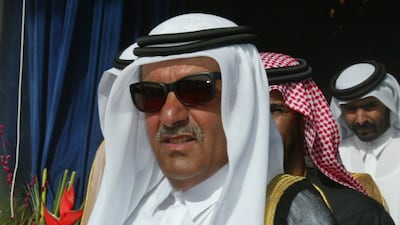
Sheikh Hamdan bin Rashid, Deputy Ruler of Dubai, Minister of Finance and Chairman of Dubai Aluminium Company inaugurates DUBAL's twenty-five year anniversary celebrations in Dubai on January 9, 2005. Sheikh Hamdan died on Wednesday, March 24, 2021. Reuters -

Chard Hills and Sheikh Hamdan bin Rashid after winning The Coronation Stakes with Ghanaati at the Royal Ascot. The popularity of horseracing in the UAE is widely attributed to Sheikh Hamdan. -
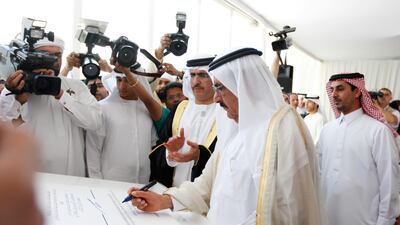
Sheikh Hamdan bin Rashid signs an inauguration document at the opening ceremony of the largest power production and water desalination plant in the UAE, in Dubai, on April 8, 2013. Sarah Dea / The National -

Sheikh Hamdan bin Rashid pictured at the Meydan Racecourse with winner of the 1,200m race, Muarrab, and rider Paul Hanagan in March 5, 2016. Pawan Singh / The National -

Sheikh Hamdan bin Rashid is presented with the Dubai World Cup trophy in 2015 after Prince Bishop won the showpiece race. Pawan Singh / The National -
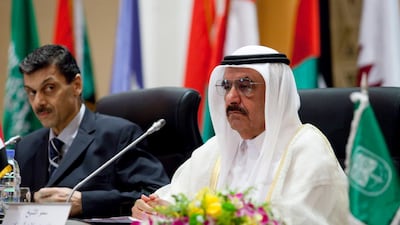
Sheikh Hamdan bin Rashid speaks at the opening session of the Annual Meetings of the Arab Financial Institutions and the Fourth Meeting of the Council of Arab Ministers of Finance on April 2, 2013. Razan Alzayani / The National -
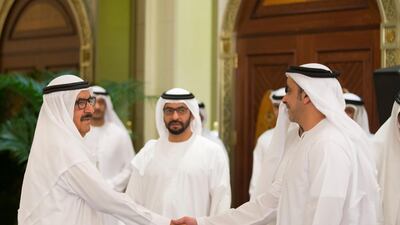
Sheikh Hamdan bin Rashid greets Sheikh Saif bin Zayed, Deputy Prime Minister and Minister of Interior, during an iftar reception at Mushrif Palace on July 1, 2014. With them is Sheikh Hamdan bin Zayed, the Ruler's Representative in Al Dhafra Region. Mohamed Al Hammadi / Crown Prince Court - Abu Dhabi -
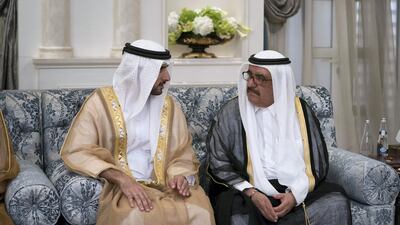
Sheikh Hamdan bin Mohammed, Crown Prince of Dubai, speaks with Sheikh Hamdan bin Rashid during an Eid Al Adha reception at Mushrif Palace on September 2, 2017. Mohamed Al Hammadi / Crown Prince Court - Abu Dhabi -
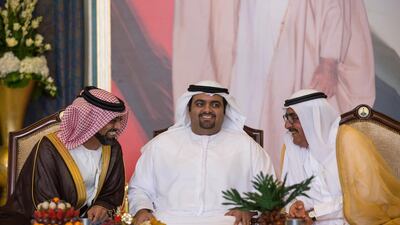
Sheikh Ammar bin Humaid Al Nuaimi, Crown Prince of Ajman, Sheikh Mohamed bin Hamad Al Sharqi, Crown Prince of Fujairah, and Sheikh Hamdan bin Rashid Al Maktoum, Deputy Ruler of Dubai and UAE Minister of Finance, attend a wedding at then Armed Forces Officers Club on March 23, 2016. Ryan Carter / Crown Prince Court - Abu Dhabi -
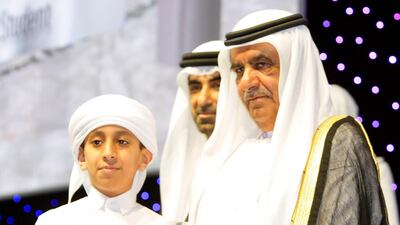
Sheikh Hamdan bin Rashid distributes the Distinguished Student Awards at Dubai International Convention Centre on April 8, 2008. Jeffrey E. Biteng / The National -
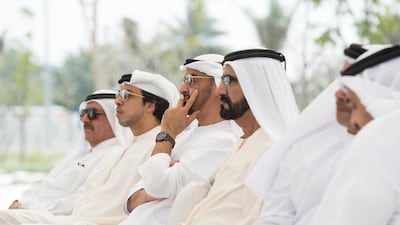
Sheikh Mohammed bin Rashid, Vice President and Ruler of Dubai, Sheikh Mohamed bin Zayed, Crown Prince of Abu Dhabi and Deputy Supreme Commander of the UAE Armed Forces, Sheikh Mansour bin Zayed, UAE Deputy Prime Minister and Minister of Presidential Affairs, and Sheikh Hamdan bin Rashid, attend a UAE Cabinet meeting at Wahat Al Karama on March 5, 2017. Ryan Carter / Crown Prince Court - Abu Dhabi -
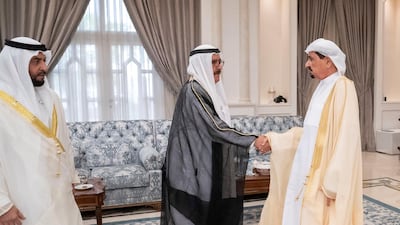
Sheikh Hamdan bin Rashid greets Sheikh Humaid bin Rashid Al Nuaimi, Ruler of Ajman, during an Eid Al Adha reception at Mushrif Palace on August 11, 2019. Eissa Al Hammadi / Ministry of Presidential Affairs -
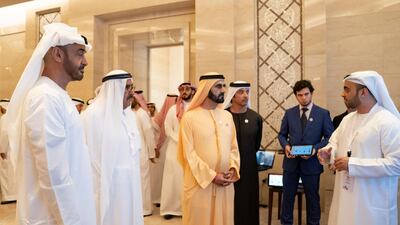
Sheikh Mohamed bin Zayed and Sheikh Mohammed bin Rashid attend the Determination Retreat, at the Presidential Palace on March 10, 2019. Also present are Sheikh Hamdan bin Rashid and Sheikh Hazza bin Zayed, Vice Chairman of the Abu Dhabi Executive Council. Ryan Carter for the Ministry of Presidential Affairs -
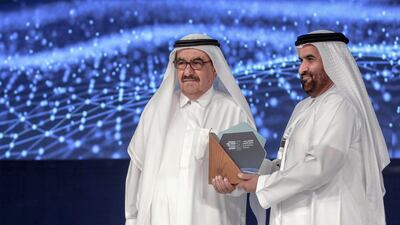
Sheikh Hamdan bin Rashid presents an award to Mohammed Ali bin Zayed Al Falasi, Deputy Governor of the UAE Central Bank, on March 11, 2019. Victor Besa / The National -
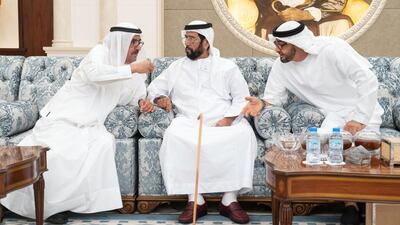
Sheikh Hamdan bin Rashid offers condolences to Sheikh Tahnoon bin Mohamed, Ruler's Representative in Al Ain Region, and Sheikh Mohamed bin Zayed on the death of Sheikh Sultan bin Zayed at Al Mushrif Palace on November 21, 2019. Rashed Al Mansoori / Ministry of Presidential Affairs -

Sheikh Hamdan bin Rashid offers condolences to Sheikh Suroor bin Mohamed on the death of Sheikh Sultan, at Al Mushrif Palace on November 21, 2019. Hamad Al Mansoori for the Ministry of Presidential Affairs -
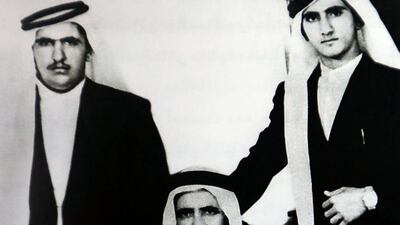
Sheikh Mohammed bin Rashid with his father, Sheikh Rashid, and brother Sheikh Hamdan Bin Rashid Al Maktoum in 1963 -

Sheikh Hamdan bin Rashid attends the Water, Energy, Technology and Environment Exhibition (WETEX) and the Dubai Solar Show 2020 virtually on October 26, 2020. Courtesy Dubai Media Office -
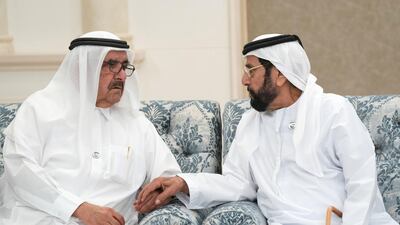
Sheikh Hamdan bin Rashid offers condolences to Sheikh Tahnoon bin Mohamed on the death of Sheikh Sultan, at Al Mushrif Palace on November 21, 2019. Hamad Al Mansoori for the Ministry of Presidential Affairs -
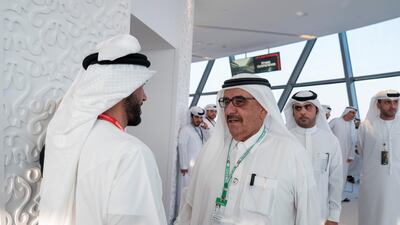
Sheikh Nahyan Bin Zayed Al Nahyan, Chairman of the Board of Trustees of Zayed bin Sultan Al Nahyan Charitable and Humanitarian Foundation and Sheikh Hamdan bin Rashid Al Maktoum, Deputy Ruler of Dubai and UAE Minister of Finance, attend the final day of the 2019 Formula 1 Etihad Airways Abu Dhabi Grand Prix, at Shams Tower. Ryan Carter for the Ministry of Presidential Affairs -
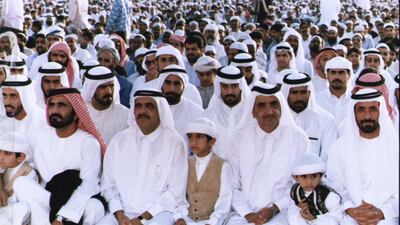
Sheikh Maktoum bin Rashid, who became Ruler of Dubai in 1958, Sheikh Hamdan Bin Rashid and Sheikh Mohammed bin Rashid, then Crown Prince of Dubai, attend Eid al Fitr prayers. -
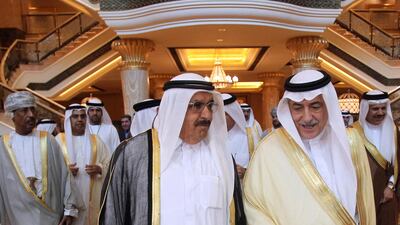
Saudi Finance Minister Ibrahim Al Assaf is greeted by Sheikh Hamdan bin Rashid after arriving in Abu Dhabi to attend a GCC finance ministers' meeting on May 7, 2011. AFP -
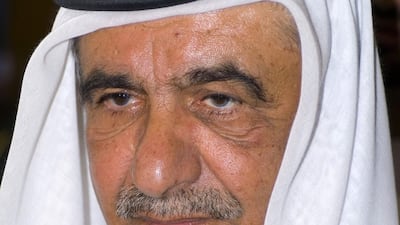
Sheikh Hamdan bin Rashid opens the 27th edition of Gitex in Dubai on September 8, 2007. Bloomberg -
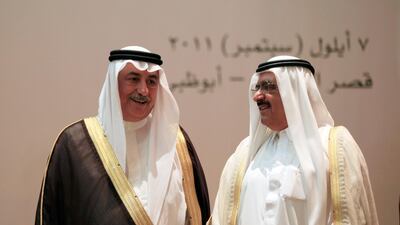
Sheikh Hamdan bin Rashid speaks to his Saudi counterpart Ibrahim Al Assaf ahead of a GCC finance ministers' meeting in Abu Dhabi on September 7, 2011. Reuters



