
Twelve paramedics on the front line of Dubai's fight against Covid-19 have contracted the virus since the outbreak began.
During a weekly press briefing, Khalifa Aldrai, executive director of Dubai Corporation for Ambulances Services, said five of those infected had since made full recoveries and were back at work.
The remaining seven are still receiving treatment for the disease.
Mr Aldrai said the health of staff was paramount and that the company was ensuring all necessary safety measures were in place to allow paramedics to carry out their essential duties.
"Of course, we have had infections. Out of 1,200 paramedics, 12 have tested positive for the virus. Five have recovered and are back at work," he said.
Mr Aldrai said it was common globally for paramedics to catch the virus with thousands of medical staff having contracted the disease since the country's outbreak.
"This is very normal. Whenever [the paramedics] help patients, they are taking a risk to support them."
Preventive measures are in place to protect staff, however, including wearing personal protective equipment (PPE) and extensive disinfection of vehicles and equipment.
"Our staff do whatever is necessary to support patients. We are all one team."
He said thermal screening equipment was in place in the living quarters of emergency workers as well as self sanitisation walk ways.
During the briefing, Omar Bushahab, head of Dubai Food Security Committee, said the emirate has sufficient essential food stocks to last for more than a year.
He said there is 13 months worth of wheat and stocks of rice to last a further eight months.
Mr Bushahab said a comprehensive food database had been built and is constantly updated to monitor stocks. Should availability of an item begin to drop, new orders are made as quickly as possible to avoid running out.
He said the shortages being felt on a global scale were being mitigated in Dubai, which has always had "strong logistical infrastructure."
"Last week, we had challenges with livestock so we responded by opening three new channels for imports," he said.
The government has encouraged suppliers and retailers to offer online shopping and delivery by offering free trade permits and allocating 58 warehouses, where they can store their products for free.
Mr Bushahab said Dubai had imported 2.4m tonnes of food over the past three months alone and that factories in the emirate were working hard to manufacture food products.
"We have a high level of stock and we are not concerned about supplying enough food for society.
"There is no reason for concern, he said."
Asked about volunteers, during the briefing, Mr Aldrai said final-year medical students had been helping the ambulance service stem the spread of the virus.
He said the emergency service is able to call on strong resources to face the current challenges head-on.
"We have a fleet of 280 ambulance vehicles. We have 130 operating at any one time around the clock."
The ambulance chief spoke of how advances in technology have been deployed to combat an unprecedented threat.
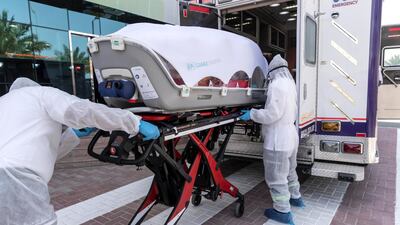
Dubai's paramedics have begun transporting Covid-19 patients in special pressure tubes to cut the risk of spreading the virus.
People with a severe case of Covid-19, of which Mr Aldrai said there had not been many, are placed in a negative pressure capsule – called an Epi-Shuttle – before being wheeled into an emergency vehicle.
Its use ensures that ambulances do not have to be disinfected after each patient has been transported, saving precious time and allowing vehicles to remain in use more frequently.
"The idea of this capsule is that it helps to protect paramedics from the virus. We know it has been used in 17 European countries and has been a success.
"We had never thought we would be using such a structure. It has been a positive experience for us."
Mr Aldrai reiterated that the majority of cases ambulance staff have come into contact with have been relatively mild and most have not required critical care.
He said the emergency teams cover all areas of the emirate and there has not been a concentration of cases in a particular district.
Mr Aldrai also revealed that two ambulances were to be converted into mobile screening and testing centres to treat vulnerable patients, such as those the elderly, people with disabilities and pregnant women, without them needing to attend a medical facility.
-

Customers wearing protective masks as they shop at the vegetables market for the upcoming Ramadan in Dubai. EPA -

AIDA prima, the flagship of AIDA Cruises docks at Port Rashid in Dubai. AFP -

Customers wearing protective masks as they shop at the vegetables market for the upcoming Ramadan in Dubai. EPA -

Kitchen staff wear protective masks, following the outbreak of the coronavirus disease in Baghdad, Iraq. Reuters -

A woman on the left holds a paper reading "When will you have it enough from stealing" as civil servants in a protest demanding the payment of overdue wages, following the outbreak of the coronavirus disease in Sulaimaniya, Iraq. Reuters -

A woman walks through a part of the mostly empty Qazvin old traditional bazaar some 93 miles northwest of the capital Tehran, Iran. AP -

Workers disinfect the Wavel camp (also known as the Jalil Camp) for Palestinian refugees in Lebanon's eastern Bekaa Valley, after the UN announced the first confirmed case of coronavirus there. AFP -

Workers disinfect the Wavel camp (also known as the Jalil Camp) for Palestinian refugees in Lebanon's eastern Bekaa Valley, after the UN announced the first confirmed case of coronavirus there. AFP -

Anti-government protesters stand on the top of their cars and wave a Lebanese flag and a cardboard fist labelled "Revolution", as they protest by driving through the streets to express rejection of the political leadership they blame for the economic and financial crisis, in Beirut, Lebanon. AP Photo -

A worker cleans and sterilises the Kaaba in the holy city of Makkah, Saudi Arabia. Reuters -

Local residents, in their flat due to the coronavirus, watch celebrations ahead of the National Sovereignty and Children's Day, in Istanbul. AP -

A customer wearing a face mask walks near seats at an outdoor market set up by the Algerian government to prevent crowding inside supermarkets, in Algiers, Algeria. Reuters -

The daughters of Palestinian Karate coach Khaled Sheikh el Eid (not pictured) train together on the rooftop of their family house at a refugee camp in Rafah, in the southern Gaza Strip. EPA


The UAE recorded 518 new cases of Covid-19 on Thursday and confirmed four more deaths of patients who had contracted the virus.
The Emirates has recorded 8,756 coronavirus cases since the start of the outbreak.
Fifty-six people have died in the country after contracting the virus, while 1,637 patients have made full recoveries.

