



Pakistan held a ceremony in Karachi to mark the arrival of ships from the UAE carrying 200 containers of food and medical supplies.
The humanitarian aid will support 500,000 Pakistani families affected by record-breaking floods that wreaked havoc across the country.
Speaking at the event, Hamad Al Zaabi, the UAE's ambassador to Pakistan, said the Emirates was among the first countries to send humanitarian aid to Pakistan and that it had set up an air bridge comprising 62 planes, news agency Wam said.
He said providing international humanitarian aid is a key pillar of the country’s foreign policy.
Mr Al Zaabi said UAE field teams have reached thousands of families in 17 flood-hit areas in Sindh Province and 10 areas in Balochistan through Emirates Red Crescent, the Khalifa bin Zayed Al Nahyan Foundation, the Mohammed bin Rashid Al Maktoum Humanitarian and Charity Establishment, and Sharjah Charity International.
-

People affected by floods queue to receive food distributed by the Red Crescent Society in Larkana, Pakistan. EPA -

Al Mahmood Social Welfare Association workers prepare food aid in Larkana, Pakistan. EPA -
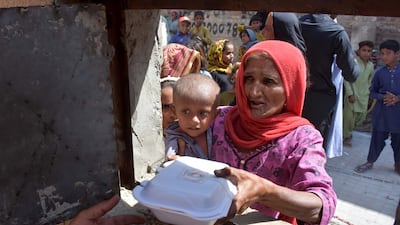
More than 33 million people have been affected by floods since June 2022, Pakistan's Climate Change Minister Sherry Rehman says. EPA -

A Pakistan Red Crescent Society worker sorts food parcels to be distributed to people affected by floods in Larkana. EPA -
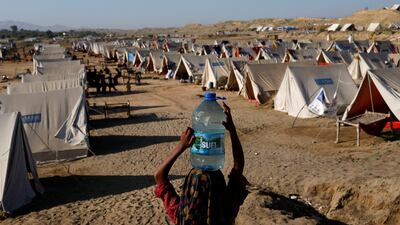
A girl carries a bottle filled with floodwater at a camp for displaced people in Sehwan, Pakistan. Reuters -
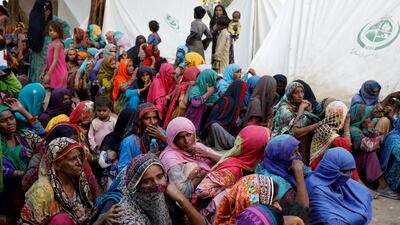
Women affected by the floods wait for food aid at a camp for displaced people in Sehwan. Reuters -
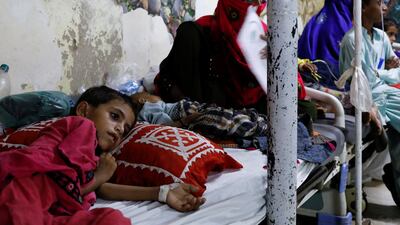
Flood-affected children suffering from malaria receive treatment at the Sayed Abdullah Shah Institute of Medical Sciences in Sehwan. Reuters -
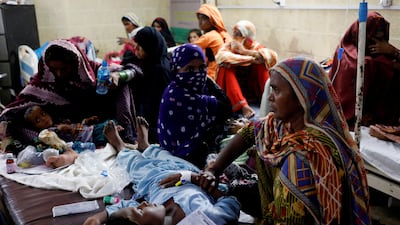
Women wait with their sick children at the medical institute in Sehwan. Reuters -
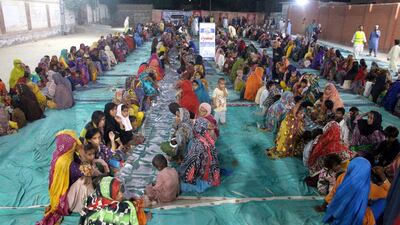
Flood-affected people eat food distributed by Al Mahmood Social Welfare Association in Larkana. EPA


He visited several areas affected by the floods in Sindh province, where he helped distribute aid that included medicine, food and shelter materials.
“The aid provided by the UAE to Sindh and Balochistan provinces are part of its urgent relief efforts, underscoring the country’s approach to supporting affected communities around the world through relief and humanitarian programmes,” Mr Al Zaabi said.
Bilawal Bhutto Zardari, Pakistan's foreign minister, thanked the UAE for its support and spoke of the historic relationship between the two countries that were established by UAE Founding Father, the late Sheikh Zayed bin Sultan Al Nahyan.
Torrential monsoon rains this year triggered the most severe flooding in Pakistan’s recent history, ultimately affecting nearly one third of the country.
The floods — worsened by climate change — washed away villages, killing about 1,730 people in the immediate flooding, injuring 12,900 and displacing 33 million.
In Sindh alone, the floods affected 12 million people and killed 796.
The UN children's agency estimated that the devastation also left 10 million children in need of immediate support, citing increased risk of waterborne diseases, drowning and malnutrition.
Pakistan has asked the international community to scale up aid for flood survivors, now threatened by the coming winter.
The UN issued an appeal for more than $800 million to help families affected by an emerging public health emergency due to damage to healthcare facilities.

