

Suhail Al Mazrouei, Minister of Energy and Infrastructure, has said the growth of bilateral relations between the UAE and China is a global model to follow.
He said the strategic ties between the two countries had been upgraded to a comprehensive partnership thanks to their significant development prospects.
In a recorded message to the 13th International Infrastructure Investment and Construction Forum, held this year in Macao, Mr Al Mazrouei said UAE-China relations had advanced significantly in recent years.
The countries have shared an applied sustainable development approach and policies that have enabled them to be international leaders in many areas, including in energy, infrastructure, housing and transport.
The UAE was among the first countries to join the Belt and Road Initiative and is one of the founding members of the Asian Infrastructure Investment Bank, while China is a major partner of the UAE, Mr Al Mazrouei added. He said there were more than 650 Emirati investment projects in China.
As a result of the Belt and Road Initiative, the UAE is now the largest logistics hub for China in the Middle East, and more than 60 per cent of China's trade in the region now transits through the UAE.
Mr Al Mazrouei said co-operation with Chinese companies was continuing, with more than 4,000 operating in the UAE. They employ 400,000 people, making them a key contributor to the UAE’s sustainable development.
Despite the challenges caused by the Covid-19 pandemic and recent geopolitical turbulence, the UAE’s construction sector is growing, Mr Al Mazrouei said.
“We are aware that investing in sustainable infrastructure is the way to achieve sustainable growth and development during the post-pandemic era,” he added.
“Under this framework, the UAE government recently adopted a federal law covering the partnership between the public and private sectors, to increase investment in sustainable infrastructure.”
The UAE has previously issued several laws aimed at attracting foreign investments, including a law that allows foreigners to fully own projects in the country.
Mr Al Mazrouei said the UAE encourages joint investments with China in every sector, most notably in the digital economy, the green economy and the circular economy.
The UAE is China’s biggest trading partner in the Arab region. In 2021, China also ranked first as the UAE's biggest trading partner, accounting for 11.7 per cent of its total foreign trade.
China remained the UAE's top trading partner during the first quarter of 2022, with bilateral trade between the two countries at Dh57 billion. The trade value is on track to expand to $200bn (Dh734.62bn) by 2030.
China to help UAE land future rover on Moon's surface: in pictures
-
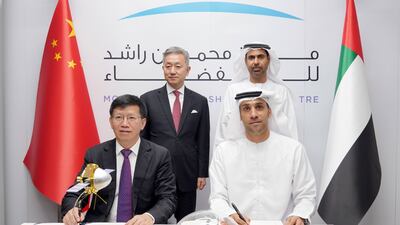
China will help the UAE to land one of its rovers on the Moon’s surface, under an agreement signed between the Mohammed bin Rashid Space Centre and the China National Space Administration on Friday. All photos: MBRSC -

This is the first time the two countries will collaborate in space. China is running a successful lunar exploration programme. It first landed on the Moon in 2013 with its Chang'e-3 spacecraft. -
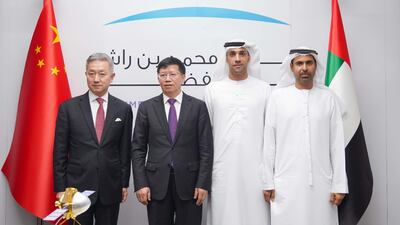
The partnership is aimed at giving the UAE easier access to the Moon, without having to build its own lander. In November, the Emirates plans to launch its first Moon mission, which involves a 10-kilogram rover, called Rashid. A Japanese lander – Hakuto-R Mission 1 – will be carrying the rover to the lunar surface. -
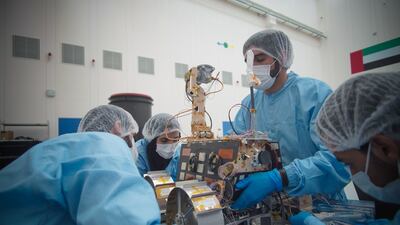
Emirati engineers carry the Rashid rover at the Mohammed bin Rashid Space Centre.



