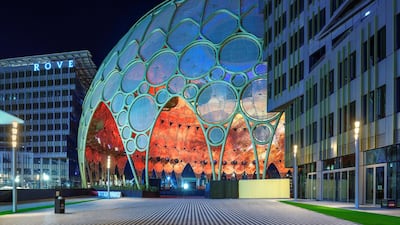
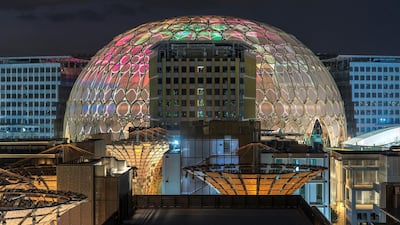
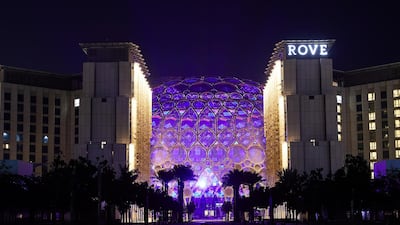
Expo 2020 Dubai prices were unveiled on Thursday, with single entry to cost Dh95 ($26) and a six-month pass Dh495.
At an event on Thursday, officials unveiled the pricing structure for the event, which will run from October 1 to March 31, 2022.
Organisers predicted that residents and visitors would take advantage of repeat visits to the site, which will be the centre of live events, music and entertainment for much of the next half year.
We are grateful for the opportunity to safely and purposefully come together in one place
Reem Al Hashimy,
director general Expo 2020 Dubai
Under-18s and people with disabilities are free to enter at any time, while the main carer or person accompanying them will be granted a 50 per cent discount.
Visitors aged 60 and over, students with a valid identity card from any academic institution in the world can also get in free.
A multi-entry month-long pass is also available for Dh195.
Tickets will go on sale online from 18 July at expo2020dubai.com. They will also be available through more than 2,500 authorised ticket resellers, including online travel agents, tour operators, hotel groups and airlines from 100-plus markets around the world.
An Expo official said a maximum of 120,000 people per day will be allowed on site. This is because of Covid-19 safety regulations, but it could change as the opening day approaches.
Reem Al Hashimy, director general of Expo 2020 Dubai, has previously said visitors will not be required to have had a coronavirus vaccine, but strongly urged people to do so.
With 91 days to go, she said the world was looking for “something to lift us up, to reassure us and to inspire us once more”.
She reiterated that organisers were confident of attracting 25 million visits over the six months, including domestic and international visitors.
Expo made an “uncompromising commitment” to welcoming visitors safely, as the pandemic rumbles on.
“In the wake of the pandemic – during which we have suffered so much as individuals, families, communities, industries and economies – we are grateful for the opportunity to safely and purposefully come together in one place," said Ms Al Hashimy, who is also Minister of State for International Co-operation.
For people unable to visit the World Fair, she said celebrations and content would be widely shared online.
“As parts of the world brace themselves against the ongoing impact of Covid-19, while others re-emerge slowly, sensibly yet with increasing confidence, our Expo 2020 is a distinct opportunity to signal, to capture and to showcase our solidarity.”
Robust safety measures planned
Medical staff will act quickly to isolate any visitor with high fever, with Covid-19 testing units in place on the site and thermal cameras to scan people's temperature.
“We do have PCR testing on site. We also have full medical services available so should we detect somebody who has a high temperature, we would be able to isolate them very quickly, ensure the proper test and ensure the site is safe,” said Sconaid McGeachin, senior vice president of communications.
Vaccinations are not mandatory for visitor entry but recommended. All Expo staff will be vaccinated, masks must be worn across the site, sanitisation will be conducted frequently and hand sanitiser stations are located throughout the site.
Technology would also be used to reduce queuing with people given time slots for access.
The world fair - the first to be staged in the Middle East - will involve 190 countries.
Nations have worked for many months to construct striking pavilions which will celebrate their culture, identity and ingenuity.
Each country taking part in the event will have its own pavilion, making for a truly global gathering in Dubai.
The international feel will be fitting for what is geared up to the biggest world’s largest in-person event held during the coronavirus pandemic, with Japan shutting borders to overseas sports fans for the Olympics to manage a surge in Covid-19 cases.
Expo 2020 Dubai was initially set to get under way in October 2020, only to be delayed for a year due to the pandemic.
Anticipation is now building with only three months to go until Expo 2020 Dubai welcomes the world.
First hotel opens on Expo site - with rooms to cost Dh1,000
About Housecall
Date started: July 2020
Founders: Omar and Humaid Alzaabi
Based: Abu Dhabi
Sector: HealthTech
# of staff: 10
Funding to date: Self-funded
Ten tax points to be aware of in 2026
1. Domestic VAT refund amendments: request your refund within five years
If a business does not apply for the refund on time, they lose their credit.
2. E-invoicing in the UAE
Businesses should continue preparing for the implementation of e-invoicing in the UAE, with 2026 a preparation and transition period ahead of phased mandatory adoption.
3. More tax audits
Tax authorities are increasingly using data already available across multiple filings to identify audit risks.
4. More beneficial VAT and excise tax penalty regime
Tax disputes are expected to become more frequent and more structured, with clearer administrative objection and appeal processes. The UAE has adopted a new penalty regime for VAT and excise disputes, which now mirrors the penalty regime for corporate tax.
5. Greater emphasis on statutory audit
There is a greater need for the accuracy of financial statements. The International Financial Reporting Standards standards need to be strictly adhered to and, as a result, the quality of the audits will need to increase.
6. Further transfer pricing enforcement
Transfer pricing enforcement, which refers to the practice of establishing prices for internal transactions between related entities, is expected to broaden in scope. The UAE will shortly open the possibility to negotiate advance pricing agreements, or essentially rulings for transfer pricing purposes.
7. Limited time periods for audits
Recent amendments also introduce a default five-year limitation period for tax audits and assessments, subject to specific statutory exceptions. While the standard audit and assessment period is five years, this may be extended to up to 15 years in cases involving fraud or tax evasion.
8. Pillar 2 implementation
Many multinational groups will begin to feel the practical effect of the Domestic Minimum Top-Up Tax (DMTT), the UAE's implementation of the OECD’s global minimum tax under Pillar 2. While the rules apply for financial years starting on or after January 1, 2025, it is 2026 that marks the transition to an operational phase.
9. Reduced compliance obligations for imported goods and services
Businesses that apply the reverse-charge mechanism for VAT purposes in the UAE may benefit from reduced compliance obligations.
10. Substance and CbC reporting focus
Tax authorities are expected to continue strengthening the enforcement of economic substance and Country-by-Country (CbC) reporting frameworks. In the UAE, these regimes are increasingly being used as risk-assessment tools, providing tax authorities with a comprehensive view of multinational groups’ global footprints and enabling them to assess whether profits are aligned with real economic activity.
Contributed by Thomas Vanhee and Hend Rashwan, Aurifer
COMPANY%20PROFILE
%3Cp%3E%3Cstrong%3EName%3A%20%3C%2Fstrong%3EKinetic%207%3Cbr%3E%3Cstrong%3EStarted%3A%3C%2Fstrong%3E%202018%3Cbr%3E%3Cstrong%3EFounder%3A%3C%2Fstrong%3E%20Rick%20Parish%3Cbr%3E%3Cstrong%3EBased%3A%3C%2Fstrong%3E%20Abu%20Dhabi%2C%20UAE%3Cbr%3E%3Cstrong%3EIndustry%3A%3C%2Fstrong%3E%20Clean%20cooking%3Cbr%3E%3Cstrong%3EFunding%3A%3C%2Fstrong%3E%20%2410%20million%3Cbr%3E%3Cstrong%3EInvestors%3A%3C%2Fstrong%3E%20Self-funded%3C%2Fp%3E%0A
More from Neighbourhood Watch:
Citadel: Honey Bunny first episode
Directors: Raj & DK
Stars: Varun Dhawan, Samantha Ruth Prabhu, Kashvi Majmundar, Kay Kay Menon
Rating: 4/5
Killing of Qassem Suleimani
Key figures in the life of the fort
Sheikh Dhiyab bin Isa (ruled 1761-1793) Built Qasr Al Hosn as a watchtower to guard over the only freshwater well on Abu Dhabi island.
Sheikh Shakhbut bin Dhiyab (ruled 1793-1816) Expanded the tower into a small fort and transferred his ruling place of residence from Liwa Oasis to the fort on the island.
Sheikh Tahnoon bin Shakhbut (ruled 1818-1833) Expanded Qasr Al Hosn further as Abu Dhabi grew from a small village of palm huts to a town of more than 5,000 inhabitants.
Sheikh Khalifa bin Shakhbut (ruled 1833-1845) Repaired and fortified the fort.
Sheikh Saeed bin Tahnoon (ruled 1845-1855) Turned Qasr Al Hosn into a strong two-storied structure.
Sheikh Zayed bin Khalifa (ruled 1855-1909) Expanded Qasr Al Hosn further to reflect the emirate's increasing prominence.
Sheikh Shakhbut bin Sultan (ruled 1928-1966) Renovated and enlarged Qasr Al Hosn, adding a decorative arch and two new villas.
Sheikh Zayed bin Sultan (ruled 1966-2004) Moved the royal residence to Al Manhal palace and kept his diwan at Qasr Al Hosn.
Sources: Jayanti Maitra, www.adach.ae
Our legal consultant
Name: Dr Hassan Mohsen Elhais
Position: legal consultant with Al Rowaad Advocates and Legal Consultants.
Tori Amos
Native Invader
Decca
COMPANY%20PROFILE
%3Cp%3E%3Cstrong%3EName%3A%3C%2Fstrong%3E%20Floward%0D%3Cbr%3E%3Cstrong%3EBased%3A%20%3C%2Fstrong%3ERiyadh%2C%20Saudi%20Arabia%0D%3Cbr%3E%3Cstrong%3EFounders%3A%20%3C%2Fstrong%3EAbdulaziz%20Al%20Loughani%20and%20Mohamed%20Al%20Arifi%0D%3Cbr%3E%3Cstrong%3ESector%3A%20%3C%2Fstrong%3EE-commerce%0D%3Cbr%3E%3Cstrong%3ETotal%20funding%3A%20%3C%2Fstrong%3EAbout%20%24200%20million%0D%3Cbr%3E%3Cstrong%3EInvestors%3A%20%3C%2Fstrong%3EAljazira%20Capital%2C%20Rainwater%20Partners%2C%20STV%20and%20Impact46%0D%3Cbr%3E%3Cstrong%3ENumber%20of%20employees%3A%20%3C%2Fstrong%3E1%2C200%3C%2Fp%3E%0A