
The UAE's nuclear power plant has started up its second unit, just four months after commercial operations began using the first reactor.
Emirates Nuclear Energy Corporation and its operating subsidiary, Nawah Energy Company, said on Friday the second unit at Barakah had been switched on successfully.
"This highlights the significant progress being made in bringing the four units of the Barakah Plant online, in a safe and timely manner, to quickly decarbonise the UAE’s energy sector," a news release read.
Start-up is the first time the unit produces heat through nuclear fission. The heat is used to create steam, turning a turbine to generate electricity.
Barakah is the region’s first operational multi-unit nuclear plant.
Its power generation will significantly reduce the country's use of gas-fired power stations to generate electricity.
Once fully up and running, the four reactors will meet about 25 per cent of the country's energy needs.
"We have reached another major milestone in the delivery of the UAE's peaceful nuclear energy programme today, as part of our journey to power the UAE with clean, abundant 24/7 electricity," said Mohamed Al Hammadi, chief executive of Enec.
"The Barakah plant supports the sustainable growth and prosperity of the nation.
"With the start-up of Unit 2, we are now almost halfway to achieving our goal of supplying up to a quarter of our nation’s electricity needs and enabling sustainable growth and, in parallel, achieving UAE climate change targets."
-
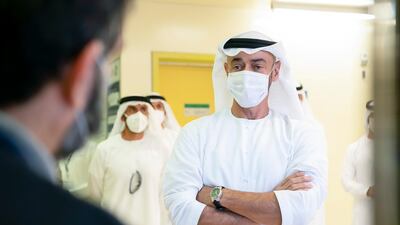
Sheikh Mohamed bin Zayed, Crown Prince of Abu Dhabi and Deputy Supreme Commander of the Armed Forces, inspects the Barakah Nuclear Energy Plant in June, 2020. Mohamed Al Hammadi / Ministry of Presidential Affairs -
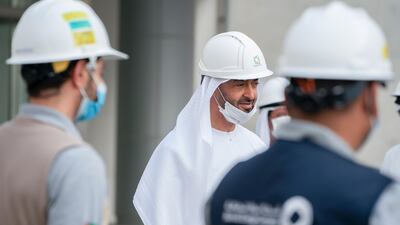
Sheikh Mohamed toured the site and met the staff. Mohamed Al Hammadi / Ministry of Presidential Affairs -
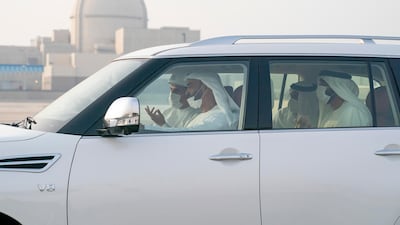
Sheikh Mohamed also visited the grounds of the plant in Al Dhafra. Mohamed Al Hammadi / Ministry of Presidential Affairs -

Sheikh Mohamed signs a helmet of an Emirates Nuclear Energy Corporation staff member, during the visit. Mohamed Al Hammadi, chief executive of Emirates Nuclear Energy Corporation, at centre. Mohamed Al Hammadi / Ministry of Presidential Affairs -
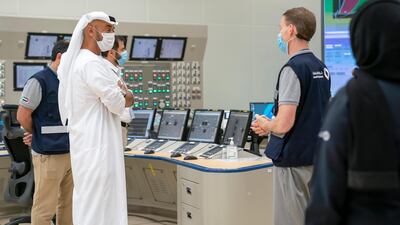
Unit 1 of the plant is now fully operational just a few months after Sheikh Mohamed's visit. Mohamed Al Hammadi / Ministry of Presidential Affairs -
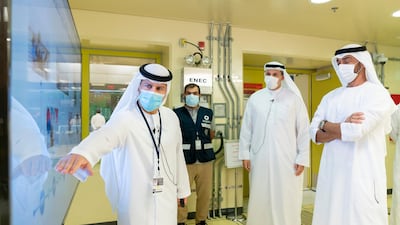
Sheikh Mohamed views a presentation by Mohamed Al Hammadi, chief executive of Emirates Nuclear Energy Corporation. Mohamed Al Hammadi / Ministry of Presidential Affairs -
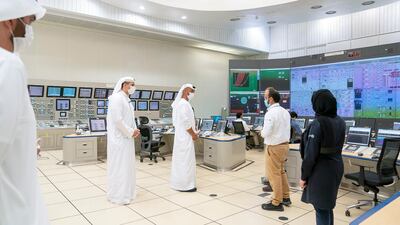
Sheikh Mohamed on the tour. When all four units are operating, the plant will supply 25 per cent of the UAE's electricity needs. Mohamed Al Hammadi / Ministry of Presidential Affairs
Jigra
Jetour T1 specs
Engine: 2-litre turbocharged
Power: 254hp
Torque: 390Nm
Price: From Dh126,000
Available: Now
Mohammed bin Zayed Majlis
Ten tax points to be aware of in 2026
1. Domestic VAT refund amendments: request your refund within five years
If a business does not apply for the refund on time, they lose their credit.
2. E-invoicing in the UAE
Businesses should continue preparing for the implementation of e-invoicing in the UAE, with 2026 a preparation and transition period ahead of phased mandatory adoption.
3. More tax audits
Tax authorities are increasingly using data already available across multiple filings to identify audit risks.
4. More beneficial VAT and excise tax penalty regime
Tax disputes are expected to become more frequent and more structured, with clearer administrative objection and appeal processes. The UAE has adopted a new penalty regime for VAT and excise disputes, which now mirrors the penalty regime for corporate tax.
5. Greater emphasis on statutory audit
There is a greater need for the accuracy of financial statements. The International Financial Reporting Standards standards need to be strictly adhered to and, as a result, the quality of the audits will need to increase.
6. Further transfer pricing enforcement
Transfer pricing enforcement, which refers to the practice of establishing prices for internal transactions between related entities, is expected to broaden in scope. The UAE will shortly open the possibility to negotiate advance pricing agreements, or essentially rulings for transfer pricing purposes.
7. Limited time periods for audits
Recent amendments also introduce a default five-year limitation period for tax audits and assessments, subject to specific statutory exceptions. While the standard audit and assessment period is five years, this may be extended to up to 15 years in cases involving fraud or tax evasion.
8. Pillar 2 implementation
Many multinational groups will begin to feel the practical effect of the Domestic Minimum Top-Up Tax (DMTT), the UAE's implementation of the OECD’s global minimum tax under Pillar 2. While the rules apply for financial years starting on or after January 1, 2025, it is 2026 that marks the transition to an operational phase.
9. Reduced compliance obligations for imported goods and services
Businesses that apply the reverse-charge mechanism for VAT purposes in the UAE may benefit from reduced compliance obligations.
10. Substance and CbC reporting focus
Tax authorities are expected to continue strengthening the enforcement of economic substance and Country-by-Country (CbC) reporting frameworks. In the UAE, these regimes are increasingly being used as risk-assessment tools, providing tax authorities with a comprehensive view of multinational groups’ global footprints and enabling them to assess whether profits are aligned with real economic activity.
Contributed by Thomas Vanhee and Hend Rashwan, Aurifer
More from this package
More from Rashmee Roshan Lall
AUSTRALIA SQUAD
Aaron Finch, Matt Renshaw, Brendan Doggett, Michael Neser, Usman Khawaja, Shaun Marsh, Mitchell Marsh, Tim Paine (captain), Travis Head, Marnus Labuschagne, Nathan Lyon, Jon Holland, Ashton Agar, Mitchell Starc, Peter Siddle
How to help
Send “thenational” to the following numbers or call the hotline on: 0502955999
2289 – Dh10
2252 – Dh 50
6025 – Dh20
6027 – Dh 100
6026 – Dh 200
The Settlers
Director: Louis Theroux
Starring: Daniella Weiss, Ari Abramowitz
Rating: 5/5
Company%C2%A0profile
What is a robo-adviser?
Robo-advisers use an online sign-up process to gauge an investor’s risk tolerance by feeding information such as their age, income, saving goals and investment history into an algorithm, which then assigns them an investment portfolio, ranging from more conservative to higher risk ones.
These portfolios are made up of exchange traded funds (ETFs) with exposure to indices such as US and global equities, fixed-income products like bonds, though exposure to real estate, commodity ETFs or gold is also possible.
Investing in ETFs allows robo-advisers to offer fees far lower than traditional investments, such as actively managed mutual funds bought through a bank or broker. Investors can buy ETFs directly via a brokerage, but with robo-advisers they benefit from investment portfolios matched to their risk tolerance as well as being user friendly.
Many robo-advisers charge what are called wrap fees, meaning there are no additional fees such as subscription or withdrawal fees, success fees or fees for rebalancing.
Ticket prices
General admission Dh295 (under-three free)
Buy a four-person Family & Friends ticket and pay for only three tickets, so the fourth family member is free
Buy tickets at: wbworldabudhabi.com/en/tickets
Notable Yas events in 2017/18
October 13-14 KartZone (complimentary trials)
December 14-16 The Gulf 12 Hours Endurance race
March 5 Yas Marina Circuit Karting Enduro event
March 8-9 UAE Rotax Max Challenge
COMPANY%20PROFILE%20
Six large-scale objects on show
- Concrete wall and windows from the now demolished Robin Hood Gardens housing estate in Poplar
- The 17th Century Agra Colonnade, from the bathhouse of the fort of Agra in India
- A stagecloth for The Ballet Russes that is 10m high – the largest Picasso in the world
- Frank Lloyd Wright’s 1930s Kaufmann Office
- A full-scale Frankfurt Kitchen designed by Margarete Schütte-Lihotzky, which transformed kitchen design in the 20th century
- Torrijos Palace dome
The%20trailblazers
The team
Videographer: Jear Velasquez
Photography: Romeo Perez
Fashion director: Sarah Maisey
Make-up: Gulum Erzincan at Art Factory
Models: Meti and Clinton at MMG
Video assistant: Zanong Maget
Social media: Fatima Al Mahmoud
Who's who in Yemen conflict
Houthis: Iran-backed rebels who occupy Sanaa and run unrecognised government
Yemeni government: Exiled government in Aden led by eight-member Presidential Leadership Council
Southern Transitional Council: Faction in Yemeni government that seeks autonomy for the south
Habrish 'rebels': Tribal-backed forces feuding with STC over control of oil in government territory
'How To Build A Boat'
Jonathan Gornall, Simon & Schuster


