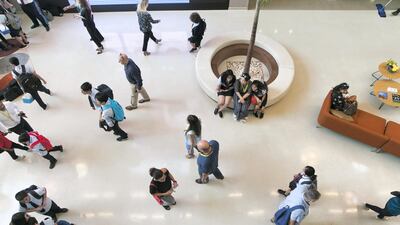
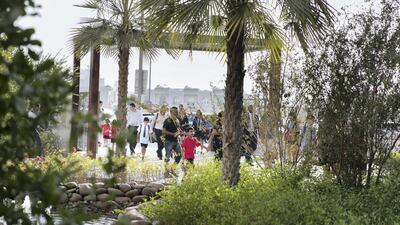
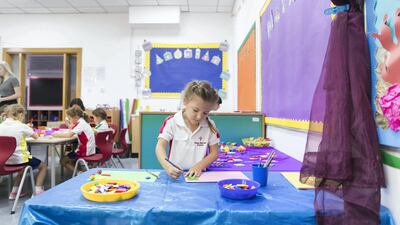
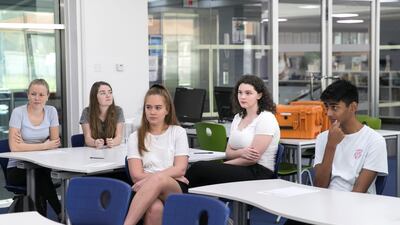
The Knowledge and Human Development Authority, Dubai's private education regulators, has released its new landscape report. Victor Besa / The National

Thirty new private schools open in Dubai despite Covid-19


Anam Rizvi
  • English
  • Arabic

A new report on education in Dubai found that 30 new private schools opened in the emirate between the academic years 2017-2018 and 2019-2020, with pupil numbers increasing by 14 per cent at new schools in the past academic year.

Dubai's private school population has declined by nearly 16,000 since the previous academic year as the education sector grapples with the unique circumstances presented by the Covid-19 pandemic.

New figures released by the Knowledge and Human Development Authority, Dubai's private schools regulator, showed 279,191 pupils were enrolled in the emirate as of November 1.

Despite setbacks, the emirate's school sector has not only proven its ability to bounce back from challenges but also recovered stronger and better.

This is down from the 295,148 learners attending private schools at the start of the 2019-2020 academic year.

The number of pupils at the emirate’s private schools had climbed consistently from 193,323 in 2010 to last year's high, according to KHDA statistics.

The KHDA's Private Schools Landscape report revealed six new schools had opened this year alone, with four either closing or merging, increasing the emirate's number of schools to 210.

Dr Abdulla Al Karam, director general of KHDA, said 2020 had been a challenging year he but was hopeful for the future as schools displayed their resilience.

“Dubai’s school sector faced unprecedented circumstances this year," he said.

“Despite setbacks, the emirate’s school sector has not only proven its ability to bounce back from challenges but also recovered stronger and better.

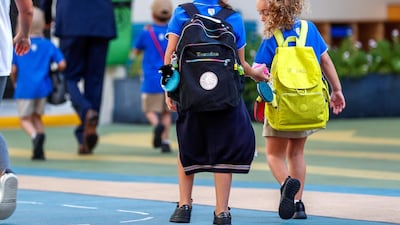
  • Pupils heading to school for the first day after the summer break at the Pearl Academy School on Muroor Road. Abu Dhabi. Victor Besa / The National
    Pupils heading to school for the first day after the summer break at the Pearl Academy School on Muroor Road. Abu Dhabi. Victor Besa / The National
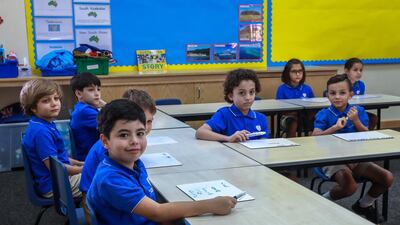
  • Youngsters start their day at the Pearl Academy School on Muroor Road, Abu Dhabi. Victor Besa / The National
    Youngsters start their day at the Pearl Academy School on Muroor Road, Abu Dhabi. Victor Besa / The National
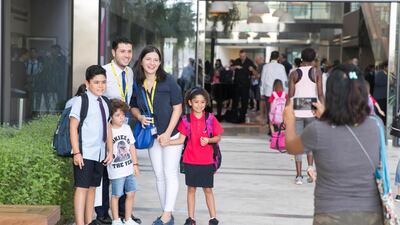
  • A mum and her two daughters pose for a photo at the Pearl Academy School. Victor Besa / The National
    A mum and her two daughters pose for a photo at the Pearl Academy School. Victor Besa / The National
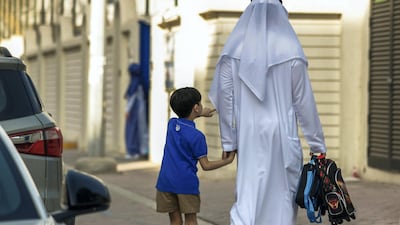
  • A father walks his son to the Pearl Academy School. Victor Besa / The National
    A father walks his son to the Pearl Academy School. Victor Besa / The National
  • Pupils at GEMS Dubai American Academy arrive after the summer break. Reem Mohammed / The National
    Pupils at GEMS Dubai American Academy arrive after the summer break. Reem Mohammed / The National
  • Youngsters make their way to classes at GEMS Dubai American Academy. Reem Mohammed / The National
    Youngsters make their way to classes at GEMS Dubai American Academy. Reem Mohammed / The National
  • Parents and pupils approach the entrance of the GEMS Dubai American Academy. Reem Mohammed / The National
    Parents and pupils approach the entrance of the GEMS Dubai American Academy. Reem Mohammed / The National
  • A pianist plays in the foyer as young students wander into the GEMS Dubai American Academy. Reem Mohammed / The National
    A pianist plays in the foyer as young students wander into the GEMS Dubai American Academy. Reem Mohammed / The National
  • Pupils say goodbye to their parents at the GEMS Dubai American Academy. Reem Mohammed / The National
    Pupils say goodbye to their parents at the GEMS Dubai American Academy. Reem Mohammed / The National
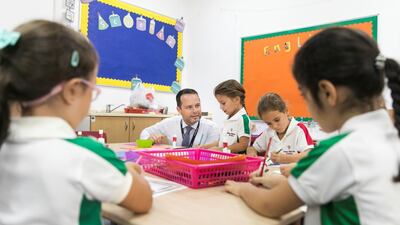
  • Brendan Fulton, principal at Dubai British School, interacts with students on their first day back. Reem Mohammed / The National
    Brendan Fulton, principal at Dubai British School, interacts with students on their first day back. Reem Mohammed / The National
  • Pupils begin the day at Dubai British School. Reem Mohammed / The National
    Pupils begin the day at Dubai British School. Reem Mohammed / The National
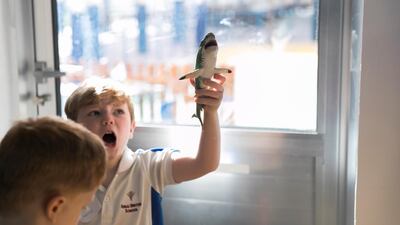
  • Youngsters take part in activities at Dubai British School. Reem Mohammed/The National
    Youngsters take part in activities at Dubai British School. Reem Mohammed/The National
  • Evie Fleming, second from right, takes part in a team-building class on the first day of school at Dubai British School. Reem Mohammed / The National
    Evie Fleming, second from right, takes part in a team-building class on the first day of school at Dubai British School. Reem Mohammed / The National

“New schools continue to open in Dubai, new families continue to move to Dubai, and our educational community continues to deliver high-quality education.”

Schools around the world have been affected by the Covid-19 pandemic.

Data from the UN shows that the pandemic affected nearly 1.6 billion learners in more than 190 countries, while the closure of educational institutions affected 94 per cent of the world’s pupil population.

The Organisation for Economic Co-operation and Development, which is comprised of 37 developed nations, found up to 60 full school days were lost between the outbreak in February and mid-May.

Dr Saif Al Dhaheri, spokesman for the National Emergency Crisis and Disaster Management Authority, said this week that the education sector was one of a number of fields to be affected by the rise of coronavirus.

But, he said, the UAE was planning for its recovery from the Covid-19 outbreak as it staged a gradual return to normality.

The KHDA landscape report, previously an annual publication, will be updated and released three times during the current academic year with reports due in late 2020 and spring of 2021.

At Dubai’s private schools, overall enrolment dropped 1.7 per cent compared with the previous academic year.

According to the KHDA study, Dubai continued to attract new investors into its school sector.

The average tuition fees at private schools in the emirate are Dh30,000, with 50 per cent of private school pupils charged less than Dh20,000 a year.

The report found 53 per cent of pupils in the emirate are undertaking blended learning, a mix of online classes and face-to-face lessons.

The remaining 47 per cent continued to study through full-time distance learning.

The landscape report showed that 88 per cent of schools followed Covid-19 rules.

In September and October, the KHDA team made 1,148 visits to schools.

At present, 20,445 teachers work in the emirate.

“We’re grateful to the teachers and school leaders who have been so devoted to their students and their work; to the parents who have placed their trust in Dubai and our schools; and to the pupils who have shown such courage and optimism throughout this period,” Dr Al Karam said.

“Our community will continue to work together in the weeks and months ahead to build a more resilient, future-focused private school sector.”


Ten tax points to be aware of in 2026

1. Domestic VAT refund amendments: request your refund within five years

If a business does not apply for the refund on time, they lose their credit.

2. E-invoicing in the UAE

Businesses should continue preparing for the implementation of e-invoicing in the UAE, with 2026 a preparation and transition period ahead of phased mandatory adoption. 

3. More tax audits

Tax authorities are increasingly using data already available across multiple filings to identify audit risks. 

4. More beneficial VAT and excise tax penalty regime

Tax disputes are expected to become more frequent and more structured, with clearer administrative objection and appeal processes. The UAE has adopted a new penalty regime for VAT and excise disputes, which now mirrors the penalty regime for corporate tax.

5. Greater emphasis on statutory audit

There is a greater need for the accuracy of financial statements. The International Financial Reporting Standards standards need to be strictly adhered to and, as a result, the quality of the audits will need to increase.

6. Further transfer pricing enforcement

Transfer pricing enforcement, which refers to the practice of establishing prices for internal transactions between related entities, is expected to broaden in scope. The UAE will shortly open the possibility to negotiate advance pricing agreements, or essentially rulings for transfer pricing purposes. 

7. Limited time periods for audits

Recent amendments also introduce a default five-year limitation period for tax audits and assessments, subject to specific statutory exceptions. While the standard audit and assessment period is five years, this may be extended to up to 15 years in cases involving fraud or tax evasion. 

8. Pillar 2 implementation 

Many multinational groups will begin to feel the practical effect of the Domestic Minimum Top-Up Tax (DMTT), the UAE's implementation of the OECD’s global minimum tax under Pillar 2. While the rules apply for financial years starting on or after January 1, 2025, it is 2026 that marks the transition to an operational phase.

9. Reduced compliance obligations for imported goods and services

Businesses that apply the reverse-charge mechanism for VAT purposes in the UAE may benefit from reduced compliance obligations. 

10. Substance and CbC reporting focus

Tax authorities are expected to continue strengthening the enforcement of economic substance and Country-by-Country (CbC) reporting frameworks. In the UAE, these regimes are increasingly being used as risk-assessment tools, providing tax authorities with a comprehensive view of multinational groups’ global footprints and enabling them to assess whether profits are aligned with real economic activity. 

Contributed by Thomas Vanhee and Hend Rashwan, Aurifer

Essentials

The flights
Etihad and Emirates fly direct from the UAE to Delhi from about Dh950 return including taxes.
The hotels
Double rooms at Tijara Fort-Palace cost from 6,670 rupees (Dh377), including breakfast.
Doubles at Fort Bishangarh cost from 29,030 rupees (Dh1,641), including breakfast. Doubles at Narendra Bhawan cost from 15,360 rupees (Dh869). Doubles at Chanoud Garh cost from 19,840 rupees (Dh1,122), full board. Doubles at Fort Begu cost from 10,000 rupees (Dh565), including breakfast.
The tours 
Amar Grover travelled with Wild Frontiers. A tailor-made, nine-day itinerary via New Delhi, with one night in Tijara and two nights in each of the remaining properties, including car/driver, costs from £1,445 (Dh6,968) per person.

RACE CARD

6.30pm: Maiden (TB) Dh82,500 (Dirt) 1,200m

7.05pm: Maiden (TB) Dh82,500 (D) 1,900m

7.40pm: Handicap (TB) Dh102,500 (D) 2,000m

8.15pm: Conditions (TB) Dh120,000 (D) 1,600m

8.50pm: Handicap (TB) Dh95,000 (D) 1,600m

9.25pm: Handicap (TB) Dh87,500 (D) 1,400m

Who's who in Yemen conflict

Houthis: Iran-backed rebels who occupy Sanaa and run unrecognised government

Yemeni government: Exiled government in Aden led by eight-member Presidential Leadership Council

Southern Transitional Council: Faction in Yemeni government that seeks autonomy for the south

Habrish 'rebels': Tribal-backed forces feuding with STC over control of oil in government territory

APPLE IPAD MINI (A17 PRO)

Display: 21cm Liquid Retina Display, 2266 x 1488, 326ppi, 500 nits

Chip: Apple A17 Pro, 6-core CPU, 5-core GPU, 16-core Neural Engine

Storage: 128/256/512GB

Main camera: 12MP wide, f/1.8, digital zoom up to 5x, Smart HDR 4

Front camera: 12MP ultra-wide, f/2.4, Smart HDR 4, full-HD @ 25/30/60fps

Biometrics: Touch ID, Face ID

Colours: Blue, purple, space grey, starlight

In the box: iPad mini, USB-C cable, 20W USB-C power adapter

Price: From Dh2,099