
Dubai's schools are preparing to welcome pupils as they are expected to return to classrooms after the summer holidays.
Schools are putting up signage to help maintain social distancing, and other precautionary checks to keep children and staff stay safe on the campus.
About 295,000 pupils will return to 209 private schools in Dubai in September, after schools closed in March to contain the spread of coronavirus.
The Knowledge and Development Authority (KHDA), the emirate's private school regulator, has asked schools in the emirate to submit their plans to accommodate pupils.
"While all the protocols will apply to all schools equally, they will have different impact on each school,” the KHDA said in a note to schools.
“Some schools will have the space and the resources to welcome all pupils back at the same time, while others may not. We understand that a one-size-fits-all solution will not be appropriate in these circumstances."
Alan Williamson, chief executive officer at Taaleem, Dubai's second largest school operator, said the group’s schools would seek KHDA's permission to open their campuses for full-time in-person classes.
"Our class sizes are not huge, with 24 to 28 pupils in every class, and we can remove some furniture to ensure a two-metre distance between pupils," said Mr Williamson.
"We will comply with the guidance and we want to open fully for all our pupils.
"Our classrooms are big enough to ensure social distancing with the correct signage and procedures in place."
Mr Williamson said Taaleem will be happy to follow the guidelines set by each emirate as they expect 90 to 95 per cent of the pupils to return to school in August.
Those who are unable to do so because of health reasons, will continue studies online.
"Some parents are waiting to see when a vaccine will be developed and there are some pupils who may have exceptional health reasons for not joining the class,” he said.
“For those pupils we will continue to provide an online learning experience including tasks, recorded and planned lessons, and access to live classes."
Officials at Taaleem have studied global best practices in Hong Kong, Singapore, the Scandinavian countries and the United Kingdom.
-
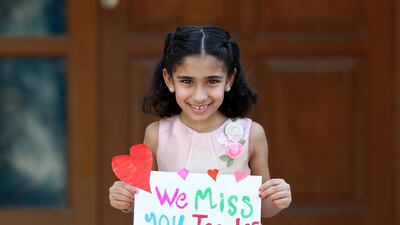
Shamma Tahlak, 8, from the UAE. Her teachers are Miss Hannah, Miss Kholoud, Miss Doa and Miss Rahaf at GEMS National School for Girls in Dubai. "We miss you, teachers. Coming soon." Chris Whiteoak / The National -

Alex Slater, 3, from Scotland. His teachers are Ms Criselle, Ms Joanne and Ms Lyka at Paddington Nursery in Dubai. "I miss my teachers. I want to do fruit sharing again and go back to the library," he said. Chris Whiteoak / The National -

Joyce and Daniel Lim, 6 and 4, from America. Their teachers are Laura Clayton and Zanaira Hussain at Repton Abu Dhabi. They said: "I miss seeing and learning from our teachers in the classroom. I hope to see all my teachers and classmates again very soon." Victor Besa / The National -

Lucy, 20 months, who is British-Australian. Her teachers are Ms Sri and Miss Lavanya at Paddington Nursery in Dubai. "Love to my teachers and classmates at Paddington," she says. Chris Whiteoak / The National -

Alex Georgi, 4, who is Egyptian, Canadian and American. His teacher is Ms Bradley at Repton Abu Dhabi. He said: "Thank you for all your help. I enjoyed my time in FS2 dolphins class and I learned so many new things. I will miss you very much next year." Victor Besa / The National -
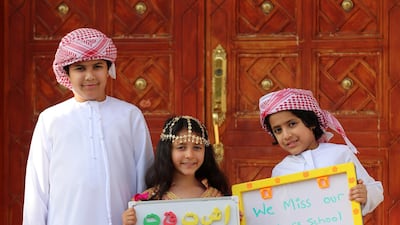
From left to right: Bader, Aisha and Zeyad, aged 8, 5 and 7, from the UAE. Their teachers are Mr Ben, Ms Basemah, Ms Katy, Ms Hanadi, Ms Riz and Ms Seera at GEMS National School for Boys and GEMS National School for Girls in Dubai. "Thanks so much." Chris Whiteoak / The National -
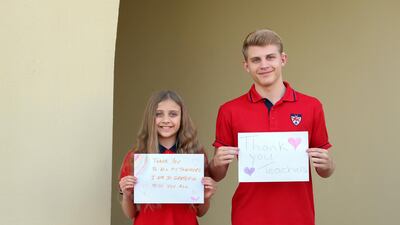
Halle and Alexander, 10 and 17, from the UK. Their teachers are Mr Makin, Mr Dacanay and Mr Turner at Dwight School in Dubai. Alexander says: "I'm profoundly deaf with a cochlear implant. I miss being in a school environment as being face to face with my peers and teachers is so important for my well-being. I am extremely lucky as my teachers are always there to assist me with whatever I need. But it doesn't beat being physically at school". Halle says: "I miss going to school every day and being in a classroom. I miss my teachers, my friends and hanging out and having lunch together. I am grateful for all the help the teachers have given us online, especially Mr Makin, my homeroom teacher, who makes us all smile every day." Chris Whiteoak / The National -

From left to right: Marc aged 6, Emma aged 3 and Jorge aged 9, who are all Spanish-Palestinian. Their teachers are Ms Aisling, Ms Zohra and Mr Benn at Amity School and Learning Spaces Nursery in Abu Dhabi. Emma says: "I love Ms Zohra. She is very nice and she says sharing is caring." Marc says: "I really like Ms Aisling. She's very good to me and I miss her a lot." Jorge says: "Mr Benn, you are the BEST TEACHER I've ever had. Thanks for everything." Victor Besa / The National -

Liliana Varsanyi de Zoysa, 5, from Hungary. Her teacher is Ms Sabrin Sayed at GEMS Founders School in Dubai. "Thank you for everything you do!" was her message. Chris Whiteoak / The National -

Lenay and Cayleigh Joubert, 7 and 11, from South Africa. Their teachers are Ms Shona Wills and William McKee at Dubai International Academy. They said: "Ms Shona, I miss you so much, I love you!" and "I miss you, Mr McKee". Chris Whiteoak / The National -

Sophia Caunin, 6, from the Philippines. Her teacher is Mr James Gorman at GEMS Cambridge International School in Abu Dhabi. She says: "Thank you, Mr James, for all the learnings that you have taught me during this amazing Year 2. For always helping me whenever I am struggling in my school work and making us all laugh every day. I will surely miss you when I go to Year 3 in September. I will definitely visit you in your class when everything is back to normal. Love, Sophia." Victor Besa / The National -

Ellie Gregory, 4, from England. Her teacher is Ms Anne Marie at Smart Start Kindergarten in Dubai. "I really miss my teachers and friends so much. I miss dancing and singing together in my classroom." Chris Whiteoak / The National -
Kamran and Areesa Blakey, 6 and 3, from the UK. Their teachers are Miss Corkhill and Miss Mishka at Arcadia Preparatory School and Paddington Nursery in Dubai. "We miss you and hope to see you soon". Chris Whiteoak / The National -
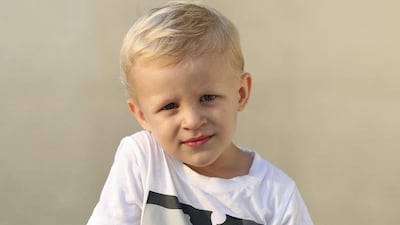
Alex, 2, from the US. His teacher is Ms Sri at Paddington Nursery in Dubai. "I'm having fun with parents at home but I'm missing so much my nursery teacher, nannies and my friends, Carl and Ayan. I'm grateful for what I have, and I am grateful for my family. Staying home and doing distant learning has made me discover deep respect for teachers. Hopefully it won't be long before we can all see each other again." Chris Whiteoak / The National -

Miguel Adrian Rey Lazatin, 4, from the Philippines. His teacher is Susan Tony at Canadian International School in Abu Dhabi. "Thank you to all my KG1-D teachers who made my first year at CIS an amazing experience. I enjoyed our daily activities, the Arabic class, the library day and playtime. I miss and cannot wait to see you all again." Victor Besa / The National -

Zayed, 8, and Maya, 5, who are German-Egyptian. Their teachers are Ms Angelica, Ms Abeer, Ms Insiya and Ms Qudisia at Emirates Private School in Abu Dhabi. Zayed said: "Dear teachers, I want to thank you all for you patient with us while e-learning. It was for all of us a new situation. I am happy to see you all next year. Stay safe." Maya said: "I miss you so much. I am waiting to see you all back. Thank you for your help, always. Miss you." Victor Besa / The National -

Toby Walker, 10, from the UK. His teacher is Rojan Hull at GEMS First Point in Dubai. "To all my teachers, thank you for all your support during distance learning. Can't wait to get back and see you and my friends." Chris Whiteoak / The National -

Arjun Vaibhav, 9, Springdales School Dubai. "I miss my school and my lovely teachers. Waiting to meet my friends and all my teachers. I love them all and thank them for all their efforts to teach us online. We do give virtual hugs to each other online when we are happy. Ms Sangeeta, Ms Shital, Ms Shamama, Ms Celine, Ms Lakshmi, Ms Manel and Ms Marwa, I love you all and miss you a 'latte'." Chris Whiteoak / The National


"Parents want to get back to work and want to send their children to school. Children are missing the totality of the curriculum be it the science labs or the dance studios," he said.
Schools will have scanners at the entrances and have signage around the school, especially water coolers or sand pits, informing pupils if they come too close to one another.
Campuses will be more controlled and physical education classes would look different as contact sports cannot be played, said Mr Williamson.
Schools have been encouraged to create teaching and learning models that meet the needs of their specific communities.
Raza Khan, chief executive officer at Al Najah Education, which operates three schools in the emirates including Horizon International School, Dubai, said: "We have detailed plans in place to ensure every child can safely come to school, every day, come September."
"We are introducing new health and safety checks, phased pick-up and drop-off and creative new ways for the children to enjoy physical education safely."
The federal government on Monday said it was working on a nationwide plan to bring pupils back to class in September.
Members of the Education Business Group, which represents 100 private schools in the UAE, have announced their readiness to welcome pupils back to schools with all the necessary safety protocols.
"Over the past months, the schools have been conducting regular sanitisation measures and once schools reopen, all safety protocols will be maintained including social distancing. Teachers and staff members will also be trained to maintain the protocols," said a spokesman of the group.

