


Dubai’s Salik road toll system is expanding, with two new gates being added in November to the eight dotted across the emirate.
Another potential change is the introduction of dynamic pricing, with higher charges being levied at peak times.
Dubai's Roads and Transport Authority (RTA) said it was considering a “flexible tariff that varies according to gate locations and congestion levels”.
It is now 17 years since Salik was introduced and, over that time, Dubai has continued to grow at a rapid pace, leading to increases in population and changes in demand on the emirate's extensive road network.
University of Plymouth in the UK
Forecasts have suggested the emirate's population could double in the coming two decades, which would put greater pressure on transport systems.
By looking to tailor Salik to improve traffic conditions, the RTA is following a path well-trodden by other transport authorities that have made changes to congestion charging systems to make them work more effectively.
Abu Dhabi introduced its own road toll system – Darb – in January 2021. It charges motorists during the peak hours of 7am to 9am and again from 5pm to 7pm.
The tolls are active from Monday to Saturday, with charges waived on Sundays and public holidays.
Successful congestion systems
Singapore's congestion charging system, which has been amended over time, is often given as an example of an initiative that works well.
In 1975, Singapore introduced its Area Licensing Scheme, in which drivers charged a fixed fee to enter a central zone at peak hours in the morning on weekdays and on Saturdays.
Among the issues that emerged were that traffic congestion was a major problem outside the area where a charge was levied.
Another perceived weakness was that the system imposed just a single charge on vehicles no matter how many times they entered the central zone.
Just as Dubai is considering doing, Singapore's authorities brought in a more flexible system.
Since 1998, the city state's Electronic Road Pricing (ERP) system has meant that, as the government puts it, “toll charges are levied on vehicles according to time and congestion levels”.
This encourages drivers to change their route or time or travel to avoid busier roads, or to use public transport.
Economic benefits
Tony May, emeritus professor of transport engineering at the University of Leeds in the UK, said variable pricing of the kind that Singapore had, and that Dubai is set to introduce, “does make a lot of sense”.
The highest fee may be charged during the peak period and a lower fee during the “shoulder” period on either side of the peak.
“One thing you will do if you charge just in the peak is getting people to switch to before and after [the peak],” Prof May said.
“Having some peak and shoulder charge is useful and you can do that on a fixed basis, or what Singapore and Stockholm do, is to have the charge variable based on the known level of traffic.”

Singapore’s traffic management policies have been credited with cutting congestion, which has economic benefits, lowers carbon emissions and reduces pollution.
A study in Transport Reviews last year highlighted the way that congestion is associated with “psychophysiological stress”, so freer-flowing traffic is likely to improve mental health or well-being, especially among professional drivers.
The margins between free-flowing and gridlocked can be quite fine, with a road that experiences about 2,000 vehicles an hour likely to be able to cope, while one that has 2,200 passing through will usually be gridlocked.
Singapore’s system continues to evolve and could lead to the introduction of distance-based pricing, where drivers are charged for how far they travel.
Some transport analysts have said that price-per-mile charging works better than zone charging, although its introduction in some countries would be up against considerable political opposition.
Unpopular with motorists
Congestion charges of any kind is often unpopular with some motorists.
Research published in 2022 indicated that hostility had reduced the number of cities in which it had been introduced.
Another notable congestion charge was implemented in London in 2003, which introduced a levy for entering the city's central zone during the daytime from Monday to Friday.
It was effective at improving traffic flows in the years after it was introduced, with reports indicating that traffic volumes in 2006 were down 15 per cent and congestion down by 30 per cent.

Yet there has been significant growth in the number of certain types of vehicles, such as taxis, which are exempt from the charge.
There have also been subsequent rises in congestion, leading some politicians in the city to call for more sophisticated forms of road pricing.
In a survey published last year, London commuters were found to spend 156 hours a year stuck in traffic on average each year, the highest figure among 1,000 cities looked at.
London Mayor Sadiq Khan previously called on Transport for London, the organisation responsible for London's roads, to look into charging motorists according to when, where and how far they drove, although he has also said that he would never introduce a pay-per-mile system.
“Transport for London have been talking about a variable charging system and they have never got round to it,” Prof May said.

Following the lead of Singapore, London and many other cities, Manhattan in New York is set to introduce a congestion charge in May following many years of discussions.
Congestion charges and similar programmes typically have been found to work most effectively when combined with measures to improve public transport and to promote walking and cycling.
London, for example, significantly increased capacity on its buses when it brought in its congestion charge.
Prof Jon Shaw, of Plymouth University in the UK and the co-editor of a book called Transport Matters, highlighted that Nice, a city in France, is making significant improvements to its transport infrastructure, albeit without a congestion charge.
“Nice has gone from having no trams and being quite congested and relying on buses to having three tram lines. It’s got more on the way,” Prof Shaw said.
“It’s given over a lot of road space to cycling. It’s had a real transformation in its public transportation.”
He said Freiburg in Germany was further along in encouraging the use of public transport, although the city has the advantage – unlike, for example, Dubai or Los Angeles – of being compact.
“It’s [got] trams, it’s bike friendly, pedestrian friendly. It’s also compact,” he said.
“It’s more difficult for public transport or cycling to play a really significant role in moving people around the less dense places – people have got further to go, further to walk to the bus stops.”
Other ways to promote the use of public transport include ensuring that buses can flow freely, as this gives motorists a reason to leave their car at home. Setting aside a lane is a common way of achieving this.
“If I wanted to get the bus into work at 8am from my house to the university, but the bus [was likely to get] caught up in traffic congestion, there’s no reliable benefit,” Prof Shaw said.
“If, on the other hand, I knew at whatever time I took it, it would take me 10 minutes, while if I drove it would take me half an hour, that’s an incentive to take the bus.”
As well as congestion charges and public transport improvements, other measures sometimes used include encouraging staggered start times at work, or working from home for some days each week.
“You can pull a range of methods together that work in concert and give you your policy levers to pull,” Prof Shaw said.
Salik toll gates – in pictures
-
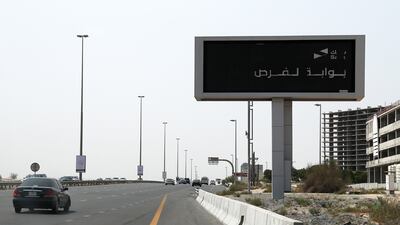
Electronic traffic signs on Umm Sequim St, which is being used to advertise the new Salik IPO scheme in Dubai. Pawan Singh / The National -

Vehicles pass under a toll gate on Sheikh Zayed Road in Dubai on Monday, September 5, 2022. Toll gate operator Salik will make an initial public offering on the emirate's stock market, becoming the latest state-linked company to list. AP -

Electronic traffic signs on Al Khail, which is being used to advertise the new Salik IPO scheme in Dubai. Pawan Singh / The National -
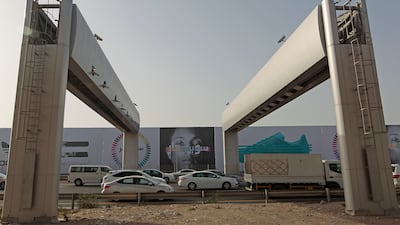
Drivers are charged Dh4 ($1.09) for each gate that they pass through. There are eight gates at present, but Salik's IPO prospectus says that more could be built. The National -
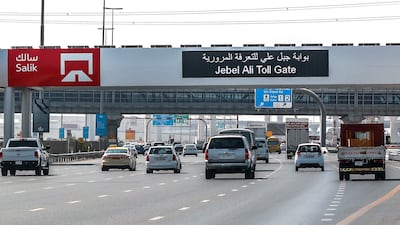
Motorists are required to have a tag on the windscreen of their car and an online account to use the high-speed motorway. Victor Besa / The National -
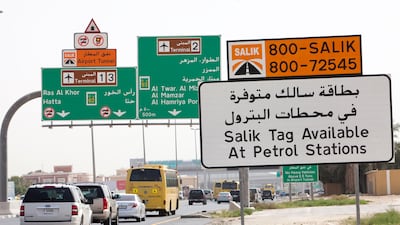
Signs warn drivers that they need a tag on their vehicle to use this road. Jaime Puebla / The National -
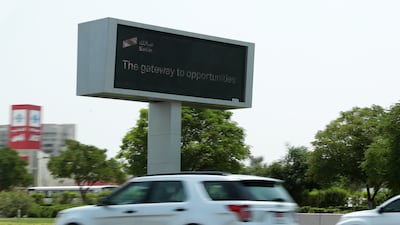
Electronic traffic signs on E311 highway, which is being used to advertise the new Salik IPO scheme in Dubai. Pawan Singh / The National



