


Sultan Al Neyadi to perform first spacewalk by an Arab astronaut
The UAE's Sultan Al Neyadi will become the first Arab astronaut to perform a spacewalk on April 28.
It will be a giant leap forward for the country's growing space programme and for the region.
But it is a significant step he is well prepared to make.
Astronauts assigned to carry out spacewalks must first spend several hours in one of the world's largest indoor pools to get ready for the daunting task.
The 12-metre-deep pool is located in the Neutral Byouancy Laboratory at the Sonny Carter Training Facility in Houston, Texas.
Operational since 1995, it has served not only Americans, but those who have partnerships with Nasa, including astronauts from parts of Europe, Japan, Canada, and most recently from the UAE.
-
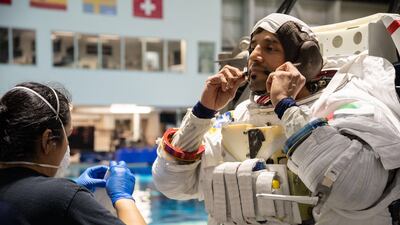
Sultan Al Neyadi wears his EVA suit for spacewalk training in the indoor pool. He will perform the first spacewalk by an Arab astronaut on April 28, 2023. Photo: MBRSC -
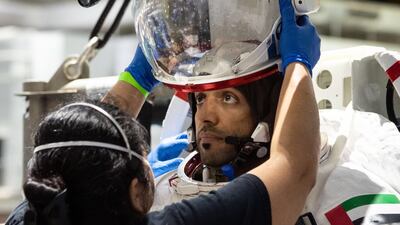
Dr Al Neyadi will repair communication hardware with Nasa colleague Stephen Bowen during their spacewalk. Photo: MBRSC -
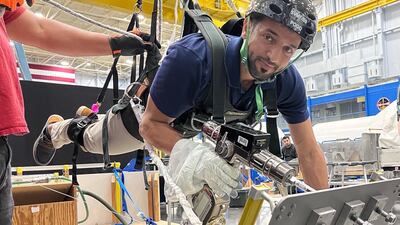
Dr Al Neyadi has received extensive training for the spacewalk. Photo: Sultan Al Neyadi Twitter -
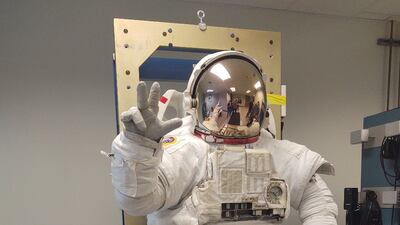
The Extravehicular Activity suit is worn during spacewalks outside of the International Space Station and for training at the world's largest indoor pool at the Johnson Space Centre in Houston, Texas. MBRSC -
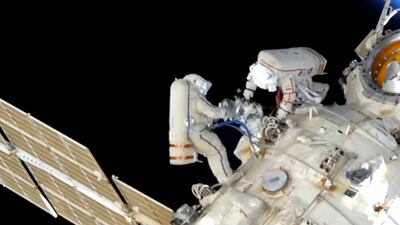
In this photo taken from video footage released by Roscosmos Space Agency, Roscosmos' cosmonauts Oleg Artemyev and Denis Matveev are seen during their spacewalk on the International Space Station (ISS) on Monday, April 18, 2022. Roscosmos Space Agency via AP -
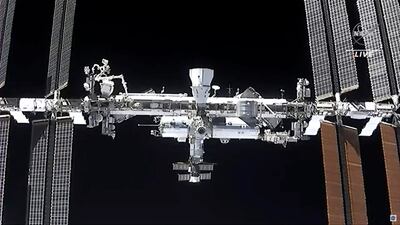
Spacewalks outside of the International Space Station are generally a daunting task, but imagine doing them while wearing bulky spacesuits that weigh 127 kilograms. Astronauts regularly venture outside of the football field-sized orbiting laboratory to do maintenance work on the structure, such as fixing solar panels and repairing the hardware. Nasa via AP -

Astronaut and Expedition 65 Flight Engineer Mark Vande Hei inspects a spacesuit in preparation for a spacewalk at the International Space Station on April 17, 2021. AP -
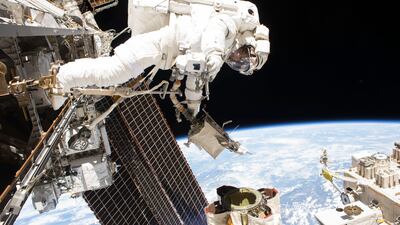
In this photo provided by Nasa, astronaut Mark Vande Hei performs a spacewalk to lubricate the Canadarm2 on October 10, 2017. AP -
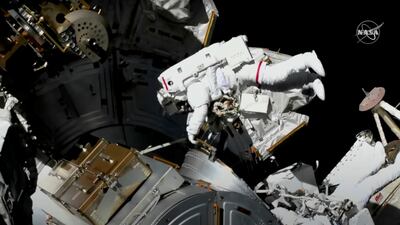
In a still image from a video, astronauts conduct a spacewalk to replace a faulty antenna on the International Space Station on December 2, 2021. Reuters


"The NBL serves as the perfect training centre for astronauts as they prepare for their space flight missions," Nasa said.
"Although astronauts do not achieve true weightlessness in the NBL, the simulations do provide each crew member with a solid spacewalking foundation which better prepares them for the extravehicular activities (EVAs) they will conduct in zero gravity."
Astronauts routinely venture outside of the International Space Station to carry out repair work and install or replace equipment on the exterior of the structure.
Why is it so deep?
The pool is 12.1m deep and holds 23.4 million litres of water to help simulate microgravity so astronauts can train.
Neutral buoyancy means the object has an equal tendency to float as it does to sink. To help achieve this in water, Nasa uses a combination of weights and flotation devices.

This helps astronauts-in-training spend up to seven hours beneath the water, where a mock-up of the ISS is placed.
They wear their 127kg-heavy EVA suits while training underwater.
While they do not feel the weight of the bulky suit in space, they do still feel some of it during their NBL training because they are not experiencing true weightlessness.
Getting into the spacesuit
But before they can go underwater, astronauts first have to complete the lengthy process of suiting up.
"Putting on a spacesuit takes 45 minutes, including the time it takes to put on the special undergarments that help keep astronauts cool," Nasa said.
"After putting on the spacesuit, to adapt to the lower pressure maintained in the suit, the astronaut must spend a little more than an hour breathing pure oxygen before going outside the pressurised module."
Spending seven hours underwater
The astronauts are then lowered into the pool using a special robotic lift.
They sometimes spend up to seven hours underwater, practising the tasks they will be doing during the real spacewalk.
Their suits are fitted with oxygen-enriched breathing gas, or nitrox, so they can carry out the long training sessions.
How do they keep the water clean?
Nasa said that the water within the NBL is recycled every 19.6 hours.
It is automatically monitored and controlled to a temperature of 27-31°C to prevent hypothermia.
It is also chemically treated to control contaminant growth, which also helps reduce long-term corrosion effect on training mock-ups and equipment.

