


I was 25 years old when, in the early hours of March 20, 2003, US-led coalition forces invaded Iraq and overthrew the government of Saddam Hussein.
It was just after midnight and I had only recently returned home from a quick dinner and a tour of the streets of Baghdad.
Earlier that evening, just a few shops remained open while the anxiety and anticipation of war were clearly seen on people's faces as they rushed home before a midnight curfew.
Seconds after I heard a big explosion, my father yelled: “War, it is war! War has started!”
The loud explosion forced me to instinctively bend over to cover my head with my hands.
As the air raid sirens shattered the dark, cold night of winter warning us of the bombs and missiles to come, the fear of an uncertain future became shockingly real.
As a child during the Iraq-Iran war in the 1980s, I had become familiar with the loud, wailing sirens, but they never failed to make my heart fall to my feet.
The noise that echoed across the city sounded like a pack of a thousand hungry wolves, howling in unison.
The aerial bombardment that followed was the start of the invasion, the “shock and awe” campaign and the show of military force few of us had seen before.
After a few days, the bombing finally began to relent, maybe because of a huge sandstorm that swept into Baghdad giving the city an ominous red glow.
I remember people saying the storm was a gift from God as it thwarted the advance of US troops.
It was only a temporary reprieve, as, by April 9, the US forces occupied Baghdad and pulled down Saddam Hussein’s bronze statue in a scene that will last forever in people's minds.
That moment was a gesture to announce the end of an era for Iraq.
This Monday will mark 20 years since the Iraq war of 2003 which succeeded in its goal of toppling the Saddam Hussein regime.
Memories still flash in my mind of the invasion that year, and the ones that followed.
Some Iraqis were happy to end Saddam’s regime while others were angry, and many were confused.
They didn’t know what to do and had mixed feelings.

The country moved into further chaos after the invasion
At that time, I felt better days would surely come and we would become a modern country like Japan or Germany after the Second World War. The reality was much different.
The 2003 war was followed by years of conflict and violent turmoil that led to the deaths of thousands of Iraqis and the exodus of millions more.
The country was dragged into chaos and Iraqis witnessed seemingly endless violence, an uncertain future and a loss of government trust.
Countless street battles between US forces and militias, scores of car bombings and kidnappings followed, and Iraqis lost hope for a better future for the country.
The majority of us did not know the politicians who arrived with the US troops.
Those politicians told Iraqis they too were fighting against Saddam’s regime, and vowed to make Iraq good once more.
After false claims by the coalition forces that Iraq’s hidden weapons of mass destruction justified the invasion, the US administration made another huge mistake.
Offering democracy to Iraqis — many who lived their entire lives knowing nothing about voting — proved a costly error.
People were encouraged to participate in elections in 2005 but the majority of voting happened based on sectarian beliefs.
The result was catastrophic as the sectarian war erupted, sending Baghdad towards another horrendous era of bloodshed and front-line battles.
At its lowest ebb, 40 per cent of the nation was held captive by the Islamic State of Iraq and Syria, the Salafi-Jihadist militants hellbent on establishing an Islamic caliphate.
Brutal battles to recover Mosul and other cities, soon followed as Iraq descended into chaos.
As many as four million left the country before the 2003 war.
The invasion only accelerated that trend as the number of displaced, internally and outside of Iraq would swell to nine million by 2020.
I witnessed the effects of 13 years of sanctions before the US invasion and an embargo that destroyed Iraqi society and plunged millions into poverty.
Thousands of Iraqi children died senselessly due to malnutrition and a lack of medicine because of the sanctions.
But the effect of the US invasion was painful and surreal to comprehend.
In 2003, the demands of the Iraqi people were simple: we needed security, good education and healthcare.
But fundamentally, we needed effective governance from officials who wanted the best for Iraq.
In 2023, those demands remain. Iraq is plagued with rampant corruption, while unemployment is now staggeringly high.
There is widespread public distrust in the government’s ability to deliver services and security, leading many to question if it was all worth the turmoil and heartbreak of war that devastated so many lives.
2003 invasion of Iraq — in pictures
-
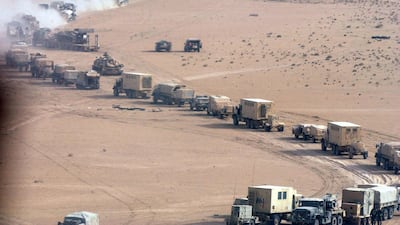
A long US military convoy moving inside an unspecified area of southern Iraq on March 21, 2003. US and British forces were poised to capture the city of Basra on day two of the war to topple President Saddam Hussein. AFP -
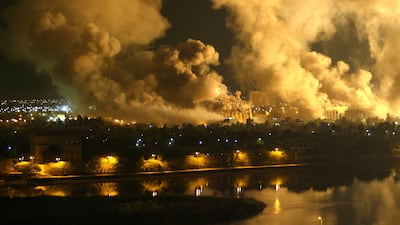
Smoke covers the presidential palace compound in Baghdad on March 21, 2003 during a massive US-led air raid on the Iraqi capital. Smoke billowed from a number of sites, including one of President Saddam Hussein's palaces, an AFP correspondent said. AFP -

Members of Britain's 16 Air Assault Brigade on patrol during a sandstorm in the deserts around the oil fields of Rumaila in southern Iraq on March 25, 2003. AFP -
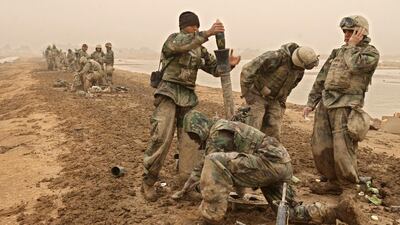
US Marines from the 2nd Batallion 8th Regiment load mortar shells into launchers in Nasiriyah, about 360 kilometres south-east of Baghdad, as they pound Iraqi positions early on March 26, 2003. AFP -
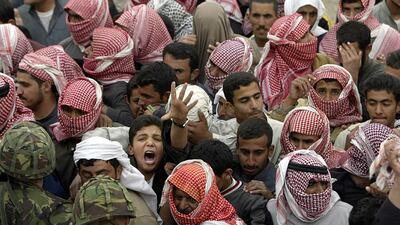
An Iraqi boy struggles amid a crowd to reach for giveaways thrown from a lorry in the southern city of Safwan on March 26, 2003. AFP -

Residents flee the burning town of Basra in southern Iraq on March 28, 2003. British soldiers said the fleeing refugees had described a city still in the grip of an Iraqi military that had hidden large amounts of artillery tanks in civilian and commercial areas. AFP -

Iraqi Republican guards cheer as they pass a wrecked US army Abrams tank, south of Baghdad, on April 6, 2003. AFP -
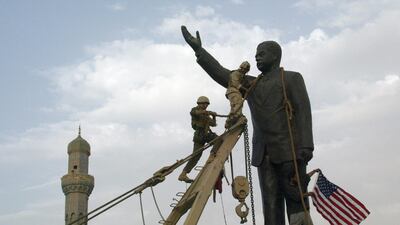
US Marines chain the head of a statue of Saddam Hussein before pulling it down in Baghdad's Firdous Square on April 9, 2003, while an Iraqi waves the US flag. US troops moved into the heart of the Iraqi capital meeting little resistance. AFP -
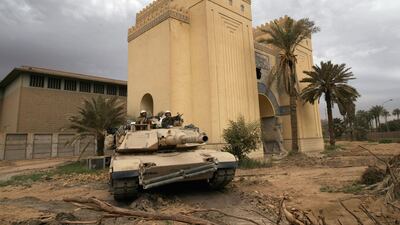
A US tank takes up position outside the plundered Iraqi National Museum in Baghdad on April 16, 2003. Getty Images -
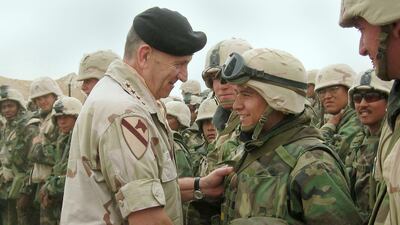
Gen Tommy Franks shakes hands with US Marines of the 1st Marine Expeditionary Force in the Iraqi city of Numaniyah, about 140 kilometres south-east of Baghdad, on April 7, 2003. Getty Images -
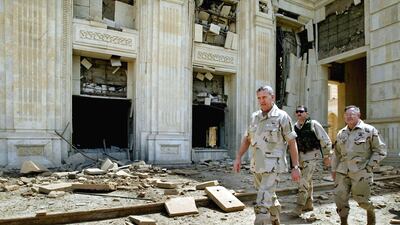
Gen Tommy Franks (c) visits a palace of Saddam Hussein in Baghdad on April 16, 2003. Getty Images -

US Secretary of Defence Donald Rumsfeld (c) is saluted by US Army Lt Gen William Wallace as he arrives at Baghdad International Airport on April 30, 2003. Getty Images -
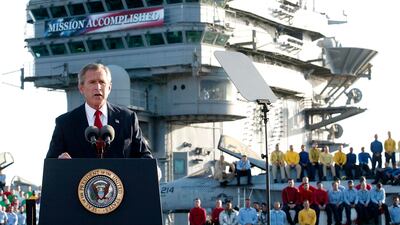
US President George W Bush addresses the nation aboard the nuclear aircraft carrier USS Abraham Lincoln on May 1, 2003. Mr Bush declared that major fighting was over in Iraq, calling it "one victory in a war on terror". AFP



