

Legal procedures based on Abu Dhabi’s civil family court system, which allows non-Muslim couples to divorce and marry in a non-Sharia process, will be introduced across the UAE from today.
The federal law for non-Muslim residents, announced in December, covers family matters such as marriage, divorce, inheritance and child custody.
Previously, a couple seeking a divorce in a local court would follow a Sharia-based process. This may differ significantly from what they may be used to in their home country.
Many choose to marry, divorce or arrange a will abroad instead.
The new law is likely to lead to far more residents from overseas using simple civil procedures in the Emirates to marry and divorce.
Officials who overhauled the legal process told The National they want to ensure the law provides for all residents, regardless of faith or background.
Here, we look at the law's main provisions.
Marriage
Non-Muslim couples can now marry “based on the will of both the husband and wife”, meaning consent from the wife’s father or guardian is no longer a requirement.
The need to have several male Muslims as witnesses has also been removed.
In Abu Dhabi's family court, proceedings are closer to what you would find in a registry office wedding in the UK or Europe.
______________________________________
Abu Dhabi's Civil Family Court - in pictures
-

Officials open the Family Court at Abu Dhabi Judicial Department in 2021. Photo: ADJD -

British couple Craig Lindsay and Sarah Goodman marry in a civil ceremony in February 2022. Victor Besa / The National -

Itamar Bareket, from Tel Aviv, places the ring on to his wife-to-be Nogah's finger at the civil court in Abu Dhabi. Khushnum Bhandari / The National -

The couple chose Abu Dhabi because civil marriages are not allowed in Israel. Khushnum Bhandari / The National -
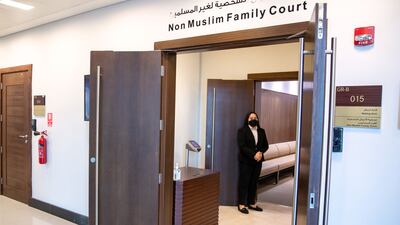
The court also handles divorces and other family matters such as inheritance. Victor Besa / The National -

The process involves paperwork and a ceremony with an official. Victor Besa / The National -

At least dozens of couples have been married at Abu Dhabi Judicial Department and many more plan to do so. Victor Besa / The National


______________________________________
A single court official guides the couple through a secular legal process, the couple sign the legal documents making them husband and wife, the rings are presented and photos are taken.
At Abu Dhabi's Civil Family Court, 2,200 marriages were registered between January and August, about 25 each day. There is expected to be similar demand in the other emirates as the law comes into effect.
Divorce
Under the new law, spouses have the right to divorce without a requirement to prove harm was done in the marriage. This is known as a “no fault divorce”.
Either spouse may now ask the court to end the marriage without the need to prove one party was at fault.
Divorce can be granted at the first hearing without the need to go through a process of family guidance counselling and mandatory mediation sessions.
Support payments, or alimony, and other subsequent requests will be submitted using a “post-divorce request form”.
In the case of a dispute regarding financial requests, several factors will be taken into account, including the length of the marriage, the age of the wife and the financial status of each spouse.
Joint custody
Joint and equal custody of children will be automatically granted to parents after divorce, with procedures in place to settle disputes.
In the event of a custody dispute, the court can be asked to intervene and make a decision on the matter. The primary consideration will always be the best interests of the child.
Previously, a mother was only given custody of her son until he reached the age of 11, and her daughter until the age of 13. The father could claim custody once the child reached those ages.
Inheritance
The new law ensures the right of a foreign resident to draw up a will giving their property to whoever they wish.
In the absence of a will, half of a person’s estate will now go to the surviving spouse. The other half will be distributed equally between the deceased’s children.
In the Sharia-based domestic court system, a son would obtain a larger share of the inheritance.
If the deceased has no children, the inheritance goes to their parents, or it may be split equally between one surviving parent and the deceased’s siblings.
Wills for non-Muslims should be registered during the signing of their marriage certificate.
Proof of paternity
The new law states that proof of paternity for non-Muslims will be based on marriage or the recognition of paternity.
DNA tests will be carried out if the parents are unknown.
Earlier this year, new rules allowed unmarried mothers to apply to get birth certificates for their babies. Before that, the presence or proof of a husband was required to legally register the child.

