• Sarah Al Amiri, Minister for Public Education and Future Technology and Chairwoman of the UAE Space Agency, talks to Dr Hiroshi Yamakawa of Japan Aerospace Exploration Agency at the Abu Dhabi Space Debate. All photos: Chris Whiteoak / The National
    Sarah Al Amiri, Minister for Public Education and Future Technology and Chairwoman of the UAE Space Agency, talks to Dr Hiroshi Yamakawa of Japan Aerospace Exploration Agency at the Abu Dhabi Space Debate. All photos: Chris Whiteoak / The National
  • Sheikh Abdullah bin Zayed, Minister of Foreign Affairs and International Co-operation, with India's Minister of State for Science and Technology Dr Jitendra Singh, centre, at the Abu Dhabi Space Debate
    Sheikh Abdullah bin Zayed, Minister of Foreign Affairs and International Co-operation, with India's Minister of State for Science and Technology Dr Jitendra Singh, centre, at the Abu Dhabi Space Debate
  • Sheikh Khaled bin Mohamed, Member of the Abu Dhabi Executive Council and Chairman of the Abu Dhabi Executive Office, at the debate
    Sheikh Khaled bin Mohamed, Member of the Abu Dhabi Executive Council and Chairman of the Abu Dhabi Executive Office, at the debate
  • Israeli President Isaac Herzog, right, with Sheikh Abdullah and Dr Singh
    Israeli President Isaac Herzog, right, with Sheikh Abdullah and Dr Singh
  • Omran Sharaf, Assistant Minister of Foreign Affairs and International Co-operation for Advanced Science and Technology, speaks on the subject of the new geopolitics of space
    Omran Sharaf, Assistant Minister of Foreign Affairs and International Co-operation for Advanced Science and Technology, speaks on the subject of the new geopolitics of space
  • Ms Al Amiri speaks at the Abu Dhabi Space Debate
    Ms Al Amiri speaks at the Abu Dhabi Space Debate
  • Sheikh Abdullah bin Zayed
    Sheikh Abdullah bin Zayed
  • Dr Singh of India speaking at the Abu Dhabi Space Debate
    Dr Singh of India speaking at the Abu Dhabi Space Debate
  • Israel's Mr Herzog speaking at the Abu Dhabi Space Debate
    Israel's Mr Herzog speaking at the Abu Dhabi Space Debate

Abu Dhabi Space Debate: Global tension threatening sector


Sarwat Nasir
  • English
  • Arabic

Global tension affecting the space sector may create challenges that have an impact of people’s daily lives, a major space conference in Abu Dhabi has been told.

Officials at the Abu Dhabi Space Debate spoke on Monday about how the world is in a “new space age”, with private companies playing a crucial role.

Delegates from more than 50 space agencies and authorities attended the two-day event.

Sarah Al Amiri, Minister of State for Public Education and Future Technology and chairwoman of the UAE Space Agency, said in her welcoming remarks that the sector was seeing many challenges.

There are growing concerns including mega-constellations of satellites that are crowding low-Earth orbit and countries increasingly looking to militarise space.

With the return of great power competition, and particularly the UN Security Council being more divided than it has ever been, it is difficult to see the kind of co-operation that there was in the 1990s and 2000s ever coming back
William Alberque of the International Institute for Strategic Studies

Experts are also concerned over whether there are the right regulations in place to police private companies aiming to commercialise low-Earth orbit.

“The impacts of these challenges will be felt way beyond the space sector and have the potential to touch people’s everyday lives around the world,” said Ms Al Amiri.

“I believe at least some of them to be potentially existential to our peaceful and collaborative exploration of the limitless exploration of space.

“There are new actors and new challenges. We have moved from the bipolar world of the Cold War and its space race to a multilateral world where some 70 nations are today considered space capable … where a fast-growing private sector is taking an increasing role and where global tensions have threatened some of the most cherished aspects of our great sector.”

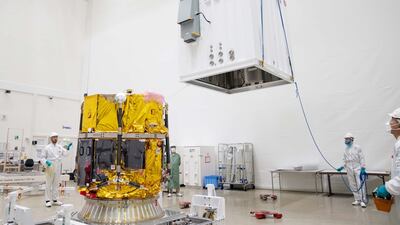
  • The Hakuto-R Mission 1 lander, with the UAE's Rashid rover stored inside it, was shipped to a Florida launch site in October. Photo: ispace
    The Hakuto-R Mission 1 lander, with the UAE's Rashid rover stored inside it, was shipped to a Florida launch site in October. Photo: ispace
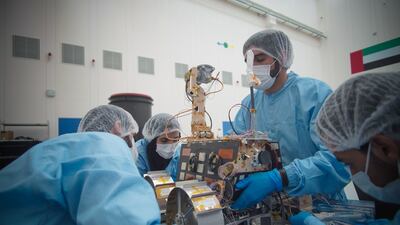
  • Emirati engineers carry the Rashid rover inside a clean room in the Mohammed bin Rashid Space Centre on June 15, 2022. Photo: MBRSC
    Emirati engineers carry the Rashid rover inside a clean room in the Mohammed bin Rashid Space Centre on June 15, 2022. Photo: MBRSC
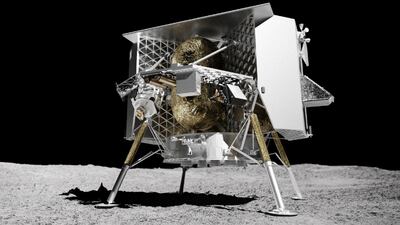
  • The Peregrine lander by US-based company Astrobotic will deliver payloads from eight countries in early 2023. Photo: Astrobotic
    The Peregrine lander by US-based company Astrobotic will deliver payloads from eight countries in early 2023. Photo: Astrobotic
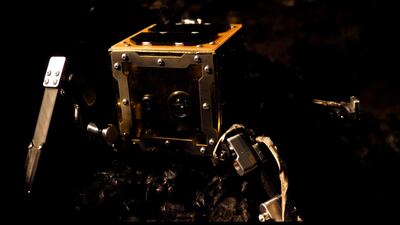
  • The Asagumo rover mission by UK company Spacebit will launch on the Peregrine lander. Photo: Spacebit
    The Asagumo rover mission by UK company Spacebit will launch on the Peregrine lander. Photo: Spacebit

She said that the most important piece of international legislation — the Outer Space Treaty by the UN — dates back to 1967.

The new US-led Artemis Accords — an international agreement that outlines peaceful exploration — has been signed by more than 20 countries, though it is not yet legally binding and mostly repeats the UN treaty.

Countries such as China and Russia are unlikely to sign, with the former Russian space chief Dmitry Rogozin saying that the agreement was “too US-centric”.

William Alberque, director of strategy, technology and arms control at the International Institute for Strategic Studies, said that there was new international competition in space.

“With the return of great power competition, and particularly the UN Security Council being more divided than it has ever been, it is difficult to see the kind of co-operation that there was in the 1990s and 2000s ever coming back,” he said.

“At this point, the Russians have gone in their own direction in terms of international co-operation.

“China is seeking to become a pre-eminent power and seeking to contest the US position in predominance.

Omran Sharaf, Assistant Minister of Foreign Affairs and International Co-operation for Advanced Science and Technology, among experts at the Abu Dhabi Space Debate on Monday. Chris Whiteoak / The National

“We are looking at international competition and at the same time you’ve got massive involvement of smaller and medium size powers — not only nations but also industry.”

China is quickly emerging as a global space power, having completed its Tiangong space station in low-Earth orbit and achieving missions to the Moon and Mars.

Meanwhile, Russia has increasingly isolated itself in space due to sanctions placed on Moscow after it invaded Ukraine.

Countries militarising space are also a growing concern. They include nations that have anti-descent satellite testing capabilities. This means they can use missile technology to destroy spacecraft.

These tests can create a dangerous amount of space debris that can endanger astronauts and other spacecraft.

But experts fear the technology can also be used during wars.

In November, Russia carried out an anti-satellite test in which it destroyed one of its satellites, creating thousands of pieces of space debris.

India ordered an anti-satellite test in 2019 in an operation called the Mission Shakti, resulting in a dangerous level of space debris.

China destroyed one of its satellites in 2007 and the US followed a year later with a similar operation.

But the US banned these tests earlier this year and is encouraging other nations to follow suit. So far, it has been joined by the UK, South Korea, New Zealand, Japan, Germany and Canada.

John Hill, deputy assistant secretary at the US Department of Defence, said that the UN could help control the behaviour of countries.

“What we’re doing at the United Nations is not a focus on systems, it’s a focus on behaviour and destructive testing of direct descent anti-satellites,” he said.

“Many nations have missiles that could do that, so you can’t ban the system but you can try to control behaviour.

“We have to conduct ourselves in space different to the way we have on domains on Earth.”

Tamkeen's offering
  • Option 1: 70% in year 1, 50% in year 2, 30% in year 3
  • Option 2: 50% across three years
  • Option 3: 30% across five years 
MATCH INFO:

Second Test

Pakistan v Australia, Tuesday-Saturday, 10am​​ daily​​​​​ at Zayed Cricket Stadium, Abu Dhabi

Entrance is free

The%20Hunger%20Games%3A%20The%20Ballad%20of%20Songbirds%20%26%20Snakes
%3Cp%3E%3Cstrong%3EDirector%3A%3C%2Fstrong%3E%C2%A0Francis%20Lawrence%3C%2Fp%3E%0A%3Cp%3E%3Cstrong%3EStars%3A%C2%A0%3C%2Fstrong%3ERachel%20Zegler%2C%20Peter%20Dinklage%2C%20Viola%20Davis%2C%20Tom%20Blyth%3C%2Fp%3E%0A%3Cp%3E%3Cstrong%3ERating%3A%20%3C%2Fstrong%3E3%2F5%3C%2Fp%3E%0A
Company%20Profile
%3Cp%3E%3Cstrong%3EName%3A%20%3C%2Fstrong%3EDirect%20Debit%20System%3Cbr%3E%3Cstrong%3EStarted%3A%3C%2Fstrong%3E%20Sept%202017%3Cbr%3E%3Cstrong%3EBased%3A%3C%2Fstrong%3E%20UAE%20with%20a%20subsidiary%20in%20the%20UK%3Cbr%3E%3Cstrong%3EIndustry%3A%3C%2Fstrong%3E%20FinTech%3Cbr%3E%3Cstrong%3EFunding%3A%3C%2Fstrong%3E%20Undisclosed%3Cbr%3E%3Cstrong%3EInvestors%3A%3C%2Fstrong%3E%20Elaine%20Jones%3Cbr%3E%3Cstrong%3ENumber%20of%20employees%3A%3C%2Fstrong%3E%208%3Cbr%3E%3C%2Fp%3E%0A
MATCH INFO

Manchester City 3
Danilo (16'), Bernardo Silva (34'), Fernandinho (72')

Brighton & Hove Albion 1
Ulloa (20')

Ten tax points to be aware of in 2026

1. Domestic VAT refund amendments: request your refund within five years

If a business does not apply for the refund on time, they lose their credit.

2. E-invoicing in the UAE

Businesses should continue preparing for the implementation of e-invoicing in the UAE, with 2026 a preparation and transition period ahead of phased mandatory adoption. 

3. More tax audits

Tax authorities are increasingly using data already available across multiple filings to identify audit risks. 

4. More beneficial VAT and excise tax penalty regime

Tax disputes are expected to become more frequent and more structured, with clearer administrative objection and appeal processes. The UAE has adopted a new penalty regime for VAT and excise disputes, which now mirrors the penalty regime for corporate tax.

5. Greater emphasis on statutory audit

There is a greater need for the accuracy of financial statements. The International Financial Reporting Standards standards need to be strictly adhered to and, as a result, the quality of the audits will need to increase.

6. Further transfer pricing enforcement

Transfer pricing enforcement, which refers to the practice of establishing prices for internal transactions between related entities, is expected to broaden in scope. The UAE will shortly open the possibility to negotiate advance pricing agreements, or essentially rulings for transfer pricing purposes. 

7. Limited time periods for audits

Recent amendments also introduce a default five-year limitation period for tax audits and assessments, subject to specific statutory exceptions. While the standard audit and assessment period is five years, this may be extended to up to 15 years in cases involving fraud or tax evasion. 

8. Pillar 2 implementation 

Many multinational groups will begin to feel the practical effect of the Domestic Minimum Top-Up Tax (DMTT), the UAE's implementation of the OECD’s global minimum tax under Pillar 2. While the rules apply for financial years starting on or after January 1, 2025, it is 2026 that marks the transition to an operational phase.

9. Reduced compliance obligations for imported goods and services

Businesses that apply the reverse-charge mechanism for VAT purposes in the UAE may benefit from reduced compliance obligations. 

10. Substance and CbC reporting focus

Tax authorities are expected to continue strengthening the enforcement of economic substance and Country-by-Country (CbC) reporting frameworks. In the UAE, these regimes are increasingly being used as risk-assessment tools, providing tax authorities with a comprehensive view of multinational groups’ global footprints and enabling them to assess whether profits are aligned with real economic activity. 

Contributed by Thomas Vanhee and Hend Rashwan, Aurifer

The years Ramadan fell in May

1987

1954

1921

1888

Updated: December 06, 2022, 4:03 AM