

Editorial: Monkeypox must not become the next pandemic
The fast-spreading monkeypox outbreak was declared a global emergency by the World Health Organisation on Saturday.
WHO Director General Dr Tedros Adhanom Ghebreyesus said the measure had been taken in an effort to intensify the international response to what he called an "extraordinary situation".
He said the virus — a zoonotic disease primarily found in tropical rainforest areas of parts of Africa — was now spreading rapidly around the world "through new modes of transmission about which we understand too little".
He made the decision to issue the global health emergency alert despite a lack of consensus among experts serving on the UN health agency's emergency committee.
It is the first time the chief of the UN health agency has taken such action.
The move comes with more than 16,000 cases recorded in 74 countries since about May.
-
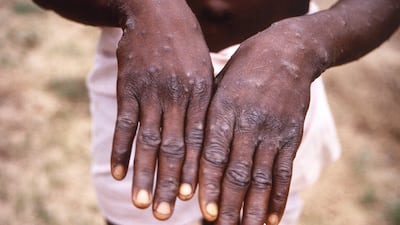
A man's hands are covered in a rash caused by the monkeypox virus that swept through the Democratic Republic of the Congo from 1996 to 1997. Reuters -
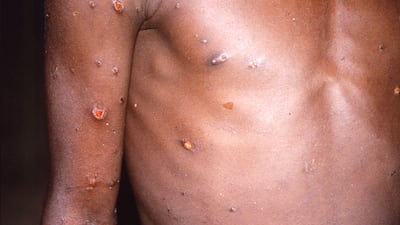
An image taken during an outbreak of monkeypox in the Democratic Republic of the Congo in 1996 and 1997 shows the arms and torso of a patient with skin lesions due to monkeypox. Reuters -
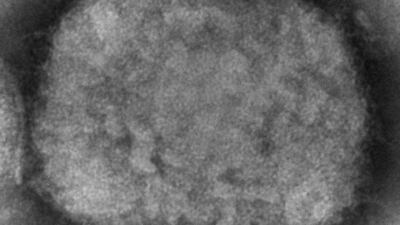
This 2003 electron microscope image made available by the Centres for Disease Control and Prevention shows a monkeypox virion, obtained from a sample associated with the 2003 prairie dog outbreak. AP -
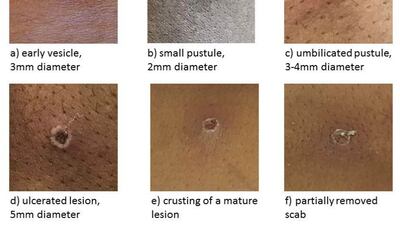
Images issued by the UK Health Security Agency show the stages of monkeypox. UK Health Security Agency -

The Massachusetts Department of Public Health confirmed a single case of monkeypox in an adult male who had recently travelled to Canada. EPA -

Roman Woelfel, head of the Institute of Microbiology of the German Armed Forces in Munich, gets to work after Germany detected its first case of monkeypox. Reuters


What is monkeypox and how do you catch it?
Monkeypox is an infection usually spread by wild animals in Central or West Africa.
It can be caught from infected wild animals, particularly rodents such as rats, mice and squirrels.
You can be infected by an animal bite or if you come into contact with an animal’s blood or bodily fluids.
It may be possible to catch monkeypox by eating meat from an infected animal that has not been properly cooked.
Human-to-human transmission can occur through touching the towels or bedding of a patient, touching monkeypox blisters, or through coughs and sneezes.
It is a cousin of the smallpox virus, and has been mostly confined to developing countries until the last few months, when it spread across Europe and the US.
Human monkeypox was first identified in 1970 in what is now the Democratic Republic of Congo in a 9-year-old boy. It became endemic in the tropical rainforests of Central and West Africa, where 11 countries reported cases.
In June 2003, the disease was reported in the US, the first time it had been detected outside Africa.
To date, monkeypox deaths have only been reported in Africa, where a more dangerous version of the virus is spreading, mainly in Nigeria and the Democratic Republic of Congo.
An evolving virus
In Africa, monkeypox mainly spreads to people from infected wild animals such as rodents, in limited outbreaks that typically have not crossed borders.
In Europe, North America and elsewhere, however, monkeypox is spreading among people with no links to animals or recent travel to Africa.
The WHO’s top monkeypox expert, Dr Rosamund Lewis, said this week that 99 per cent of all the cases beyond Africa were in men and that of those, 98 per cent involved men who have sex with men.
Experts suspected the monkeypox outbreaks in Europe and North America were spread by people who attended two raves in Belgium and Spain.
What are the symptoms and how is it treated?
Most monkeypox patients experience fever, body aches, chills and fatigue. People with more serious cases may develop a rash and lesions on the face and hands. The lesions can spread to other parts of the body.
In general, recovery takes about two to four weeks without the need to be admitted to hospital, but monkeypox can be fatal in up to 6 per cent of cases and is thought to be more severe in children.
Smallpox vaccines are effective against monkeypox and anti-viral drugs are also being developed.
Global health emergency status to boost vaccine roll-out?

The WHO previously declared emergencies for public health crises such as the coronavirus pandemic, the 2014 West African Ebola outbreak, the Zika virus in Latin America in 2016 and the continuing effort to eradicate polio.
Last month, the UN agency’s expert committee said the worldwide monkeypox outbreak did not yet amount to an international emergency, but the panel convened this week to re-evaluate the situation.
Sounding the alarm on monkeypox aims to heighten the international response to the virus, opening up the prospect of more funding to fight the outbreak the wider roll-out of vaccines.
The WHO states prior vaccination against smallpox has been found to be about 85 per cent effective in preventing monkeypox, indicating previous smallpox vaccination may result in milder illness.
The health organisation said a newer vaccine was approved for the prevention of monkeypox in 2019.
This is a two-dose vaccine for which availability remains limited, the WHO.
Dr Tedros said the WHO's assessment deems the risk from monkeypox to be moderate globally and in all regions, except for in Europe, where the risk is high.
There have been more than 2,200 cases in the UK alone.
The UK's National Health Service said this week it would step up its monkeypox vaccination programme.
Health officials said 100,000 more doses of an effective immunisation had been bought.
The EU signed an agreement in June for the supply of about 110,000 doses of the Imvanex shot, known as Jynneos in the US.
Imvanex is currently authorised in the EU for the prevention of Smallpox in adults and has been recommended for use against monkeypox by the European Medicines Agency.
The US has delivered 300,000 vaccine doses and is working on the delivery of close to 800,000 more.

