



Ravaged by poverty, war and economic collapse, Yemen faces acute humanitarian problems, which have been aggravated by threats from landmines.
Laid across much of the nation during various conflicts and uprisings in recent decades, many of these devices have been used by the Iran-backed Houthi rebels as part of the civil war that began in 2014.
However, efforts are being made to de-mine Yemen, including by the Yemeni authorities and by the Saudi Project for Landmine Clearance (Masam), launched by the King Salman Humanitarian Aid and Relief Centre.
'Mind-boggling' number of mines
Since 2018, Masam has been removing mines (anti-personnel and anti-tank), improvised explosive devices (IEDs) and unexploded ordnance (UXO).
It is a huge task because, as Ousama Algosaibi, Masam’s managing director and programme manager, puts it, the number of explosive devices laid in Yemen is “mind-boggling”.
“I think Yemen has the highest density of IEDs and mines known to man in recent years,” he says.
“I don’t think there’s any country that has had this number [laid] ... in such a short period of time.”

The Washington Institute for Near East Policy previously reported that the Houthis have carried out “mass production and deployment” of landmines, laying them at locations including near the Saudi border, along the coast and around towns.
Mr Algosaibi says landmines have been found inside villages, on agricultural and grazing land, in children’s schools, and also on roads leading to villages.
“These are all civilian areas that are now very far from any active front,” he says.
“I don’t know and I don’t understand the reason they have planted those areas with mines and IEDs.
“What is the use of planting IEDs under the floor of a children’s school? It just doesn’t make sense. Or water supplies the villagers are using? Or some medical clinics?
“Houthis want to use that as, I don’t know, a terror tool against the local population, against the local civilians.”
Seeking help from locals
The project — unusual for being supported by a party to the conflict, Saudi Arabia, which along with the UAE is fighting the Houthis — involves more than 500 people.
De-mining is carried out by 32 teams of Yemenis, who have been through comprehensive training even if, as is typical, they had previous de-mining experience.
The Houthis do not reveal where mines have been laid, so operatives often find out by speaking to locals during an initial non-technical survey (NTS).
Residents may pinpoint a location where a mine cost a relative a leg or killed an animal, and operatives can often then work out the line in which others were laid.
Metal detectors highlight the precise location of devices, which are typically collected and destroyed, hundreds at a time, in controlled explosions. IEDs and mines too dangerous to remove are blown up in situ.
Masam has cleared more than 32 million square metres and destroyed nearly 5,000 anti-personnel mines, almost 125,000 anti-tank mines, nearly 200,000 UXO, and close to 7,500 IEDs. This adds up to more than 335,000 items in total.
Preparing Yemen for recovery
Masam and other entities carrying out de-mining in Yemen are, unusually, doing their work while conflict continues to rage.
“De-mining, clearing of mines and UXO, is a precursor to stability and to making land safe for normal use – farming, agriculture, building, roads, infrastructure, that sort of thing,” says Chris Clark, special projects director for SafeLane Global, a private company providing equipment, training and other support to Masam.

"Wars obviously destroy that. Getting a head start on clearance of those mines and UXO is going to significantly benefit the reconstruction timeline of Yemen, when that timeline starts.”
While Masam operates in a country at war, Mr Clark says the project’s role is purely humanitarian and it does not work “in support of military activity in any way, shape or form”.
At risk of drone strikes
Removing and destroying landmines and other explosive devices carries obvious hazards. But operating in a war zone magnifies the dangers to the staff, with Masam having lost 28 personnel in 16 incidents.
Half of these incidents happened during de-mining, such as when a mine or other device unintentionally exploded or was booby-trapped. The other eight were caused directly by the war, such as when drones attacked vehicles or camps.
“We have had a number of casualties that are not work-related; they’ve been in the wrong place at the wrong time,” Mr Clark says.
“We’ve had Houthi drone strikes on our vehicles, because of course they don’t differentiate between us and anybody else moving around the enemy territory.”
In one incident, a de-miner returning at the end of the day recognised an IED and stopped to direct traffic away. In highlighting the threat, the de-miner saved numerous lives — but lost his own when the device was detonated.
“That’s just one of the tragic realities of working in a war zone, which is not common to other mine-action programmes,” Mr Clark says.
Some mines are particularly hazardous, Mr Clark says, with the Houthis “increasingly upping the sophistication and trickery”.
“Many of the mines that we’re encountering now are, in the classic term, booby-trapped, in that if you lift them, there’s something underneath them which will detonate,” he says.
Navigating tripwires and pressure plates
They have also encountered anti-tank mines modified so that the weight of a person is enough to set them off.
Especially unpleasant and dangerous are bounding fragmentation mines, which, when activated by tripwires or pressure plates, jump out of the ground before detonating, sending fragments in every direction.
“If you are very unlucky to be standing within that 360-degree radius, it will, in very simple terms, cut you in half, literally,” Mr Clark says.
“These are weapons of war, but they have not been used by combatant forces for some time. Of all the types of landmine available to use, should you be inclined to use them, these are undoubtedly the worst.“
An anti-personnel mine is more often than not designed to maim rather than kill. The bounding fragmentation mines are designed to kill multiple people.
”Since the beginning of 2018, there have been at least 1,424 civilians killed in Yemen by landmines and other explosive devices, according to reports from late last year quoting the UN Office for the Coordination of Humanitarian Affairs," Mr Algosaibi says.
“In all the areas that we work in, over the past few years there have been thousands of either deaths or amputations, mostly among old men or women and children."
Saving lives
Deaths and injuries would probably have been much higher had Masam and others not been active in removing explosive devices.
In areas that have been cleared, there is “a huge benefit” to local people, who can now use their water supplies, go to school, or return to farm work.
The work never stops, because if areas are retaken by the Houthis, mines may be re-laid. If the front line shifts back again, these locations need to be cleared a second or even a third time.
“You have advances and then withdrawals," Mr Algosaibi says. "Every time that happens, we have to move our teams backwards. Once they’re taken again, we move them forwards."
Aid groups feed Yemen's hungry people: in pictures
-

The father of malnourished boy Jiad Muhammad Jalal, 1, holds him at a camp for internally displaced people in Hajjah, Yemen. All photos: Reuters -

A volunteer gives a meal to a woman at a charity kitchen in Sanaa. -

About 17.4 million people need food aid as funding dries up, the UN has said. -
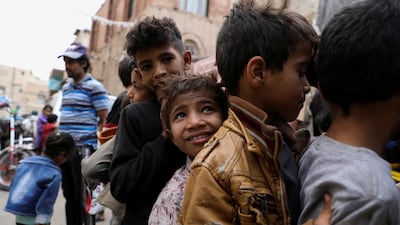
Boys stand in line as they wait to receive meals from a charity kitchen in Sanaa. -
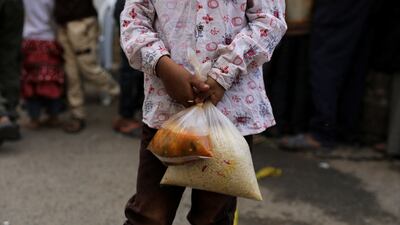
Children have been particularly affected by the conflict in Yemen, UN figures show, with 2.2 million youngsters acutely malnourished. -
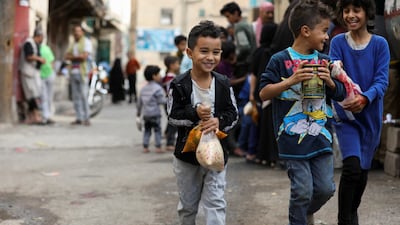
Boys leave after receiving meals from a charity kitchen in Sanaa. -
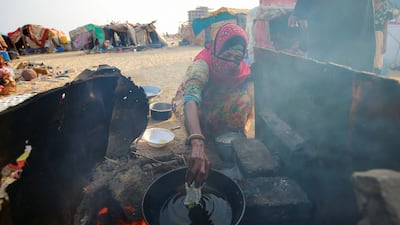
A woman cooks a meal at a camp for displaced people in Al Ghaidha. -

A girl picks food prepared by her mother at a camp for displaced people in Al Ghaidha. -

UN Secretary General Antonio Guterres has said Yemen and other vulnerable nations are being hit hard by the economic fallout from Russia’s invasion of Ukraine. -

Internally displaced people collect food aid distributed by a charity in Taez.



