• Mohammed Al Mulla, a former Dubai Police helicopter pilot, is progressing in his training at Nasa to become an astronaut. He recently completed survival training in a remote location in Alabama with nine of his Nasa colleagues. Here, he is seen building a shelter in the wilderness. All photos: Mr Al Mulla / Twitter
    Mohammed Al Mulla, a former Dubai Police helicopter pilot, is progressing in his training at Nasa to become an astronaut. He recently completed survival training in a remote location in Alabama with nine of his Nasa colleagues. Here, he is seen building a shelter in the wilderness. All photos: Mr Al Mulla / Twitter
  • Mr Al Mulla with his Nasa colleagues.
    Mr Al Mulla with his Nasa colleagues.
  • Mr Al Mulla in the wilderness during the survival training.
    Mr Al Mulla in the wilderness during the survival training.
  • Survival training involves learning to use resources to build fires and shelter.
    Survival training involves learning to use resources to build fires and shelter.
  • The astronaut trainees take a selfie together.
    The astronaut trainees take a selfie together.
  • The group were required to learn how to build fires, gather water and food, and build shelters.
    The group were required to learn how to build fires, gather water and food, and build shelters.
  • They had to work as a team.
    They had to work as a team.
  • Effective teamwork is essential in space, especially during spacewalks, work inside the International Space Station and during the cruise phase.
    Effective teamwork is essential in space, especially during spacewalks, work inside the International Space Station and during the cruise phase.
  • Nora Al Matrooshi, the first Arab female astronaut, and Mr Al Mulla with their Nasa colleagues earlier this year when their training in Houston first started.
    Nora Al Matrooshi, the first Arab female astronaut, and Mr Al Mulla with their Nasa colleagues earlier this year when their training in Houston first started.

Emirati astronauts complete gruelling survival training in US wilderness


Sarwat Nasir
  • English
  • Arabic

The UAE’s latest candidate astronauts are making progress with their training at Nasa after completing a survival course in the wilderness.

Mohammed Al Mulla, a former Dubai Police helicopter pilot, and Emirati engineer Nora Al Matrooshi, the first Arab female astronaut, learned how to build fires, make shelters and gather food and water, alongside their Nasa colleagues.

They completed the course in a remote forest at the US Army Aviation Centre of Excellence in Fort Rucker, Alabama.

Mr Al Mulla, 34, and Ms Al Matrooshi, 28, were selected to be part of the UAE’s astronaut corps last year, both who are training at Nasa's Johnson Space Centre in Houston for the next two years.

“Survival training is one of the crucial exercises undertaken by astronauts," Mr Al Mulla tweeted on Tuesday. "This is where I developed several skills such as living in difficult conditions and teamwork. My space journey has just begun,”

Survival training has been part of Nasa’s astronaut candidate course for many years.

It teaches trainees crucial skills should they crash-land in a remote location, where they would need to live off the land for days.

The astronauts learnt how to eject from an aircraft. Then, they discovered how to use the resources available to build a shelter, gather food and water, survival medicine, signalling and land navigation.

“The reason we send our new astronauts to survival training is to learn practical skills and certain soft skills they need to be working on,” said Shannon Walker, Nasa candidate class supervisor.

“Some of the aircraft we train on come equipped with an ejection seat and, should something go wrong while we are out training, they may be able to survive for a while before they can be rescued.”

The astronauts take most of their survival training as a group, when tasks are designed to test their ability to work as a team.

In space, teamwork is essential, especially during spacewalks, work inside the International Space Station, and during the cruise phase.

Hazza Al Mansouri, the UAE’s first astronaut in space, and reserve astronaut Sultan Al Neyadi, completed survival training in Russia in 2018.

They spent a year at the Gagarin Astronaut Training Centre in Russia’s Star City, which included days in the wilderness in freezing temperatures.

More intensive training awaits Mr Al Mulla and Ms Al Matrooshi, who will learn to fly T-38 supersonic jets, learn Russian, learn the systems of the International Space Station and spend hours under water to learn how to perform spacewalks.

Maj Al Mansouri and Dr Al Neyadi have completed a year of training at Nasa and will continue their progress at the space centre in Houston.

After graduating, all four astronauts would be qualified for Nasa-led missions.

UAE's first two astronauts learn how to spacewalk - in pictures

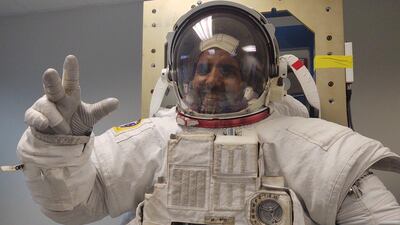
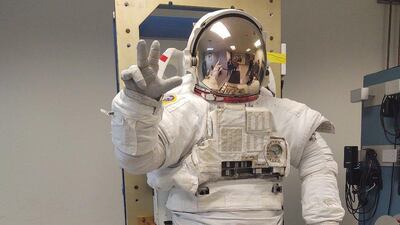
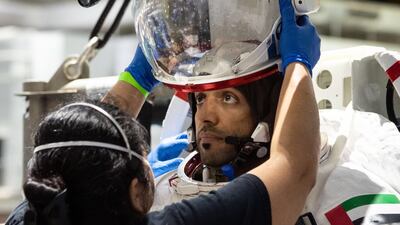
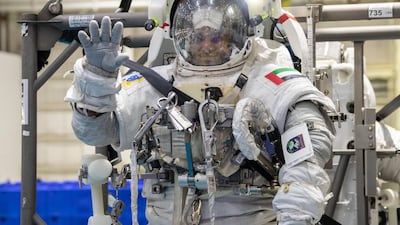
  • Hazza Al Mansouri, first Emirati man in space, wears a 130 kilogram-heavy extravehicular activities suit for spacewalk training. All photos courtesy of Mohammed bin Rashid Space Centre
    Hazza Al Mansouri, first Emirati man in space, wears a 130 kilogram-heavy extravehicular activities suit for spacewalk training. All photos courtesy of Mohammed bin Rashid Space Centre
  • The suit is worn during spacewalks outside of the International Space Station and for training at the world's largest indoor pool at the Johnson Space Centre in Houston, Texas
    The suit is worn during spacewalks outside of the International Space Station and for training at the world's largest indoor pool at the Johnson Space Centre in Houston, Texas
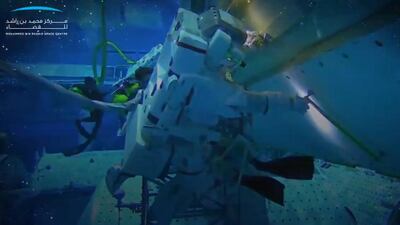
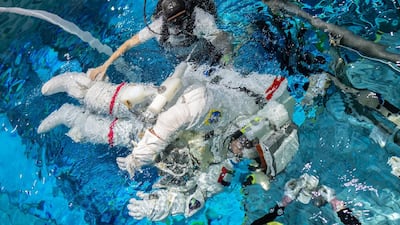
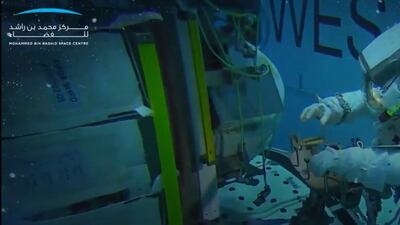
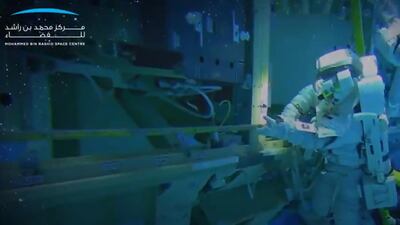
  • Located at the Neutral Buoyancy Lab (NBL), the indoor pool is 12-metres deep and has 2.4 million litres of water. It helps simulate microgravity and allows astronauts to work on a replica of the International Space Station placed underwater
    Located at the Neutral Buoyancy Lab (NBL), the indoor pool is 12-metres deep and has 2.4 million litres of water. It helps simulate microgravity and allows astronauts to work on a replica of the International Space Station placed underwater
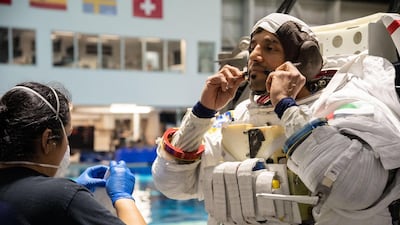
  • Sultan Al Neyadi, part of the UAE astronaut corps, wears his EVA suit for spacewalk training in the indoor pool
    Sultan Al Neyadi, part of the UAE astronaut corps, wears his EVA suit for spacewalk training in the indoor pool
  • Sultan Al Neyadi puts his helmet on for spacewalk training under water. Mr Al Neyadi was one of two people selected from 4,022 candidates to become the first Emirati astronauts. Mbrsc
    Sultan Al Neyadi puts his helmet on for spacewalk training under water. Mr Al Neyadi was one of two people selected from 4,022 candidates to become the first Emirati astronauts. Mbrsc
  • Mr Al Neyadi prepares to go underwater
    Mr Al Neyadi prepares to go underwater
  • Mr Al Neyadi goes underwater with his EVA suit on for spacewalk training
    Mr Al Neyadi goes underwater with his EVA suit on for spacewalk training
  • Astronauts can spend up to 10 hours per day at the bottom of the pool to practise maintenance work on the space station model and refine spacewalk techniques.
    Astronauts can spend up to 10 hours per day at the bottom of the pool to practise maintenance work on the space station model and refine spacewalk techniques.
  • An Emirati astronaut underwater, refining his spacewalk technique. Performing a spacewalk is an extremely dangerous task and requires practise and skill. In 2013, Italian astronaut Luca Parmitano nearly drowned when water leaked into his helmet during a spacewalk. In 2019, Nasa astronaut Chris Cassidy’s wrist mirror broke off, releasing thousands of pieces of space junk
    An Emirati astronaut underwater, refining his spacewalk technique. Performing a spacewalk is an extremely dangerous task and requires practise and skill. In 2013, Italian astronaut Luca Parmitano nearly drowned when water leaked into his helmet during a spacewalk. In 2019, Nasa astronaut Chris Cassidy’s wrist mirror broke off, releasing thousands of pieces of space junk
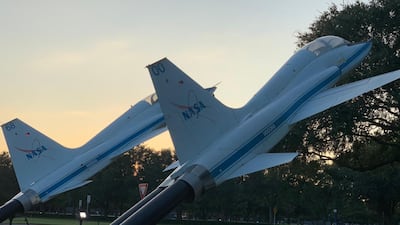
  • The Emirati astronauts are training for long-haul space missions at the Johnson Space Centre in Houston, Texas. They are also training on T-38 jets, which helps a pilot experience seven G-forces because of the speed. It can fly up to Mach 1.6 and 12,000 metres high – that is 3,000m higher than average airliners.
    The Emirati astronauts are training for long-haul space missions at the Johnson Space Centre in Houston, Texas. They are also training on T-38 jets, which helps a pilot experience seven G-forces because of the speed. It can fly up to Mach 1.6 and 12,000 metres high – that is 3,000m higher than average airliners.
Ways to control drones

Countries have been coming up with ways to restrict and monitor the use of non-commercial drones to keep them from trespassing on controlled areas such as airports.

"Drones vary in size and some can be as big as a small city car - so imagine the impact of one hitting an airplane. It's a huge risk, especially when commercial airliners are not designed to make or take sudden evasive manoeuvres like drones can" says Saj Ahmed, chief analyst at London-based StrategicAero Research.

New measures have now been taken to monitor drone activity, Geo-fencing technology is one.

It's a method designed to prevent drones from drifting into banned areas. The technology uses GPS location signals to stop its machines flying close to airports and other restricted zones.

The European commission has recently announced a blueprint to make drone use in low-level airspace safe, secure and environmentally friendly. This process is called “U-Space” – it covers altitudes of up to 150 metres. It is also noteworthy that that UK Civil Aviation Authority recommends drones to be flown at no higher than 400ft. “U-Space” technology will be governed by a system similar to air traffic control management, which will be automated using tools like geo-fencing.

The UAE has drawn serious measures to ensure users register their devices under strict new laws. Authorities have urged that users must obtain approval in advance before flying the drones, non registered drone use in Dubai will result in a fine of up to twenty thousand dirhams under a new resolution approved by Sheikh Hamdan bin Mohammed, Crown Prince of Dubai.

Mr Ahmad suggest that "Hefty fines running into hundreds of thousands of dollars need to compensate for the cost of airport disruption and flight diversions to lengthy jail spells, confiscation of travel rights and use of drones for a lengthy period" must be enforced in order to reduce airport intrusion.

Avatar: Fire and Ash

Director: James Cameron

Starring: Sam Worthington, Sigourney Weaver, Zoe Saldana

Rating: 4.5/5

Updated: February 22, 2022, 6:20 PM