


A fearsome-looking arachnid picked up by a British woman’s cat was a not-so-festive visitor over the winter break in Ras Al Khaimah.
Measuring almost 7 centimetres long and with mandibles capable of snaring small rodents and lizards, the camel spider was a Christmas gift brought into the household of Diane Petty by her adopted cat, Zeri.
Although harmless to adults, camel spiders can deliver a painful bite with their powerful jaws.
Adults can measure up to 16cm in length, suggesting the camel spider found by Ms Petty’s cat was a juvenile.
“It was quite unusual,” Ms Petty said.
“I found in my garden what looked like a baby spider. One of my cats had discovered it, which was a bit of a shame as we don’t often see them.”
Like most large arachnids, camel spiders look more dangerous than they are in reality.

The arachnid was the subject of some early fake news circulated during the Second Gulf War in 2003.
A forced-perspective photo taken by US soldiers made a camel spider they found appear much larger than in real life.
False rumours quickly circulated suggesting the animals were capable of running up to 25 kilometres an hour, could jump two metres off the ground and would feast on sleeping soldiers and the stomachs of camels.
Although the arachnids are capable of speeds of about 16kph, they are not as fast as suggested in tall-tales online. Nevertheless, they remain impressive predators in harsh desert environments.
Their jaws can measure up to a third of their body length, allowing them to seize their prey and eviscerate them quickly in a chopping, sawing motion.
Sightings remain rare in the UAE. Camel spiders will usually flee from human contact unless caught out in the scorching desert sun – then they may take refuge in a shadow cast on open ground.
“The first time I saw a camel spider was about 20 years ago when I was living in Barsha in Dubai,” Ms Petty said.
“People think they are dangerous, but that is not the case at all.
“There is often talk about how dangerous camel spiders are, but they are only ever a slight problem to smaller animals as far as I know.”
Camel spiders are not venomous, but do use their digestive fluids to liquefy their victims' flesh, making it easier to suck out their remains.
As solpugids, they are members of the arachnida class and feed on insects, rodents, lizards and small birds.
“Camel spiders are not seen that often because they are nocturnal and really fast,” said Adrian Hudson, principal ecologist for Anthesis Consulting Middle East, an environmental and sustainability consulting company.
“I have received a number of reports on them before. They are interesting creatures, although they are arachnids so technically not spiders, and belong to a completely different order.
“They do not have venom glands, no venom transfer system and do not spin webs or have book lungs, so are therefore not true spiders."
Mr Hudson said the best advice to anyone accidentally bitten by a camel spider was to keep the area clean.
“They do have powerful jaws and larger individuals can give a good nip.
“If this should happen, it’s best to keep the bite site clean if the skin was punctured, to avoid secondary infection.”

Pest controllers in Dubai said other species were more common causes of call-outs, but advised caution for those planning camping trips to the desert.
“We seldom get calls for camel spiders, as black widow spiders are the most common call-outs we get,” said Dinesh Ramachandran, UAE technical, health and safety manager for pest controllers Rentokil Boecker.
“However, we do serve a few dairy farms and desert resorts that have had camel spider sightings, and we have successfully dealt with them.
“We recommend anyone on desert trips or out camping to double check their belongings, especially camping bags and shoes before packing up.”
The UAE's rarest creatures: in pictures
-

Blanford's fox, a rare species native to the Middle East and Central Asia, was spotted on Jebel Hafeet. Courtesy: Environment Agency Abu Dhabi. -
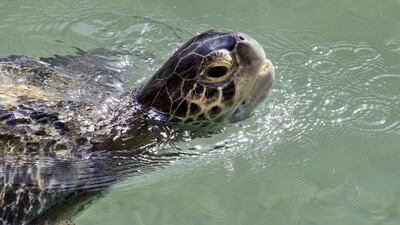
Environment Agency Abu Dhabi and The National Aquarium will launch a turtle rehabilitation programme to save hawksbill turtles. Jaime Puebla / The National -

The Arabian leopard is currently listed as critically endangered. Pawan Singh / The National -
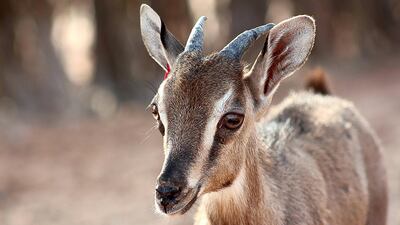
The Arabian tahr has been categorised as an endangered species, with a global population of less than 5,000. Courtesy: TDIC -
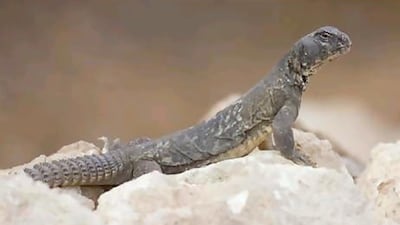
Egyptian spiny-tailed lizard is a vulnerable species. It is found in much of the Middle East. Their numbers have declined over the years and two sub-species exist in the UAE. Courtesy: IUCN -
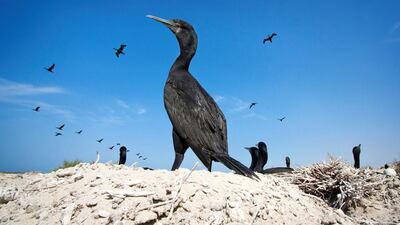
The Socotra cormorant (Phalacrocorax nigrogularis) is a threatened species. It is found in several Gulf states, including the UAE. It is threatened by development and oil spills and has a total population of less than half a million. Courtesy: Rob Gubiani -

The Houbara bustard is classified as a vulnerable species by the International Union for Conservation of Nature. Courtesy: International Fund For Houbara Conservation



