



Related: UAE rail link from Fujairah to Saudi border on track for completion
The UAE’s Etihad Rail project is a crucial step in a long-term plan to create a regional network, a leading consultant involved with the transport project said.
Etihad Rail aims to link the country’s centres of trade, industry and population, and will provide passenger and freight services.
When complete, it will stretch about 1,200 kilometres across the UAE, with plans for it to eventually connect to other Gulf nations.
Freight will be the central focus once stage two of Etihad Rail is complete, connecting the Emirates with Saudi Arabia at the border in Ghuweifat.
Alstom Middle East
Passenger travel will also expand across the country and eventually further into the region to create international rail connections similar to those in Europe.
Youssef Khalifeh, Middle East regional director for Deutsche Bahn engineering and consulting, said a GCC connected by passenger rail is an ambition unlikely to be realised for up to a decade.
“There needs to be a determination in the GCC to activate what they have already decided to do with a railway network that starts in Kuwait, travels through Saudi Arabia and stops at all other countries on the way to the UAE,” he said.
“The only sections to have been done so far are Saudi Arabia, to an extent, and the UAE, which is in stage two.
“Oman and Kuwait has nothing complete, there is no connection with Qatar yet and Bahrain is still talking about it.
“Big discussions are under way between Qatar and Saudi Arabia to connect it to the GCC rail network, and it is being activated as we speak.
“This project still needs another five to 10 years.”
-
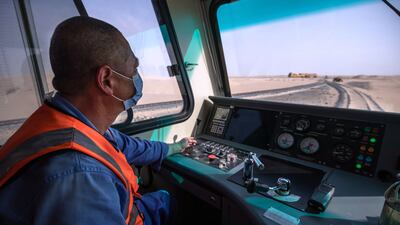
Etihad Rail's inspection train travels from Saih Shuaib to Al Maha Forest in Abu Dhabi, as officials monitor progress in the second stage of the national railway project. All photos: Victor Besa / The National -
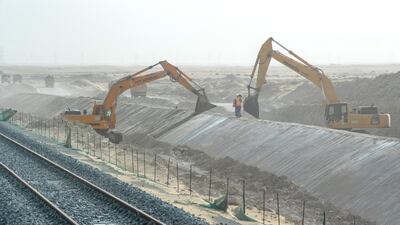
The inspection train is designated for the supervision and inspection of construction works. -
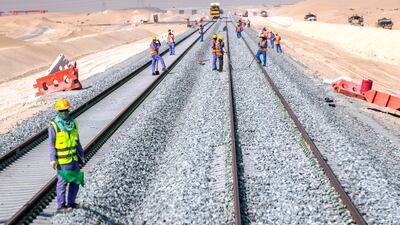
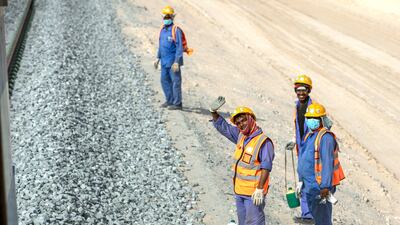
Railroad track workers along the Saih Shuaib line. -

From Saih Shuaib, tracks are being laid north toward Dubai and south toward Abu Dhabi, creating a rail link for the first time between the two emirates. -

Stage one of Etihad Rail, a 264-kilometre line, has been fully operational since January 2016. -
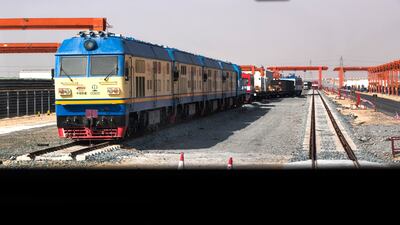
Two trains transport up to 22,000 tonnes of granulated sulphur each day from gas fields in Shah and Habshan to an export point in Ruwais. -
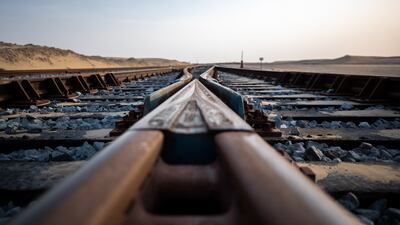
The second stage of the network will extend from Ghuwaifat on the border with Saudi Arabia and connect the emirates of Abu Dhabi, Dubai, Sharjah, Ras Al Khaimah and Fujairah on the east coast. -
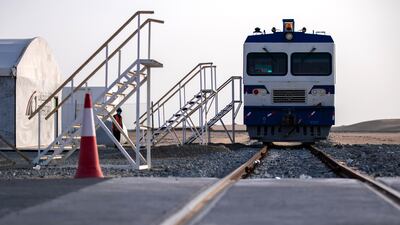
The fleet will expand from seven to 45 locomotives, transporting 60 million tonnes of cargo a year. -
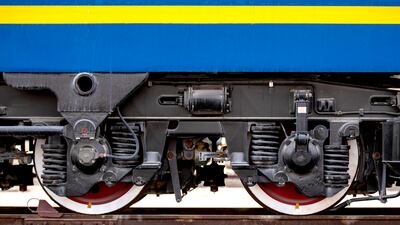
In March, Etihad Rail announced it had completed 34 per cent of the network. -
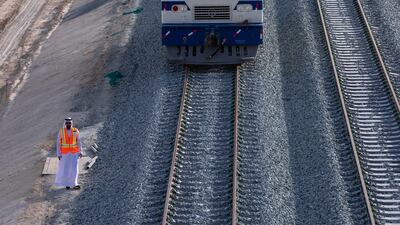
After the completion of stage two and other future expansion works, the rail network will stretch about 1,200km across the country. -
The rail service will carry both passengers and freight. -

Omar Al Sebeyi, acting executive director of the commercial sector at Etihad Rail said everyone was working hard to achieve their deadlines. -

Railroad cars about to be loaded with metal rails, rocks and other track-building materials for transporting down the line. -
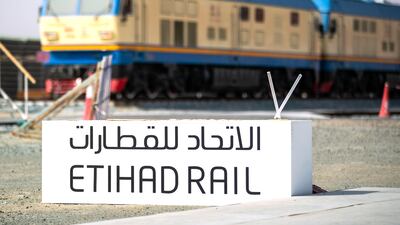
A locomotive at the railroad yard. -
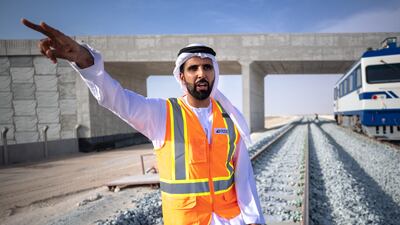
Omar Al Sebeyi, acting executive director of the commercial sector at Etihad Rail points out changes to the track.


Regional rail development has stalled owing to plunging oil prices, shrinking revenue and budgets reallocated to support national economies during the pandemic.
The biggest challenge facing a regional railway is largely cultural, said Mr Khalifeh, whose Deutsche Bahn consultancy has been heavily involved with maintenance and operation of stage one of Etihad Rail.
In a land where the car is king and fuel cheap, it could take years to encourage more people on to public transport.
A new train of thought
The passenger experience is critical to that transition, with stations becoming welcoming urban hubs at which travellers can dine, shop and work.
“For any expatriate living in this region, they are used to rail networks like we see in Europe or India,” said Mr Khalifeh, who was speaking on the sidelines of the Middle East Rail conference in Dubai.
“But for locals, culturally it is different. Why would they want to get into a train when they have a car with cheap fuel?
“There is a lack of a good train experience but that will slowly change. We have seen that in Dubai [with the Metro].
“Discussions with transport authorities are happening all the time. It is about finding the time and finance to do it elsewhere.
“In Europe and the US, stations are marvels of architecture and they have lots of attractions inside, from shopping and dining or as a workspace, so it becomes an enjoyable experience to wait for a train.”
Going full speed ahead
High-speed rail is likely to be the dominant form of mass-passenger transport in the years to come, despite the emergence of new technology such as the Hyperloop and suspended skypods transported along steel cables.
Deutsche Bahn has completed feasibility studies on first and last-mile transport options to reach stations at which trains can be boarded.
They include options for urban air mobility to catch a drone taxi or autonomous shuttle, and have been studied in Switzerland, Italy, France, Germany and the US.
The company aims to operate a 1,300km high-speed rail link between Los Angeles and San Francisco, with trains travelling at 350kph, to slash travel times from eight hours to three.
The $80 billion project is due for completion by 2029.
“This would be the first truly high-speed train in the country,” Mr Khalifeh said.
“For the next decade, DB will focus on the tried and tested form of travel, which is steel wheels on steel tracks for regional trains.
“We will also innovate with stations of the future.
“Digitalisation will see video conferencing ticket booths, which is already happening in Germany, to make reservations or buy tickets 24 hours a day.
“It must be a comfortable setting for the traveller.
“There are targets to reduce carbon footprints and the way to do that is to improve public transport, reduce the use of cars and increase renewable energy.
“The rail sector needs to invest in itself, but governments in this part of the world need to strike a value balance between roads and railways, as we all need to gain by helping the environment.”
Hydrogen-powered train to boost environment
Rail remains one of the more energy-efficient forms of travel, and that is expected to further improve as technology progresses.
On average, trains emit about 10 times less carbon dioxide per passenger kilometre than do planes, and about five times less than cars.
Urban transport specialist Alstom developed the Dubai Tram, and also worked on Dubai Metro and stage one of Etihad Rail’s signalling.
The company’s Coradia iLint is the world’s first hydrogen fuel cell passenger train.

It is quiet, emission-free and emits only condensation and water vapour.
The train was trialled in Poland on non-electrified lines, and is now in operation across Europe.
Alstom’s regional managing director, Mama Sougoufara, said passenger rail has an exciting future in the Gulf.
“The planned Gulf Railway will connect the Gulf States as we see in Europe,” he said.
“I have no doubt it will be a success for both freight and passenger movement.
“As people around the world become more environmentally conscious including here in the GCC, you will see a stronger demand on lower emissions transport.”
The UAE has committed to a carbon-neutral path, and aims to achieve net zero greenhouse gas emissions by 2050.
A short round trip economy flight from Dubai to Riyadh equates to about 0.4 tonnes of carbon emissions, almost a quarter of personal emissions targets.
“Providing a rail solution will significantly decrease that amount, even without using green energy,” said Mr Sougoufara.
“To incentivise people, governments and the industry need to ensure that public transport is available, affordable, convenient, attractive and more efficient than personal cars or planes, where appropriate.
“Unlike countries with established networks, the GCC has the opportunity to build new networks with the latest technology from the start.”

