


A mysterious jet of energy has been captured emerging from a supermassive black hole, in a detailed photograph by the telescope that took the first picture of a black hole two years ago.
The Event Horizon Telescope, consisting of eight radio observatories that act as one Earth-sized telescope, caught the enormous jet escaping from a black hole in the centre of the Centaurus A galaxy. The findings were published in the Nature Astronomy journal on Monday.
astronomer
Supermassive black holes – which are the largest type and are millions to billions of times the mass of the Sun – destroy most nearby matter, including gas and dust, through their gravitational pull.
But some surrounding particles escape moments before capture and are blown out into space, creating jets.
For decades, astronomers have been trying to study how the phenomenon occurs.

"This allows us for the first time to see and study an extragalactic radio jet on scales smaller than the distance light travels in one day,” said Michael Janssen, an astronomer at the Max Planck Institute for Radio Astronomy in Bonn and Radboud University Nijmegen.
“We see up close and personal how a monstrously gigantic jet launched by a supermassive black hole is being born.”
In April 2019, the first image of a black hole was released, after the telescope captured M87 – a supermassive black hole with a mass more than six million times that of the Sun.

The latest observations were made at 10 times the frequency of any previous recordings, at a resolution that was 16 times sharper, allowing astronomers to study the black hole and the jet in detail.
“It’s amazing that we can study Centaurus A now with the extreme resolution of the EHT. We have never seen this nucleus before, as we didn't have sufficiently high resolution and we weren't looking at high enough frequencies,” said Maciek Wielgus, co-author of the study and researcher at Harvard and Smithsonian Centre for Astrophysics.
"Centaurus A is our close neighbour in the intergalactic sense – it’s only about 10 million light years away. And its central region is very different from our own galactic centre – there’s so much more power emerging from the nucleus of Centaurus A.”

Through the findings, astronomers are trying to understand how jets are launched from these central regions and how they are able to extend over scales that are larger than their host galaxies without dispersing.
The new images show the jet is brighter at the edges than at the centre.
"Theoretically, jets can collide with galactic gas and heat up the edge, but the details of such a process so close to the black hole are a complete mystery,” Koushik Chatterjee, a study co-author and researcher at the Centre for Astrophysics and the Black Hole Initiative, said.
“The brightness contrast between the centre and the edge could potentially provide us with new insights about the plasma physics both within and around jets, making Centaurus A an exciting target for next-generation black hole simulations.”
Researchers now hope to photograph the central black hole of Centaurus A at even higher resolutions.
The wonders of space - in pictures
-
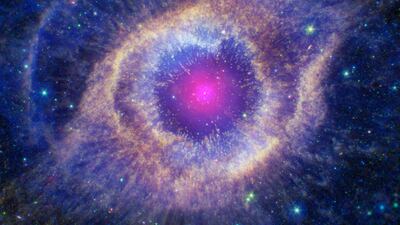
Helix Nebula is a phase when a star like the Sun runs out of fuel, it expands and its outer layers puff off, and then the core of the star shrinks. All photos: Nasa -
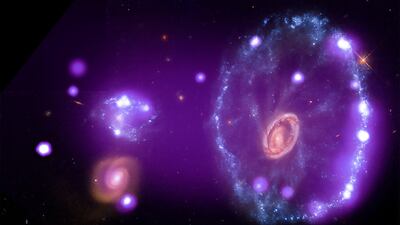
This Cartwheel Galaxy resembles a bull's eye, which is appropriate because its appearance is partly due to a smaller galaxy that passed through the middle of this object. -
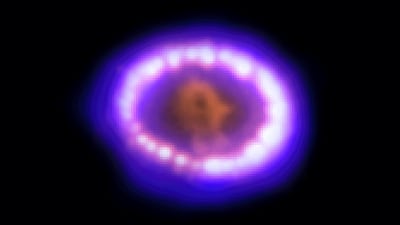
On February 24, 1987, observers in the southern hemisphere saw a new object in a nearby galaxy called the Large Magellanic Cloud. This was one of the brightest supernova explosions in centuries and soon became known as Supernova 1987A. -
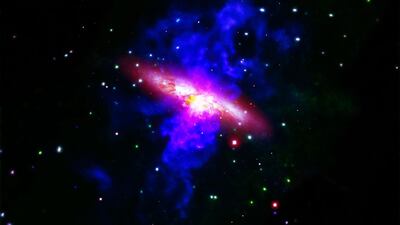
Messier 82, or M82, is a galaxy that is oriented edge-on to Earth. This gives astronomers an interesting view of what happens as this galaxy undergoes bursts of star formations. -
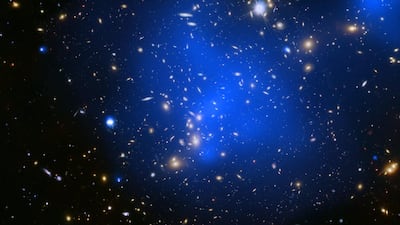
Galaxy clusters are the largest objects in the universe held together by gravity. They contain enormous amounts of superheated gas, with temperatures of tens of millions of degrees, which glow brightly in X-rays and can be observed across millions of light years between galaxies. -

What will be the next star in our Milky Way galaxy to explode as a supernova? Astronomers aren't certain, but one candidate is in Eta Carinae, a volatile system containing two massive stars that closely orbit each other.



