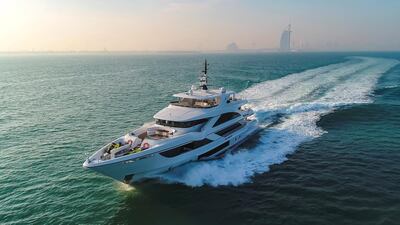
Inside Gulf Craft: the UAE's megayacht shipyard


Georgia Tolley
  • English
  • Arabic

While the world feels the impact of the Covid-19 pandemic, the mega-rich have been seeking added sanctuary by snapping up yachts so they can physically distance in the lap of luxury.

Boat brokers are struggling to meet demand, but that is good news for one privately owned UAE company.

Far from the bustling berths of Monaco and Cannes, where most superyachts spend the summer, is the emirate of Umm Al Quwain, on a peninsula in the north of the UAE.

Along a coastline dominated by mangroves and blue-clawed crabs is one of the world's top ten shipyards. Gulf Craft employs more than 1,000 people, and has made more than 10,000 vessels since it was established by Emirati businessman Mohammed Alshaali in 1982.

We have doubled production for our larger yachts, and maybe even tripled production of smaller vessels
Talal Nasralla,
Gulf Craft chief executive

Inside cavernous indoor warehouses that cover an area bigger than four football pitches, Gulf Craft makes some of the world's most luxurious superyachts.

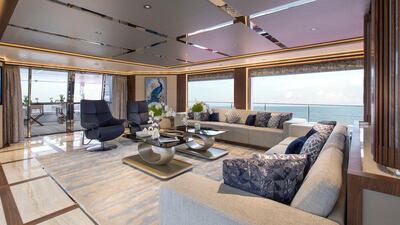
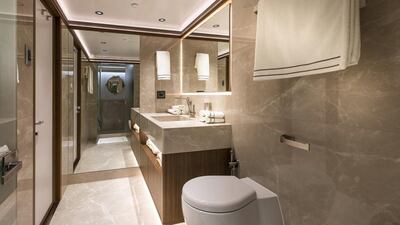
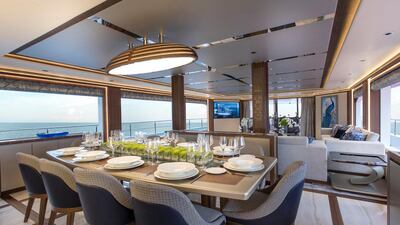
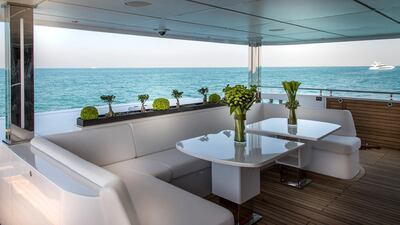
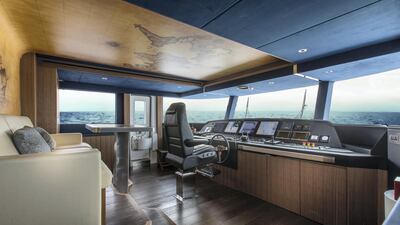
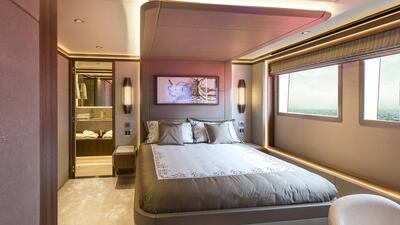
This is not an assembly plant; nearly every element of each vessel is designed and built in Umm Al Quwain – from the moulding of the carbon-fibre hulls, to the joinery of the five-star interiors and the welding of the sleek metalwork which surrounds the decks.

Chief executive Talal Nasralla said this is a point of pride for the company, but it also makes them competitive on price.

"At Gulf Craft we look at the craftsmanship. We compete on the world stage in terms of taste, finish and quality because our team of craftsmen work with their hands and look at the very fine details," said Mr Nasralla, who took over as chief executive in February.

"We are a vertically integrated company. Everything is made in-house, and that brings down costs."

Gulf Craft can make 200 boats a year and specialises in composite yachts made out of carbon fibre and vinyl ester rather than from steel and aluminium, which also brings down the price.

Composite vessels consume less fuel than their metal counterparts, do not rust and have a shallow draft – meaning their keel is not far below the waterline – ideal for navigating the shallow waters around the UAE, the Caribbean and the Mediterranean Sea.

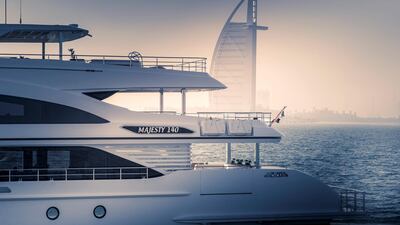
Prices start at $70,000 (Dh257,000) for a 31 foot day boat, and soar to $17m (Dh63m) for a Majesty 140.

The National toured the shipyard and watched the boatbuilders at work – sanding, cutting and welding.

Outside, two 150-tonne travel lifts designed to raise the biggest of yachts stood idle. But moored up along the quayside were some of Gulf Craft's newest vessels, their decks covered in protective blue sheets as labourers added the finishing touches.

One was the flagship megayacht called Majesty 175, which was sold to a prominent Emirati businessman for $35m (Dh129m).

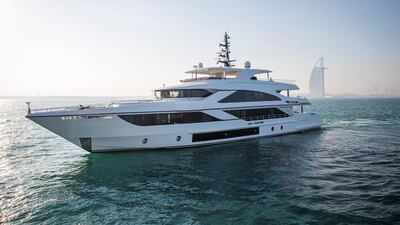
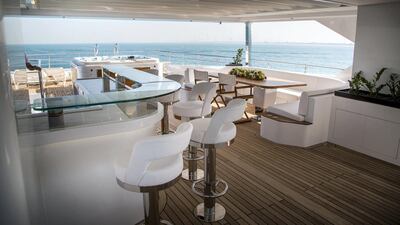
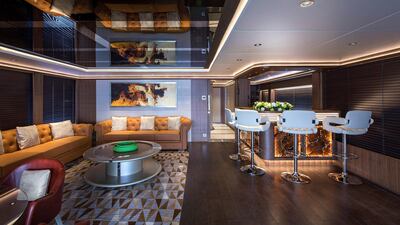
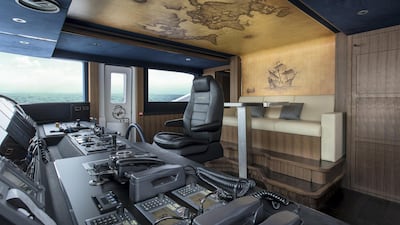
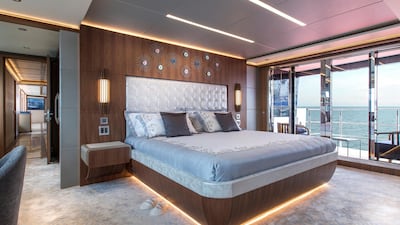
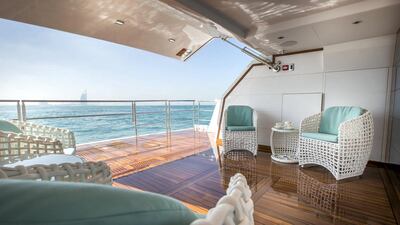
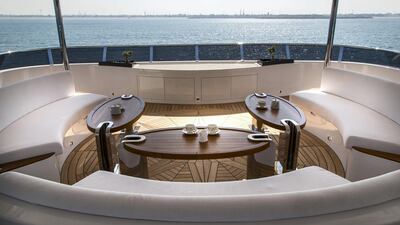
Measuring 53 metres, it is the world's largest composite production vessel, comprising four decks, seven en suite bedrooms, a gym, a lift, a professional kitchen and discrete staff quarters for 10.

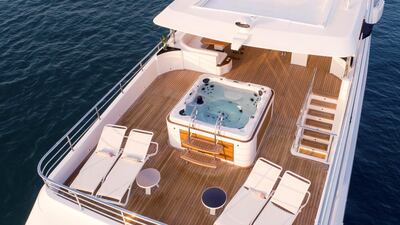
It looked ready to sail – just the infinity swimming pool needed filling.

The impact of the pandemic

During the local and international lockdowns of 2020, the Gulf Craft boatyards had to close, and supply chains were disrupted, causing production delays. Sales slowed to a trickle, as the world's population stayed home.

But this year, the company bounced back with a stronger first quarter than the past three years, Mr Nasralla said.

"The company took a very wise decision to continue building during 2020, so we came out on the other side of the pandemic with a wealth of stock. This meant we were able to meet the rising demand at the beginning of 2021.

"In the past we've seen the yard build up to two or three large yachts, maximum, a year. Now we have five, nearly six orders for our 100ft yacht.

"We have doubled production for our larger yachts, and maybe even tripled production of smaller vessels. We have a build backlog up to mid-2022."

Gulf Craft sells its boats to buyers all over the world, including to the GCC, Turkey, Russia, Italy, Slovenia and the US. In America, sales of vessels, marine products and services surged to a 13-year high last year – $47 billion – an increase of nine per cent from the previous year, according to the National Marine Manufacturers Association.

Gulf Craft's customers are not all established industry leaders with deep pockets, Mr Nasralla said.

"We have a good mix of clients, but what we've seen lately is that the younger generation of buyers are coming into the picture, and especially in the last couple of years, we have seen younger people more interested in being at sea with their families.

"There's a generation of those younger nomads, buying our smaller yachts."

Socially distanced at sea

Mr Nasralla believes the yachting industry's recovery in the past six months is in part down to last year's lockdowns.

"We believe that this is partly driven by the social distancing that people feel when they are on the yacht with their families," he said.

"Of course, the lack of travel during 2020 is contributing as well, plus the closure of certain destinations, but people have also realised that spending time on a yacht with their family and friends provides them with the ultimate vacation at home.

"Plus, when travel restrictions ease in the future, it will be relatively easy for them to take their yachts around the world, so it's a full solution."

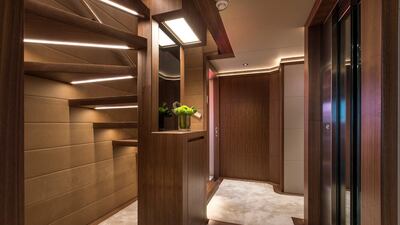
In pictures: Gulf Craft's Majesty 140


500 People from Gaza enter France

115 Special programme for artists

25   Evacuation of injured and sick

WITHIN%20SAND
%3Cp%3EDirector%3A%20Moe%20Alatawi%3C%2Fp%3E%0A%3Cp%3EStarring%3A%20Ra%E2%80%99ed%20Alshammari%2C%20Adwa%20Fahd%2C%20Muhand%20Alsaleh%3C%2Fp%3E%0A%3Cp%3ERating%3A%203%2F5%3C%2Fp%3E%0A
UAE currency: the story behind the money in your pockets
360Vuz PROFILE

Date started: January 2017
Founder: Khaled Zaatarah 
Based: Dubai and Los Angeles
Sector: Technology 
Size: 21 employees
Funding: $7 million 
Investors: Shorooq Partners, KBW Ventures, Vision Ventures, Hala Ventures, 500Startups, Plug and Play, Magnus Olsson, Samih Toukan, Jonathan Labin

Family reunited

Nazanin Zaghari-Ratcliffe was born and raised in Tehran and studied English literature before working as a translator in the relief effort for the Japanese International Co-operation Agency in 2003.

She moved to the International Federation of Red Cross and Red Crescent Societies before moving to the World Health Organisation as a communications officer.

She came to the UK in 2007 after securing a scholarship at London Metropolitan University to study a master's in communication management and met her future husband through mutual friends a month later.

The couple were married in August 2009 in Winchester and their daughter was born in June 2014.

She was held in her native country a year later.

The%20specs
%3Cp%3E%3Cstrong%3EEngine%3A%20%3C%2Fstrong%3E2.3-litre%204cyl%20turbo%0D%3Cbr%3E%3Cstrong%3EPower%3A%20%3C%2Fstrong%3E299hp%20at%205%2C500rpm%0D%3Cbr%3E%3Cstrong%3ETorque%3A%20%3C%2Fstrong%3E420Nm%20at%202%2C750rpm%0D%3Cbr%3E%3Cstrong%3ETransmission%3A%20%3C%2Fstrong%3E10-speed%20auto%0D%3Cbr%3E%3Cstrong%3EFuel%20consumption%3A%20%3C%2Fstrong%3E12.4L%2F100km%0D%3Cbr%3E%3Cstrong%3EOn%20sale%3A%20%3C%2Fstrong%3ENow%0D%3Cbr%3E%3Cstrong%3EPrice%3A%20%3C%2Fstrong%3EFrom%20Dh157%2C395%20(XLS)%3B%20Dh199%2C395%20(Limited)%3C%2Fp%3E%0A
FIGHT CARD

Welterweight Mostafa Radi (PAL) v Tohir Zhuraev (TJK)

Catchweight 75kg Leandro Martins (BRA) v Anas Siraj Mounir (MAR)

Flyweight Corinne Laframboise (CAN) v Manon Fiorot (FRA)

Featherweight Ahmed Al Darmaki (UAE) v Bogdan Kirilenko (UZB)

Lightweight Izzedine Al Derabani (JOR) v Atabek Abdimitalipov (KYG)

Featherweight Yousef Al Housani (UAE) v Mohamed Arsharq Ali (SLA)

Catchweight 69kg Jung Han-gook (KOR) v Elias Boudegzdame (ALG)

Catchweight 71kg Usman Nurmagomedov (RUS) v Jerry Kvarnstrom (FIN)

Featherweight title Lee Do-gyeom (KOR) v Alexandru Chitoran (ROU)

Lightweight title Bruno Machado (BRA) v Mike Santiago (USA)

Ruwais timeline

1971 Abu Dhabi National Oil Company established

1980 Ruwais Housing Complex built, located 10 kilometres away from industrial plants

1982 120,000 bpd capacity Ruwais refinery complex officially inaugurated by the founder of the UAE Sheikh Zayed

1984 Second phase of Ruwais Housing Complex built. Today the 7,000-unit complex houses some 24,000 people.  

1985 The refinery is expanded with the commissioning of a 27,000 b/d hydro cracker complex

2009 Plans announced to build $1.2 billion fertilizer plant in Ruwais, producing urea

2010 Adnoc awards $10bn contracts for expansion of Ruwais refinery, to double capacity from 415,000 bpd

2014 Ruwais 261-outlet shopping mall opens

2014 Production starts at newly expanded Ruwais refinery, providing jet fuel and diesel and allowing the UAE to be self-sufficient for petrol supplies

2014 Etihad Rail begins transportation of sulphur from Shah and Habshan to Ruwais for export

2017 Aldar Academies to operate Adnoc’s schools including in Ruwais from September. Eight schools operate in total within the housing complex.

2018 Adnoc announces plans to invest $3.1 billion on upgrading its Ruwais refinery 

2018 NMC Healthcare selected to manage operations of Ruwais Hospital

2018 Adnoc announces new downstream strategy at event in Abu Dhabi on May 13

Source: The National

The biog

Hobbies: Writing and running
Favourite sport: beach volleyball
Favourite holiday destinations: Turkey and Puerto Rico​

Mercer, the investment consulting arm of US services company Marsh & McLennan, expects its wealth division to at least double its assets under management (AUM) in the Middle East as wealth in the region continues to grow despite economic headwinds, a company official said.

Mercer Wealth, which globally has $160 billion in AUM, plans to boost its AUM in the region to $2-$3bn in the next 2-3 years from the present $1bn, said Yasir AbuShaban, a Dubai-based principal with Mercer Wealth.

Within the next two to three years, we are looking at reaching $2 to $3 billion as a conservative estimate and we do see an opportunity to do so,” said Mr AbuShaban.

Mercer does not directly make investments, but allocates clients’ money they have discretion to, to professional asset managers. They also provide advice to clients.

“We have buying power. We can negotiate on their (client’s) behalf with asset managers to provide them lower fees than they otherwise would have to get on their own,” he added.

Mercer Wealth’s clients include sovereign wealth funds, family offices, and insurance companies among others.

From its office in Dubai, Mercer also looks after Africa, India and Turkey, where they also see opportunity for growth.

Wealth creation in Middle East and Africa (MEA) grew 8.5 per cent to $8.1 trillion last year from $7.5tn in 2015, higher than last year’s global average of 6 per cent and the second-highest growth in a region after Asia-Pacific which grew 9.9 per cent, according to consultancy Boston Consulting Group (BCG). In the region, where wealth grew just 1.9 per cent in 2015 compared with 2014, a pickup in oil prices has helped in wealth generation.

BCG is forecasting MEA wealth will rise to $12tn by 2021, growing at an annual average of 8 per cent.

Drivers of wealth generation in the region will be split evenly between new wealth creation and growth of performance of existing assets, according to BCG.

Another general trend in the region is clients’ looking for a comprehensive approach to investing, according to Mr AbuShaban.

“Institutional investors or some of the families are seeing a slowdown in the available capital they have to invest and in that sense they are looking at optimizing the way they manage their portfolios and making sure they are not investing haphazardly and different parts of their investment are working together,” said Mr AbuShaban.

Some clients also have a higher appetite for risk, given the low interest-rate environment that does not provide enough yield for some institutional investors. These clients are keen to invest in illiquid assets, such as private equity and infrastructure.

“What we have seen is a desire for higher returns in what has been a low-return environment specifically in various fixed income or bonds,” he said.

“In this environment, we have seen a de facto increase in the risk that clients are taking in things like illiquid investments, private equity investments, infrastructure and private debt, those kind of investments were higher illiquidity results in incrementally higher returns.”

The Abu Dhabi Investment Authority, one of the largest sovereign wealth funds, said in its 2016 report that has gradually increased its exposure in direct private equity and private credit transactions, mainly in Asian markets and especially in China and India. The authority’s private equity department focused on structured equities owing to “their defensive characteristics.”

Benefits of first-time home buyers' scheme
  • Priority access to new homes from participating developers
  • Discounts on sales price of off-plan units
  • Flexible payment plans from developers
  • Mortgages with better interest rates, faster approval times and reduced fees
  • DLD registration fee can be paid through banks or credit cards at zero interest rates
The%20specs%3A%20Taycan%20Turbo%20GT
%3Cp%3E%3Cstrong%3EEngine%3A%20%3C%2Fstrong%3EDual%20synchronous%20electric%20motors%0D%3Cbr%3E%3Cstrong%3EPower%3A%20%3C%2Fstrong%3E1%2C108hp%0D%3Cbr%3E%3Cstrong%3ETorque%3A%20%3C%2Fstrong%3E1%2C340Nm%0D%3Cbr%3E%3Cstrong%3ETransmission%3A%20%3C%2Fstrong%3ESingle-speed%20automatic%20(front%20axle)%3B%20two-speed%20transmission%20(rear%20axle)%0D%3Cbr%3E%3Cstrong%3ETouring%20range%3A%20%3C%2Fstrong%3E488-560km%0D%3Cbr%3E%3Cstrong%3EPrice%3A%20%3C%2Fstrong%3EFrom%20Dh928%2C400%0D%3Cbr%3E%3Cstrong%3EOn%20sale%3A%20%3C%2Fstrong%3EOrders%20open%3C%2Fp%3E%0A
Updated: July 04, 2021, 5:30 AM