
After a career laden with belts, cash and kudos, boxing great Floyd Mayweather Jr retired undefeated over 50 fights -- but his flawless record faces an unlikely challenge from an obscure Thai fighter known as the "dwarf giant".
At 5ft 2in and weighing just 47.6 kilograms, minimumweight Wanheng Menayothin is shorter, leaner and significantly less wealthy than Mayweather, who briefly emerged from retirement last year to fight MMA star Conor McGregor for a $100 million purse (Dh367 million).
If Wanheng triumphs on Wednesday afternoon he will equal Mayweather's feat of winning 50 successive fights.
His WBC minimumweight belt is on the line against Panamanian challenger Leroy Estrada.
The fight, to be held outside the town hall of second-tier Thai city Nakhon Ratchasima, has none of the glitz or pay-per-view pull of a Mayweather bout in Las Vegas.
But still Wanheng will enter boxing lore with victory - and, at 32 years of age, has time to go one better and match the 51 wins, one draw and no losses set by Mexican flyweight Ricardo Lopez.
It is not just the box office power that differentiates Mayweather from the Thai, who turned to the ring at the age of 12 as a path out of poverty.
While the prelude to Mayweather fights was defined by hype and trash-talking, Wanheng has adopted a more karmic approach.
"I'm not feeling pressured, you win and you lose, and that's the nature of sports," he said at his gym in Bangkok a few days before defending his title.
But he said he had trained hard with the aim of "equalling Floyd".
Nicknames also capture the difference between the pair.
-
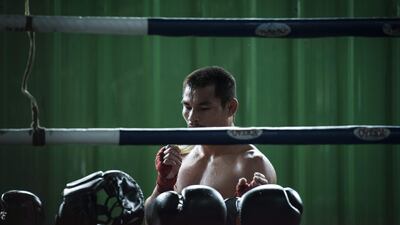
World Boxing Council (WBC) mini-flyweight champion, Wanheng Menayothin, taking out his mouthguard during a training session in Bangkok. Unsung outside the boxing world, the Thai fighter nicknamed the "dwarf giant" is quietly closing in on Floyd Mayweather's undefeated 50 fight record and with it an unlikely place among the sport's greats. Lillian Suwanrumpha / AFP -
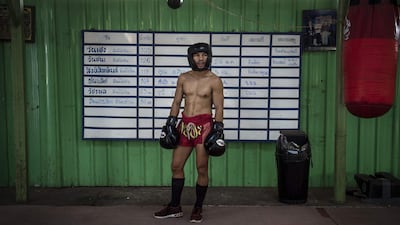
World Boxing Council (WBC) mini-flyweight champion, Wanheng Menayothin, waiting to spar during a training session in Bangkok. Lillian Suwanrumpha / AFP -
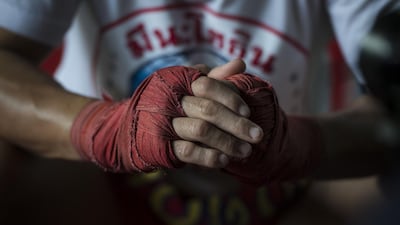
World Boxing Council (WBC) mini-flyweight champion, Wanheng Menayothin, clasping his wrapped knuckles during an interview before a training session in Bangkok. Lillian Suwanrumpha / AFP -
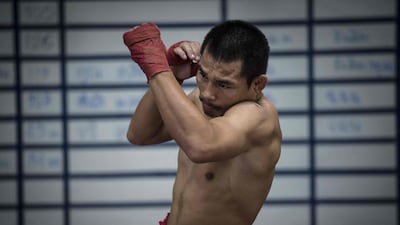
World Boxing Council (WBC) mini-flyweight champion, Wanheng Menayothin, warming up during a training session in Bangkok. Lillian Suwanrumpha / AFP -
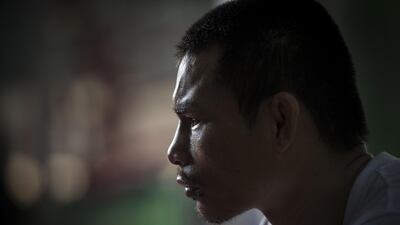
World Boxing Council (WBC) mini-flyweight champion, Wanheng Menayothin, sitting for an interview before a training session in Bangkok. Lillian Suwanrumpha / AFP -
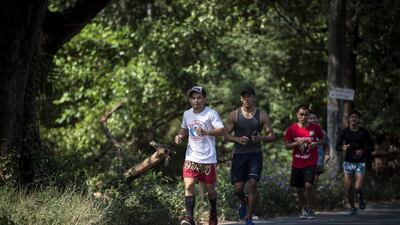
World Boxing Council (WBC) mini-flyweight champion, Wanheng Menayothin, running with other boxers from his gym before a training session in Bangkok. Lillian Suwanrumpha / AFP -
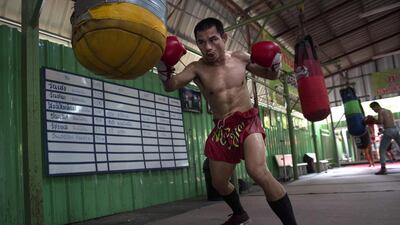
World Boxing Council (WBC) mini-flyweight champion, Wanheng Menayothin, punching a bag during a training session in Bangkok. Lillian Suwanrumpha / AFP -
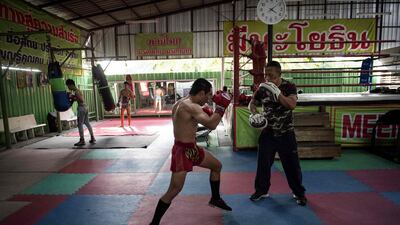
World Boxing Council (WBC) mini-flyweight champion, Wanheng Menayothin (C), doing pad work with his trainer during a training session in Bangkok. Lillian Suwanrumpha / AFP


In addition to "Money", the American fought under the moniker "Pretty Boy" and "The Best Ever", tags he still rolls out on a Twitter profile boasting more than eight million followers.
With Wanheng, it's more complicated.
Fighters in Thailand often compete under the label of their gym, which is where his second name Menayothin - the name of his Bangkok gym - comes from.
His legal name is Chayaphon Moonsri, while his most widely used nickname is the "dwarf giant" because of his small stature and powerful punches.
But the boxer also fights under the alias "Five-Star Grilled Chicken" as part of sponsorship deal with Thai food giant CP Chicken.
Should Wanheng win on Wednesday his name will enter the record books, but with an asterisk of sorts.
He has fought mostly low-profile Asian challengers on his home turf in Thailand.
His rivals have been a mixed bag - one last year had 44 losses, while another in 2014 had 24.
In December he tied Rocky Marciano's 49-0 tally with a win over Japanese contender Tatsuya Fukuhara.
Mayweather, meanwhile, had a much tougher ride defeating some of the sport's all-time greats, including Manny Pacquiao and Oscar De La Hoya. The welterweight has 27 KOs to Wanheng's 17.
"With respect to Wanheng he's never beaten anyone of note. In the west this fight will be nothing more than a trivial pursuit question," Anson Wainwright, a boxing correspondent for The Ring magazine, told AFP, adding that matching the record would nevertheless be a "good achievement."
Carlos Costa, a boxing reporter covering the fight, said the 23-year-old Estrada also poses a unique challenge to Wanheng, 32.
"He's younger and fresher," Costa said of Estrada. "He's hungry for glory, and that makes a boxer always dangerous."
And the Panamanian is in no mood to help Wanheng into the history books, saying "this is my opportunity to be a champion".

