

Perhaps the best gauge of how intense a sporting rivalry has become is to ask how much effort goes into stoking it. If so, the leading football clubs of North Africa, whose noisiest arguments have for a very long time been chiefly with one another, are clearly acknowledging the growing menace to their hierarchy from much further away.
In Rades, Tunisia last week, a great deal of creative energy, imagination and wit was devoted to a vast tifo, an illustrated banner designed to stretch across the full width of stadium grandstand, for display in the home leg of Esperance of Tunis’s African Champions League quarter-final against Mamelodi Sundowns of South Africa. Esperance supporters are expert in all aspects of stadium atmospherics and, on the frequent occasions when their team triumph in a major competition those fans tend to be thanked by players, coaches and club executives for their role in providing rousing support. Visitors to Esperance expect a hostile, intimidating experience.
Sundowns got the full visual blast. The enormous tifo featured a ghoulish figure in Esperance red pushing a firm hand down on the head of a cowering victim, clearly representing the team from Pretoria. And a message was spelt out in towering letters, in English: "Tokoloshe Haunts," it said.
The artists had done thorough homework here. A tokoloshe, as a limited number of people from outside southern Africa would know, is a folkloric creature with magical, malevolent powers. Children in South Africa and neighbouring countries grow up frightened of the tokoloshe – until they grow up and learn the creature is entirely make-believe.
So it was that the players of Sundowns, walking into the cauldron of the Rades stadium were confronted, behind one goal, by arresting images and a surprisingly precise cultural reference. Esperance’s fans had worked hard at preparing a special shock for their visitors.
But did all that, or the shrill, partisan crowd, disturb Sundowns? Not enough to keep them from diligently protecting the 1-0 lead they had achieved in the Pretoria leg of the tie, a fixture marred by some skirmishes between opposing fans. In Tunis, Sundowns held their nerve. The 0-0 draw, would be enough to put them into the semi-finals, and to avenge last season’s 2-0 aggregate win for Esperance, when the two clubs met at the last-four stage.
-
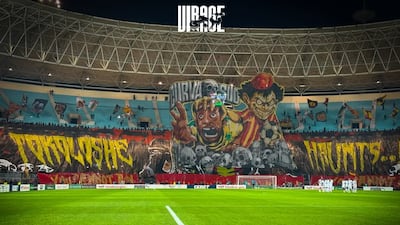
The Esperance fans created this Tifo to welcome Mamelodi Sundowns to Tunis in the CAF Champions League quarter-final second leg. Photo: Ultramaniatics / X -
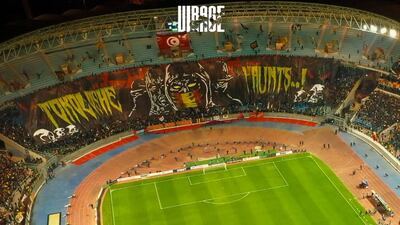
The Esperance fans created this Tifo to welcome Mamelodi Sundowns to Tunis in the CAF Champions League quarter-final second leg. Photo: Ultramaniatics / X -

The Esperance fans created this Tifo to welcome Mamelodi Sundowns to Tunis in the CAF Champions League quarter-final second leg. Photo: Ultramaniatics / X -
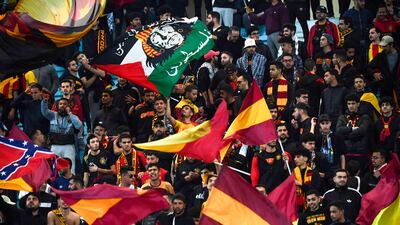
Esperance's fans cheer ahead of the second leg of the CAF Champions League quarter-final against Mamelodi Sundowns. AFP -

Esperance's fans cheer ahead of the second leg of the CAF Champions League quarter-final against Mamelodi Sundowns. AFP -
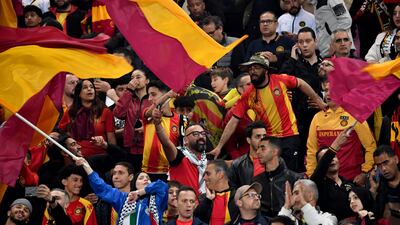
Esperance's fans cheer ahead of the second leg of the CAF Champions League quarter-final against Mamelodi Sundowns. AFP -
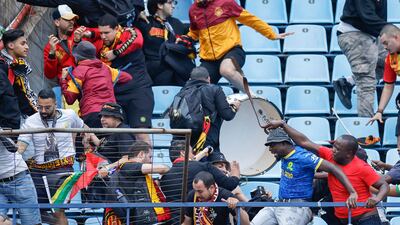
The first leg between Esperance and Mamelodi Sundowns in Pretoria was marred by fighting between fans. AFP -
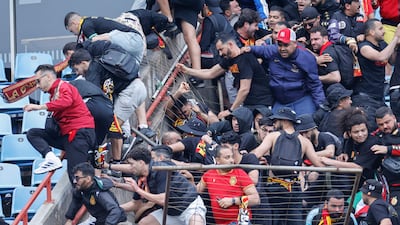
The first leg between Esperance and Mamelodi Sundowns in Pretoria was marred by fighting between fans. AFP -
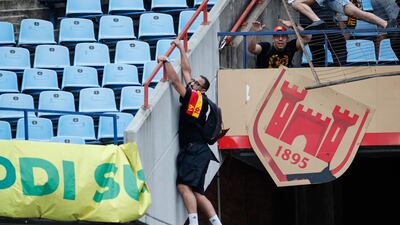
The first leg between Esperance and Mamelodi Sundowns in Pretoria was marred by fighting between fans. AFP -

The first leg between Esperance and Mamelodi Sundowns in Pretoria was marred by fighting between fans. AFP


It also broke the usual pattern in the latter phases of African club football’s most prestigious tournament, which is that North African expertise, coupled with a fierce crowd reception in the North African leg of a tie, trumps the best of what the continent’s south, west or east can manage. And, that each May or June, the gold and silver medals duly go to clubs from the Mena region.
The record over the past decade is stark. In the last eight editions of the CAF Champions League, 15 of the 16 finalists were clubs from Egypt, Tunisia or Morocco. The roll of honour this century has 75 per cent of its champions from Egypt, Tunisia, Morocco or Algeria. Cairo’s Al Ahly, the kings of Mena football, have claimed 10 of their 12 all-time African champion crowns since 2001; in the same period, a mere five titles have gone south of the Sahara.
The last African champion to break that mould were Sundowns, in 2016, when they beat Cairo’s Zamalek in the final. The victorious head coach, Pitso Mosimane, remembers how significant that win seemed, and that to achieve it, the club from the south had to alter their attitude, to no longer cower at the northern powerhouse.
“The north Africans – Egypt, Morocco, Tunisia and Algeria – just dominate at Champions League level,” he told The National. “But I’m an inquisitive guy and I thought: ‘What is it they do that we can’t do in sub-Saharan football?’ Can we be in that space, ruffle some feathers, compete and maybe change the mentality? We had feared the north Africans but there was a change of mentality and culture.”
The reaction from Cairo to that interruption of normal service would be swift. Al Ahly promptly headhunted Mosimane to be their head coach, launching his varied managerial career across the Middle East and, while he was at Al Ahly, reuniting the Egyptian giants with the Champions League title for two successive seasons.
Almost 10 years on, the North-South divide looks to be closing again, and not just because of one relatively wealthy club, Sundowns. Approaching this weekend’s semi-finals, there’s an intriguing possibility that, for the first time since TP Mazembe of the Democratic Republic of Congo beat Heartland of Nigeria in 2009, there’ll be no North African presence in the CAF Champions League final.
The last four stage delivers a double confrontation between clubs from the well-resourced South African league – Sundowns and Orlando Pirates – and from the lordly Egyptian Premier League, represented by the aristocrats of Al Ahly and the upstarts, Pyramids.
There’ll be apprehension within the two squads making their long journeys south for this weekend’s first legs. Al Ahly, the holders, are in Pretoria to play a Sundowns team fresh from what their head coach Miguel Cardoso described as a “brave” performance in Rades, a venue whose ambience he knows well, having coached Esperance to the final last season. “Having been there, I’ve sensed how teams playing against Esperance have felt small – and if you feel reduced because of shouting in the stands, you won’t be the right position to take on the match.”
His Sundowns had not been ‘haunted’, neither by a tokoloshe or by the weight of history. Their progress was a coming-of-age. “Champions League matches are for grown-ups,” Cardoso said. “Not for kids and not for naive players.” Al Ahly, the tried-and-tested masters of pan-African, indeed pan-Arab, knockout football, have been warned.
So have Pyramids, who meet Pirates in Soweto on Saturday evening. Pirates, whose sole African club title dates back 30 years, are also riding a wave of confidence about their gumption against North African opposition. They beat Al Ahly in Cairo in the group phase of this Champions League campaign, both teams progressing to the knockouts; Pirates also won at CR Belouizdad in Algiers, and the manner of their quarter-final victory against Mouloudia – MC Alger – was eye-catching, not just for the fact of a 1-0 triumph – an advantage maintained through last week’s goalless second leg – but for the self-assurance they showed in a hostile July 5th stadium.

There was vivid pre-match theatre. In the hour before kick off of Mouloudia versus Pirates, the visiting South Africans ostentatiously lined up, as a team, in the goalmouth. Members of their support staff appeared to drop some liquid, or maybe it was powder, on the pitch.
These sorts of rituals are fairly routine in African club football, and while they caricature the idea of summoning some sort of supernatural influence, they are really a psychological provocation. Pirates’ actions certainly roused the crowd in Algiers, as did the choreographed approach by Pirates players towards fans in which the South Africans crossed their forearms in front of their chests, a traditional gesture of allegiance to the Soweto club.
It was a symbol of defiance. It might have backfired. But Pirates held their nerve, picked up a valuable away goal and then learnt for certain that their opponents had been riled. At the end of the second leg there were a series of physical scuffles between coaching and support staff of the two clubs. This is a rivalry that will seethe well into next season and beyond.
Added to all this southern rebellion was last week’s stunning away victory by Stellenbosch, an upwardly mobile, young club from South Africa’s Cape region, over Zamalek, five-time African champions, in the CAF Confederation Cup. Feathers are being ruffled, the old order is being challenged. The North African monopoly looks under its most serious threat for nearly a decade.

