

Max Verstappen passed Lewis Hamilton with six laps remaining to win a thrilling US Grand Prix and deny the Mercedes driver his first win of the season.
Verstappen appeared on course to sail to the chequered flag and emulate Michael Schumacher and Sebastian Vettel by taking a record-equalling 13 victories in a single year.
But the two-time world champion hit trouble at the Circuit of Americas with his final pit stop when he was left stationary for 11.1 seconds as Red Bull struggled to bolt on his front-left tyre.
With only 20 laps remaining, Verstappen’s miserable stop allowed Hamilton to take the lead.
Verstappen fell behind Charles Leclerc after his tyre trouble, but fought his way past the Ferrari driver with 15 laps left to set up a blockbuster finish as Hollywood star Brad Pitt watched the drama unfold from the back of Hamilton’s Mercedes garage.
As the lap counter ticked down, Hamilton’s lead began to evaporate and with 10 laps remaining, Verstappen moved to within 2sec of his Mercedes rival.
By lap 50 of 56, the margin stood at only 0.5sec as Hamilton’s silver mirrors suddenly became occupied with Verstappen’s blue machine. Verstappen did not waste any time to make his move.
On the 190mph charge to Turn 12, the newly crowned double world champion darted into Hamilton’s slipstream before jinking to the left and placing his Red Bull on the centre of the apex.
Hamilton tried to come back at the man, who so controversially denied him a record world crown in Abu Dhabi 10 months ago, but Verstappen held his nerve, despite warnings for exceeding track limits, to take the spoils.
Most F1 title wins - in pictures
-

MOST F1 DRIVERS' TITLES 2 - Fernando Alonso (2005, 2006): The Spanish driver lifted the title two years on the spin with Renault. The first wih 133 points with Kimi Raikkonen second (112) and Michael Schumacher (62) third. The following campaign he secured 134 points finishing ahead of Schumacher (121) and Felipe Massa (80). AFP -
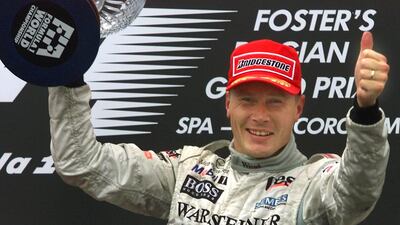
2 wins - Mika Hakkinen (1998, 1999): The flying Finn won two titles on the spin, both with McLaren-Mercedes. The first, he finished with 100 points, 14 clear of Michael Schumacher, the second with 76 points, just two ahead of Eddie Irvine. AFP -

2 wins - Emerson Fittipaldi (1972, 1974): The Brazilian Lotus-Ford driver secured his first title after finishing on 61 points, 16 clear of Jackie Stewart. The second, with McLaren, he led the way with 55 points, three ahead of Clay Regazzoni. AP -

2 wins - Jim Clark (1963, 1965): For his first title, the British Lotus-Climax driver won seven races that season - a record not matched until Alain Prost in 1984 - finishing 25 points ahead of Graham Hill. Two years later, he pushed Hill back into second place again. Getty -

2 wins - Graham Hill (1962, 1968): For his first title, the British BRM driver came out on top in season-long battle with countryman Jim Clark. Six years later, driving for Lotus-Climax, Hill would take the honours again, with Jackie Stewart second. -
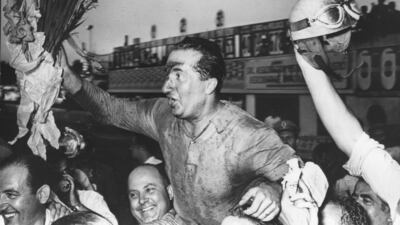
2 wins - Alberto Ascari (1952, 1953): The Italian guided his Ferrari to victory two years on the trot becoming the first driver to successfully defend his title. Allsport -
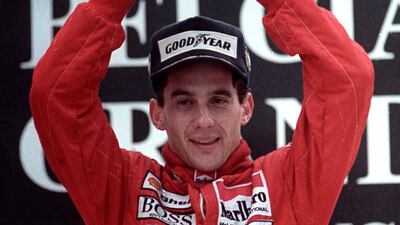
3 wins - Ayrton Senna (1988, 1990, 1991): The fearless Brazilian secured three titles in four years, holding off the challenge of McLaren rival Alain Prost in '88 and '90, with Nigel Mansell finishing second in '91. He would later admit to deliberately colliding with Prost in the penultimate race in '88 that would clinch him the title. Reuters -
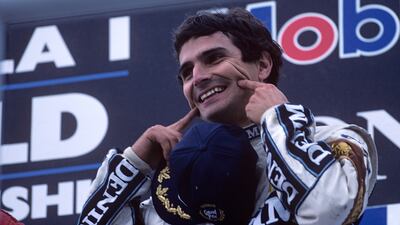
3 wins - Nelson Piquet (1981, 1983, 1987): Three wins in seven years for the Brazilian, the first two for Brabham, the last with Williams. He won the first two titles by just one and two points - over Carlos Reutemann and Alain Prost, repectively. Getty -
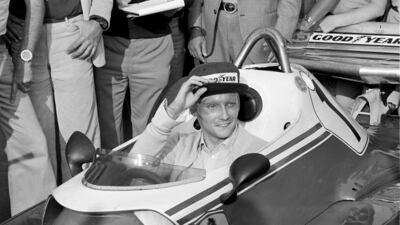
3 wins - Niki Lauda (1975, 1977, 1984): The Austrian driver destoyed the opposition in '75 and '77 as his lightning quick Ferrari won the title over Jody Scheckter both years by by 19.5 and 17 points, respectively. A thrilling battle with Alain Prost in '84 saw Lauda take the title by just half a point. AP -
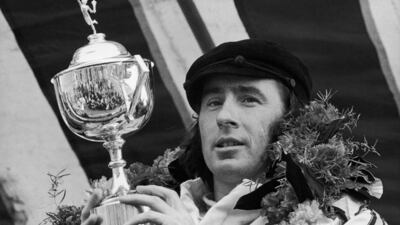
3 wins - Jackie Stewart (1969, 1971, 1973): The British driver sealed his first title with Matra-Ford by 26 points over Jacky Ickx. He won his other two titles with Tyrrell - the first ahead of Ronnie Peterson by 29 points, then Emerson Fittipaldi by 16. Getty. -
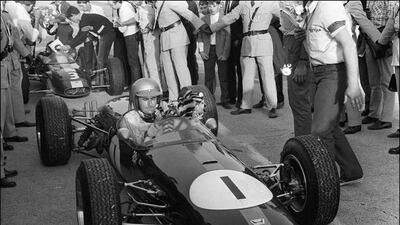
3 wins - Jack Brabham (1959, 1960, 1966): The Australian racing legend won his first two titles in a driving a Cooper-Climax, the first by four points ahead of Tony Brooks, the second finishing six points in front of Bruce McLaren. His final title came in a car of his own manufacture - Brabham-Repco - as he ended the season 14 points clear of John Surtees. AFP -

4 wins - Sebastian Vettel (2010, 2011, 2012, 2013): The German driver became the youngest champion in F1 history - aged 23 years, 134 days - when he won his first title with Red Bull, finishing four points ahead of Fernando Alonso. The last race in Abu Dhabi had been the first time Vettel had led the championship that season. Christopher Pike / The National -
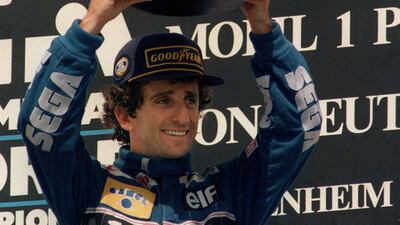
4 wins - Alain Prost (1985, 1986, 1989, 1993): The French driver's most controversial title came in '89 when, in the penultimate race of the season in Japan, he collided with McLaren teammate Ayrton Senna in an incident that ended with the Brazilian disqualified for missing a chicane following the crash and the championship handed to Prost. AFP -

5 wins - Juan Manuel Fangio (1951, 1954, 1955, 1956, 1957): The Argentine would dominate the first decade of F1 and his record of five titles - with four different teams; Alfa Romeo, Ferrari, Mercedes-Benz, and Maserati - would stand for a remarkable 46 years. -

7 wins - Lewis Hamilton (2008, 2014, 2015, 2017, 2018, 2019, 2020): The British driver became the youngest ever world champion - aged 23 years, 300 days - when he held off the challenge of Felipe Massa to take the title by one point. His last title came in 2020 - his fourth in a row - when he beat Mercedes teammate Valtteri Bottas by a whopping 124 points after winning 11 out of 17 races. Getty -
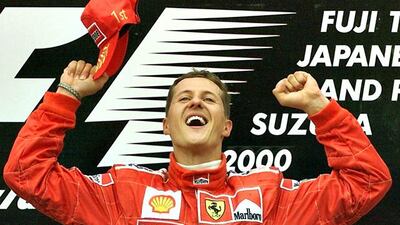
7 wins - Michael Schumacher (1994, 1995, 2000, 2001, 2002, 2003, 2004): The German great won his first title with Benetton in controversial fashion. During the final race in Australia, he collided with title rival Damon Hill taking them both out of the race, handing Schumacher the championship. His final title came in '04 when he dominated with Ferrari from start to finish, winning 13 out of 18 races. AFP


Leclerc finished third ahead of Sergio Perez as Red Bull secured their first constructors’ title since 2013.
George Russell finished fifth, one place ahead of Lando Norris. Fernando Alonso crossed the line in seventh despite being sent airborne and out of control after he collided with Lance Stroll at 180mph.
Alonso grazed the wall before he was able to limp back to the pits for repairs. Bits of Aston Martin fell off Stroll’s machine and into the coming traffic but the grid escaped without injury.
Verstappen secured his second title in Japan a fortnight ago, but a cloud hung over his championship party in Austin after Red Bull’s breach of the sport’s financial rules.
On Saturday, it was also confirmed that Dietrich Mateschitz, the Austrian billionaire who founded Red Bull in 1984 and secured their entry on the F1 grid 21 years later, had lost his long battle with cancer.
An emotional Verstappen dedicated his career to Mateschitz after news broke of his death on Saturday night.
And moments after the grid stood shoulder-to-shoulder to pay tribute to Mateschitz with a round of applause, the Dutch driver delivered a textbook start to move past pole-sitter Carlos Sainz.
There would be further misery for Sainz when Russell sent him out of the race after he thudded into his Ferrari.
F1 salaries 2022 - in pictures
-
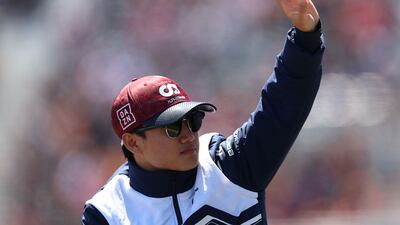
20. Yuki Tsunoda (Alpha Tauri) earns $750,000 a year, according to spotrac, making him the lowest paid F1 driver in 2022. AFP -

17= Guanyu Zhou (Alfa Romeo) $1,000,000. AFP -
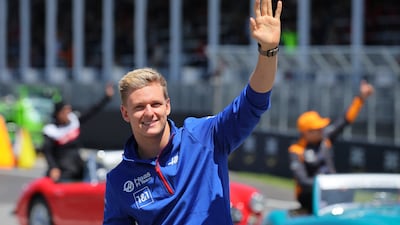
17= Mick Schumacher (Haas) $1,000,000. Reuters -
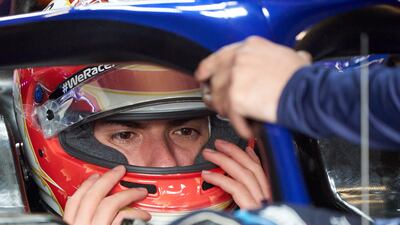
17= Nicholas Latifi (Williams) $1,000,000. EPA -
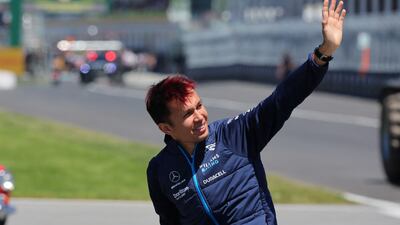
16. Alexander Albon (Williams) $2,000,000. Reuters -
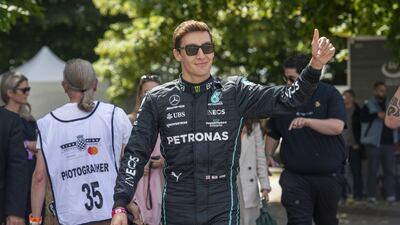
13= George Russell (Mercedes) $5,000,000. PA -

13= Esteban Ocon (Alpine) $5,000,000. AFP -
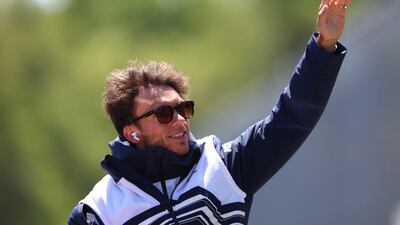
13= Pierre Gasly (Alpha Tauri) $5,000,000. Getty -
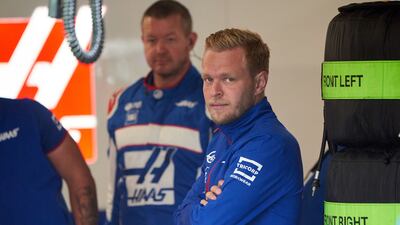
12. Kevin Magnussen (Haas) $6,000,000. EPA -
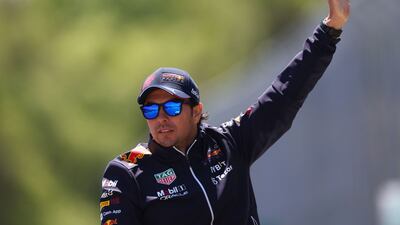
11. Sergio Perez (Red Bull) $8,000,000. Getty -
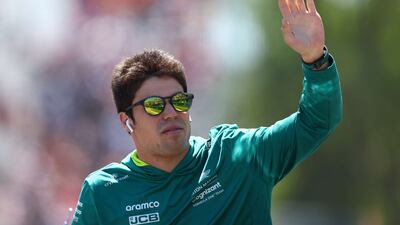
8= Lance Stroll (Aston Martin) $10,000,000. AFP -
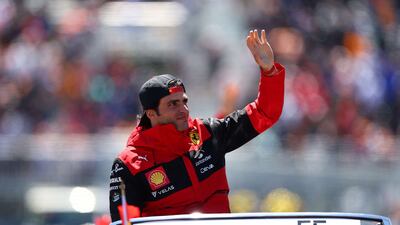
8= Carlos Sainz (Ferrari) $10,000,000. AFP -
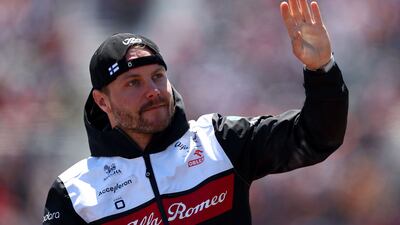
8= Valtteri Bottas (Alfa Romeo) $10,000,000. Getty -
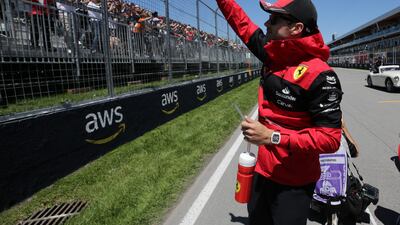
7. Charles Leclerc (Ferrari) $12,000,000. Reuters -
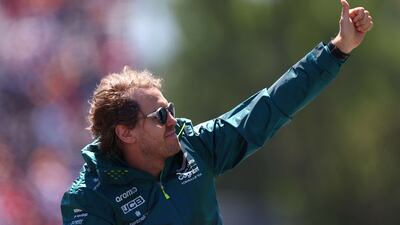
5= Sebastian Vettel (Aston Martin) $15,000,000. AFP -
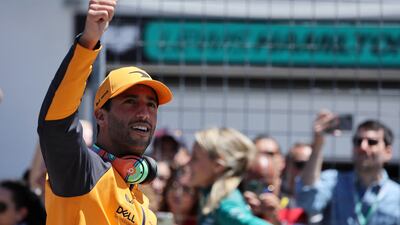
5= Daniel Ricciardo (McLaren) $15,000,000. Reuters -

3= Lando Norris (McLaren) $20,000,000. Getty -
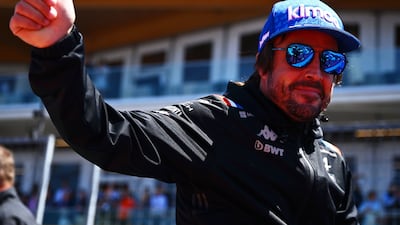
3= Fernando Alonso (Alpine), $20,000,000. Getty -
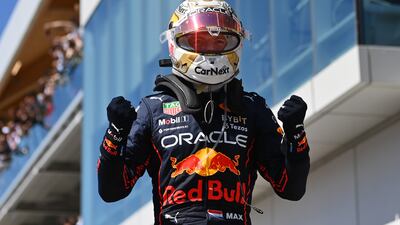
2. Max Verstappen (Red Bull) $25,000,000. AFP -
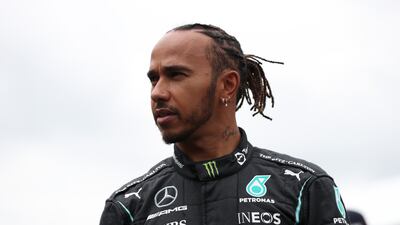
1. Seven-time champion Lewis Hamilton (Mercedes) is the top paid F1 driver in 2022, according to sportrac.com, with a salary of $40,000,000. PA


Verstappen was on cruise control to the flag but recovered from his desperate pit stop to claim the 33rd win of his career.
That moved him ahead of Alonso and into sixth on the all-time list, with only Hamilton (103), Schumacher (91), Sebastian Vettel (53), Alain Prost (51) and Ayrton Senna (41) ahead of him.
“It was a tough race. It was all looking good but the pit stop was longer than we would have liked," Verstappen said.
“I had to give it everything and I pushed to the limit to come back. This win is definitely dedicated to Dietrich and what he has done for everyone.”
Verstappen celebrated his 25th birthday just last month.
He has failed to win only six of the 19 rounds of an utterly one-sided campaign and with three rounds in Mexico, Brazil and Abu Dhabi still remaining, it seems unconceivable he will not become the sole holder of the most wins in a single campaign.
“So close, but yet so far,” said Hamilton on the radio. “Let’s keep pushing.
“We were so so close. I did everything I could to stay ahead but they were a little bit too quick today. I am shattered. The car was a handful.
"It felt amazing to be in the lead. That is something we have been working so hard on, and I held so much hope, but we will hold on to that, keep pushing and try to give it everything in the next three races.
"It will come to us.”

