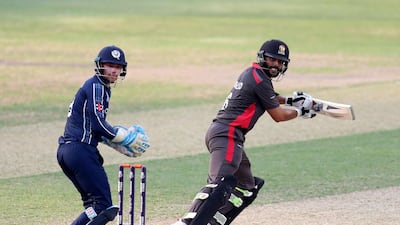
UAE's Rameez Shahzad against Scotland in a World Cup Qualifier at the Dubai International Stadium in 2019. Chris Whiteoak / The National

Batsman Rameez Shahzad 'dreams' of making UAE return


Paul Radley
  • English
  • Arabic

Rameez Shahzad is craving a return to UAE national duty, saying: “It is always going to be my team”.

The 33-year-old is one of the most successful batsmen in the history of the game here.

He averages over 53 in one-day internationals, and is the only player with two ODI centuries for the UAE.

However, he has been on the outside looking in in the recent past. He has not played an ODI since 2018, and is now without an Emirates Cricket Board central contract.

The loss of his pro deal at the end of last year has had notable effects. He now works part-time in a car showroom, as well as a cricket coach, and has to fit his own training around those commitments.

He has also moved to an apartment near to the cricket grounds in Ajman, from one a similar distance from the UAE’s training base at the ICC Academy in Dubai Sports City.

Despite his altered circumstances, he says he remains passionate about a return to playing for the national team.

He says he watched the ODI series against Ireland in January intently, even wearing his grey UAE shirt while doing so.

“Of course I still want to be involved – it is always going to be my team,” Rameez said.

“I haven’t been training with the UAE team, but I have been working with academies and doing training in my own time. Hopefully I can make a comeback soon.”

When he might get the chance to do so is unclear. The UAE are not scheduled to return to competitive action until August, with a World Cup League Two series against Unites States and Scotland.

However, his appetite to compete for a place is a major boon for a side whose batting resources are increasingly enviable.

I still want to be involved – it is always going to be my team

CP Rizwan showed his merit with a sparkling century when they beat Ireland in January.

Mohammed Wasim will surely debut as soon as he becomes eligible in the coming months, having consolidated the reputation he built in Abu Dhabi T10 with more excellence in the Bukhatir League.

There are also a variety of young batsmen, such as Alishan Sharafu, Aryan Lakra and Vriitya Aravind, who have been spoken about in glowing terms by UAE coach Robin Singh.

“Since Robin has come in he has been making us play lots of 50-over matches, and that is a good thing,” Rameez said.

“That is not something we did before. If the current team can play together a lot, then they will be able to understand each other’s mentalities a lot better.

“You need to adapt, and learn how to switch your game between the formats, too.”

Rameez caught the eye himself in the Bukhatir League, playing a role in guiding the team to Friday’s final, which they eventually lost to InterGlobe Marine.

Despite missing the early pool matches because of any ankle injury, he was straight up to speed with an innings of 71 on his return to action.

He followed that with a 64-ball century in the quarter final – an innings which he said was unintentionally fast.

“I actually wasn’t planning to play an aggressive knock like that,” Rameez said. “I just wanted to rotate the strike, and get back into the 50-over format mentality.

“I just kept looking for singles, then when I got past 50, the overs were finishing and I needed to play aggressive shots.

“That’s what 50-over cricket is about. It is not about just hitting fours and sixes. It is important to focus on singles, because once you go a level higher, it is not going to be the same.

“The wickets are not going to be the same, the bowlers are not going to be the same, so you can’t rely only on boundaries. You need to know how to rotate strike.”

Rameez believes he has some ideas to offer if he does earn a recall to the national team.

“The mentality is just to try to hit boundaries,” he said. “Even when we do that and get 300, imagine the number of dot balls there are in that.

“Look at the UAE side’s matches against Ireland, and see how many dot balls they faced.

"We need to look to stop doing that, try to rotate every ball, and take the boundaries when they come as well.”


Mercer, the investment consulting arm of US services company Marsh & McLennan, expects its wealth division to at least double its assets under management (AUM) in the Middle East as wealth in the region continues to grow despite economic headwinds, a company official said.

Mercer Wealth, which globally has $160 billion in AUM, plans to boost its AUM in the region to $2-$3bn in the next 2-3 years from the present $1bn, said Yasir AbuShaban, a Dubai-based principal with Mercer Wealth.

Within the next two to three years, we are looking at reaching $2 to $3 billion as a conservative estimate and we do see an opportunity to do so,” said Mr AbuShaban.

Mercer does not directly make investments, but allocates clients’ money they have discretion to, to professional asset managers. They also provide advice to clients.

“We have buying power. We can negotiate on their (client’s) behalf with asset managers to provide them lower fees than they otherwise would have to get on their own,” he added.

Mercer Wealth’s clients include sovereign wealth funds, family offices, and insurance companies among others.

From its office in Dubai, Mercer also looks after Africa, India and Turkey, where they also see opportunity for growth.

Wealth creation in Middle East and Africa (MEA) grew 8.5 per cent to $8.1 trillion last year from $7.5tn in 2015, higher than last year’s global average of 6 per cent and the second-highest growth in a region after Asia-Pacific which grew 9.9 per cent, according to consultancy Boston Consulting Group (BCG). In the region, where wealth grew just 1.9 per cent in 2015 compared with 2014, a pickup in oil prices has helped in wealth generation.

BCG is forecasting MEA wealth will rise to $12tn by 2021, growing at an annual average of 8 per cent.

Drivers of wealth generation in the region will be split evenly between new wealth creation and growth of performance of existing assets, according to BCG.

Another general trend in the region is clients’ looking for a comprehensive approach to investing, according to Mr AbuShaban.

“Institutional investors or some of the families are seeing a slowdown in the available capital they have to invest and in that sense they are looking at optimizing the way they manage their portfolios and making sure they are not investing haphazardly and different parts of their investment are working together,” said Mr AbuShaban.

Some clients also have a higher appetite for risk, given the low interest-rate environment that does not provide enough yield for some institutional investors. These clients are keen to invest in illiquid assets, such as private equity and infrastructure.

“What we have seen is a desire for higher returns in what has been a low-return environment specifically in various fixed income or bonds,” he said.

“In this environment, we have seen a de facto increase in the risk that clients are taking in things like illiquid investments, private equity investments, infrastructure and private debt, those kind of investments were higher illiquidity results in incrementally higher returns.”

The Abu Dhabi Investment Authority, one of the largest sovereign wealth funds, said in its 2016 report that has gradually increased its exposure in direct private equity and private credit transactions, mainly in Asian markets and especially in China and India. The authority’s private equity department focused on structured equities owing to “their defensive characteristics.”

Abramovich London

A Kensington Palace Gardens house with 15 bedrooms is valued at more than £150 million.

A three-storey penthouse at Chelsea Waterfront bought for £22 million.

Steel company Evraz drops more than 10 per cent in trading after UK officials said it was potentially supplying the Russian military.

Sale of Chelsea Football Club is now impossible.