The Indian team entered the red-ball leg of the South Africa tour with high expectations of registering their first ever Test series win in the country.
Victory in the preceding ODI series had raised hopes of similar form being shown by the Test regulars but the first match in Centurion turned out to be an unmitigated disaster as Rohit Sharma's team lost by an innings in three days.
More than the defeat, it was the lack of fight in any department that was the biggest concern for the team that made it to both finals of the World Test Championship.
Apart from KL Rahul's century, Jasprit Bumrah's reliable bowling and Virat Kohli's fight, the Indian team was no match for the Proteas.
More worryingly, the seamers selected for the match – Prasidh Krishna and all-rounder Shardul Thakur – proved woefully short of Test standard.
Injury to veteran quick Mohammad Shami has exposed the lack of depth in India's Test bowling resources and they have been forced to bring in limited-overs specialist Avesh Khan for the second Test, which begins on January 3 in Cape Town.
Sharma's captaincy too left a lot to be desired. He opened sessions with his weakest bowlers, persisted with Krishna even when he struggled to put the ball in one spot and himself had a forgettable match with the bat.
It resulted in another heavy away defeat against a major side. India have now lost their last three away Tests against top teams by considerable margins, including the World Test Championship final against Australia. They also failed to defend 378 in the fourth innings in the one-off Test against England in Birmingham the year before.
Captain Sharma has promised a fightback in the second Test.
Dean Elgar of South Africa on his way to making 140 not out on day two of the First Test against India at SuperSport Park on December 27, 2023, in Centurion, South Africa. Gallo Images
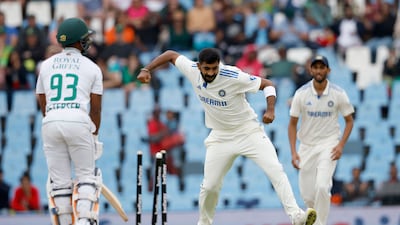
South Africa’s David Bedingham is bowled out by India's Mohammed Siraj. Reuters
Dean Elgar of South Africa celebrates his 100. Gallo Images
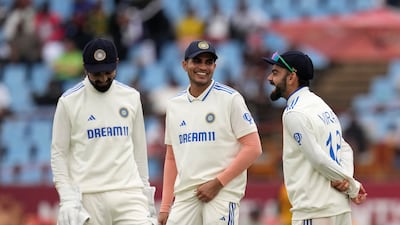
India's Virat Kohli, right, jokes with teammates Shubman Gill, centre, and KL Rahul. AP
South Africa’s David Bedingham celebrates after reaching his half century on his Test debut. Reuters
India's Mohammed Siraj, right, celebrates after bowling South Africa's David Bedingham for 56. AP
South Africa's Dean Elgar, left, is congratulated by batting partner David Bedingham after scoring a century. AFP
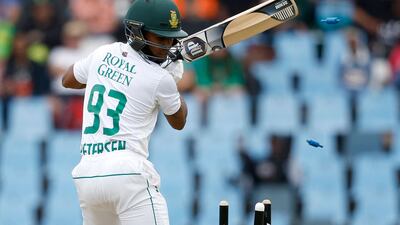
India's Jasprit Bumrah celebrates after the dismissal of South Africa's Keegan Petersen. AFP
South Africa's Keegan Petersen is bowled by India's Jasprit Bumrah. AFP
Mohammed Siraj of India fields on the boundary. Gallo Images
India's KL Rahul is bowled by South Africa's Nandre Burger for 101. AFP
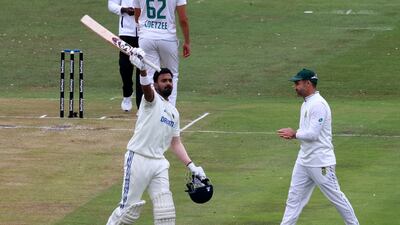
India's KL Rahul celebrates his century. Reuters
“Honestly, we're not good enough to win this match,” Sharma said after India were dismissed for 131 in their second innings on the third day of the opening Test.
“I thought we got decent runs on the board on that track in the first innings, KL Rahul did brilliantly to get us that century. But then we failed to exploit the conditions with the ball.
“Then again, we didn't show up with the bat today as well. Our batting was poor in the second innings. If you want to win Test matches, you’ve got to come together collectively. But we failed to do that.
“When you lose a game in three days, there’s not a lot of positives but like I mentioned, the way KL Rahul batted in the first innings showed a lot of us what you need to do on that kind of pitch. A lot of our bowlers haven't been here before, they're still learning. So I don't want to be too critical of them.
“We will regroup, and we'll fight back."
A year that saw the Indian team enter finals of both the Test and ODI world title events ended with a humbling defeat that points to a difficult path ahead as the core of the team enter the closing stages of their careers.

1. Domestic VAT refund amendments: request your refund within five years
If a business does not apply for the refund on time, they lose their credit.
2. E-invoicing in the UAE
Businesses should continue preparing for the implementation of e-invoicing in the UAE, with 2026 a preparation and transition period ahead of phased mandatory adoption.
3. More tax audits
Tax authorities are increasingly using data already available across multiple filings to identify audit risks.
4. More beneficial VAT and excise tax penalty regime
Tax disputes are expected to become more frequent and more structured, with clearer administrative objection and appeal processes. The UAE has adopted a new penalty regime for VAT and excise disputes, which now mirrors the penalty regime for corporate tax.
5. Greater emphasis on statutory audit
There is a greater need for the accuracy of financial statements. The International Financial Reporting Standards standards need to be strictly adhered to and, as a result, the quality of the audits will need to increase.
6. Further transfer pricing enforcement
Transfer pricing enforcement, which refers to the practice of establishing prices for internal transactions between related entities, is expected to broaden in scope. The UAE will shortly open the possibility to negotiate advance pricing agreements, or essentially rulings for transfer pricing purposes.
7. Limited time periods for audits
Recent amendments also introduce a default five-year limitation period for tax audits and assessments, subject to specific statutory exceptions. While the standard audit and assessment period is five years, this may be extended to up to 15 years in cases involving fraud or tax evasion.
8. Pillar 2 implementation
Many multinational groups will begin to feel the practical effect of the Domestic Minimum Top-Up Tax (DMTT), the UAE's implementation of the OECD’s global minimum tax under Pillar 2. While the rules apply for financial years starting on or after January 1, 2025, it is 2026 that marks the transition to an operational phase.
9. Reduced compliance obligations for imported goods and services
Businesses that apply the reverse-charge mechanism for VAT purposes in the UAE may benefit from reduced compliance obligations.
10. Substance and CbC reporting focus
Tax authorities are expected to continue strengthening the enforcement of economic substance and Country-by-Country (CbC) reporting frameworks. In the UAE, these regimes are increasingly being used as risk-assessment tools, providing tax authorities with a comprehensive view of multinational groups’ global footprints and enabling them to assess whether profits are aligned with real economic activity.
Contributed by Thomas Vanhee and Hend Rashwan, Aurifer
Tenants also require a letter of no objection from their landlord before being allowed to list the property.
There is a cost of Dh1,590 before starting the process, with an additional licence fee of Dh300 per bedroom being rented in your home for the duration of the rental, which ranges from three months to a year.
Anyone hoping to list a property for rental must also provide a copy of their title deeds and Ejari, as well as their Emirates ID.
Cast: Nayanthara, Siddharth, Meera Jasmine, R Madhavan
Star rating: 2/5
Living in...
This article is part of a guide on where to live in the UAE. Our reporters will profile some of the country’s most desirable districts, provide an estimate of rental prices and introduce you to some of the residents who call each area home.
Bookshops: A Reader's History by Jorge Carrión (translated from the Spanish by Peter Bush),
Biblioasis
TWISTERS
Director: Lee Isaac Chung
Starring: Glen Powell, Daisy Edgar-Jones, Anthony Ramos
1: Commit to countering all types of terrorism and extremism in all their manifestations
2: Denounce violence and the rhetoric of hatred
3: Adhere to the full compliance with the Riyadh accord of 2014 and the subsequent meeting and executive procedures approved in 2014 by the GCC
4: Comply with all recommendations of the Summit between the US and Muslim countries held in May 2017 in Saudi Arabia.
5: Refrain from interfering in the internal affairs of countries and of supporting rogue entities.
6: Carry out the responsibility of all the countries with the international community to counter all manifestations of extremism and terrorism that threaten international peace and security