MORE FROM CON COUGHLIN
The formation of Afghanistan’s latest coalition government may have ended months of political uncertainty, but it is unlikely to provide a speedy remedy for all of the country's challenges. First and foremost, it is essential that the leaders of the country’s new coalition set aside the deep personal animosity that has dominated the political scene since last September’s presidential election contest.
As with Afghanistan’s previous presidential election in 2014, the 2019 ballot was marred by claims of corruption and increasingly bitter exchanges between President Ashraf Ghani and his main rival and erstwhile coalition partner, Abdullah Abdullah, who served as the country’s chief executive in the previous administration.
Dr Abdullah, in particular, resorted on several occasions during the campaign to indulging in personal insults against Mr Ghani, denouncing him as a remote, self-centred leader who had deceived and disappointed the public, even describing him as an “ant without wings.”
The deep antipathy that has existed between the two men and their supporters since then is one reason it has taken eight months for them to resolve their differences and agree to form a new coalition.
For the feud did not end with the election, the results of which were not announced until February. Although the electoral commission concluded that Mr Ghani had won, Dr Abdullah dismissed its conclusion as fraudulent, and declared himself the winner. This led to the ludicrous spectacle whereby, on March 9, the two politicians each conducted their own inauguration ceremonies, held just metres apart in Kabul, in which, in effect, they sought to establish rival governments.
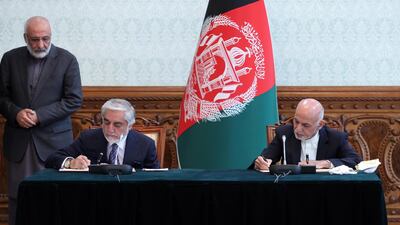
Thankfully, the high farce that has characterised Afghan politics in recent months is now at an end after the two leaders finally agreed to resolve their differences and sign a political agreement under which they will share power equally. Under the terms of the agreement, which was signed last Sunday, Mr Ghani will continue to serve as President while Dr Abdullah is appointed Chairman of the National Reconciliation High Council, with both leaders agreeing to appoint equal numbers of cabinet ministers.
The failure of the two men to resolve their differences earlier has been a source of immense frustration both for the Afghan people and the wider world beyond, especially the US, which has been immersed in peace negotiations with the Taliban to end the civil war while the Afghan government has been reduced to a state of limbo by the constant political in-fighting.
Thus, while Washington is clearly pleased that Afghanistan now has a new government, US Secretary of State Mike Pompeo, who announced an intention to cut $1 billion in aid to Kabul in protest at the two-governments fiasco, nevertheless could not resist chiding the Afghan leaders for taking so long to resolve their differences. A terse statement issued by the State Department remarks: “Secretary Pompeo noted that he regretted the time lost during the political impasse.”
Thankfully, the high farce that has characterised Afghan politics in recent months is now at an end
While Mr Ghani, commenting on the formation of the new government, said its goals were “to ensure a path to peace, improve governance, protect rights, respect laws and values”, it is clear, certainly from Washington’s perspective, that its first priority must be to revive peace negotiations between the Taliban and the Afghan government.
A first round of talks, which were due to take place on March 10, were delayed by the ongoing political standoff between Mr Ghani and Dr Abdullah. The meeting had been arranged after the US and the Taliban signed their historic deal on February 29, whereby the US agreed to withdraw its remaining forces from Afghanistan in return for the Taliban helping to reduce violence in the country and ensure that Islamist terror groups, such as Al Qaeda and ISIS, would no longer be offered sanctuary.
There have been promising signs from the Taliban that the militant group is serious about upholding its end of the deal. A letter issued by Haibatullah Akhundzada, the leader of the Taliban, to mark the end of Ramadan reiterated that the militants are "committed to the agreement [with the US]...and urges the other side to honour its own commitments and not allow this critical opportunity to waste”.
Yet serious questions do remain following a significant upsurge in terrorist activity since it was signed, with Afghan government officials reporting that more than 3,800 attacks have been carried out since early March.
These include last week’s horrific attack on a maternity ward in Kabul, in which 24 people, including mothers, babies and nurses, were killed, which the Afghan government has blamed on the Taliban.
In spite of the ferociousness of the attacks, the US continues to insist that the Taliban are sticking to their end of the bargain because they have observed their commitment not to attack US-led coalition forces.
But this distinction will bring little comfort to the Afghan people, who continue to suffer at the hands of the Taliban and other extreme Islamist groups, such as ISIS.
As Dr Anwar Gargash, the UAE Minister of State for Foreign Affairs, commented on Twitter following the formation of the new Afghan coalition, “abhorrent violence targeting the helpless in Afghanistan must be strongly opposed”, adding that “a political process cannot succeed until there is an end to the terror engulfing the country”.
Whether the recent upsurge in violence can be brought to an end now depends on the ability of the new Afghan government to engage in peace talks with the Taliban, a process that Kabul has previously resisted on the grounds that it does not negotiate with terrorists. But with the Taliban buoyed by its deal with Washington and now a major force in Afghan politics, the new government may find it has no alternative but to reach a deal with its bitter foe.
Con Coughlin is the Telegraph’s defence and foreign affairs editor

The President's Cake
Director: Hasan Hadi
Starring: Baneen Ahmad Nayyef, Waheed Thabet Khreibat, Sajad Mohamad Qasem
Rating: 4/5
THE DETAILS
Kaala
Dir: Pa. Ranjith
Starring: Rajinikanth, Huma Qureshi, Easwari Rao, Nana Patekar
Rating: 1.5/5
Teaching in coronavirus times
The Comeback: Elvis And The Story Of The 68 Special
Simon Goddard
Omnibus Press
Avatar: Fire and Ash
Director: James Cameron
Starring: Sam Worthington, Sigourney Weaver, Zoe Saldana
Rating: 4.5/5
EMERGENCY PHONE NUMBERS
Estijaba – 8001717 – number to call to request coronavirus testing
Ministry of Health and Prevention – 80011111
Dubai Health Authority – 800342 – The number to book a free video or voice consultation with a doctor or connect to a local health centre
Emirates airline – 600555555
Etihad Airways – 600555666
Ambulance – 998
Knowledge and Human Development Authority – 8005432 ext. 4 for Covid-19 queries
Who was Alfred Nobel?
The Nobel Prize was created by wealthy Swedish chemist and entrepreneur Alfred Nobel.
- In his will he dictated that the bulk of his estate should be used to fund "prizes to those who, during the preceding year, have conferred the greatest benefit to humankind".
- Nobel is best known as the inventor of dynamite, but also wrote poetry and drama and could speak Russian, French, English and German by the age of 17. The five original prize categories reflect the interests closest to his heart.
- Nobel died in 1896 but it took until 1901, following a legal battle over his will, before the first prizes were awarded.
A cryptocurrency primer for beginners
Cryptocurrency Investing for Dummies – by Kiana Danial
There are several primers for investing in cryptocurrencies available online, including e-books written by people whose credentials fall apart on the second page of your preferred search engine.
Ms Danial is a finance coach and former currency analyst who writes for Nasdaq. Her broad-strokes primer (2019) breaks down investing in cryptocurrency into baby steps, while explaining the terms and technologies involved.
Although cryptocurrencies are a fast evolving world, this book offers a good insight into the game as well as providing some basic tips, strategies and warning signs.
Begin your cryptocurrency journey here.
Available at Magrudy’s , Dh104
More coverage from the Future Forum
Ten tax points to be aware of in 2026
1. Domestic VAT refund amendments: request your refund within five years
If a business does not apply for the refund on time, they lose their credit.
2. E-invoicing in the UAE
Businesses should continue preparing for the implementation of e-invoicing in the UAE, with 2026 a preparation and transition period ahead of phased mandatory adoption.
3. More tax audits
Tax authorities are increasingly using data already available across multiple filings to identify audit risks.
4. More beneficial VAT and excise tax penalty regime
Tax disputes are expected to become more frequent and more structured, with clearer administrative objection and appeal processes. The UAE has adopted a new penalty regime for VAT and excise disputes, which now mirrors the penalty regime for corporate tax.
5. Greater emphasis on statutory audit
There is a greater need for the accuracy of financial statements. The International Financial Reporting Standards standards need to be strictly adhered to and, as a result, the quality of the audits will need to increase.
6. Further transfer pricing enforcement
Transfer pricing enforcement, which refers to the practice of establishing prices for internal transactions between related entities, is expected to broaden in scope. The UAE will shortly open the possibility to negotiate advance pricing agreements, or essentially rulings for transfer pricing purposes.
7. Limited time periods for audits
Recent amendments also introduce a default five-year limitation period for tax audits and assessments, subject to specific statutory exceptions. While the standard audit and assessment period is five years, this may be extended to up to 15 years in cases involving fraud or tax evasion.
8. Pillar 2 implementation
Many multinational groups will begin to feel the practical effect of the Domestic Minimum Top-Up Tax (DMTT), the UAE's implementation of the OECD’s global minimum tax under Pillar 2. While the rules apply for financial years starting on or after January 1, 2025, it is 2026 that marks the transition to an operational phase.
9. Reduced compliance obligations for imported goods and services
Businesses that apply the reverse-charge mechanism for VAT purposes in the UAE may benefit from reduced compliance obligations.
10. Substance and CbC reporting focus
Tax authorities are expected to continue strengthening the enforcement of economic substance and Country-by-Country (CbC) reporting frameworks. In the UAE, these regimes are increasingly being used as risk-assessment tools, providing tax authorities with a comprehensive view of multinational groups’ global footprints and enabling them to assess whether profits are aligned with real economic activity.
Contributed by Thomas Vanhee and Hend Rashwan, Aurifer
The Orwell Prize for Political Writing
Twelve books were longlisted for The Orwell Prize for Political Writing. The non-fiction works cover various themes from education, gender bias, and the environment to surveillance and political power. Some of the books that made it to the non-fiction longlist include:
- Appeasing Hitler: Chamberlain, Churchill and the Road to War by Tim Bouverie
- Some Kids I Taught and What They Taught Me by Kate Clanchy
- Invisible Women: Exposing Data Bias in a World Designed for Men by Caroline Criado Perez
- Follow Me, Akhi: The Online World of British Muslims by Hussein Kesvani
- Guest House for Young Widows: Among the Women of ISIS by Azadeh Moaveni
Labour dispute
The insured employee may still file an ILOE claim even if a labour dispute is ongoing post termination, but the insurer may suspend or reject payment, until the courts resolve the dispute, especially if the reason for termination is contested. The outcome of the labour court proceedings can directly affect eligibility.
- Abdullah Ishnaneh, Partner, BSA Law
Who's who in Yemen conflict
Houthis: Iran-backed rebels who occupy Sanaa and run unrecognised government
Yemeni government: Exiled government in Aden led by eight-member Presidential Leadership Council
Southern Transitional Council: Faction in Yemeni government that seeks autonomy for the south
Habrish 'rebels': Tribal-backed forces feuding with STC over control of oil in government territory
MORE FROM CON COUGHLIN
