
The Middle East and North Africa is often unfairly characterised in other parts of the world as being a region that only knows conflict. As this newspaper's coverage has shown, this is a place where innovation and collective achievement – in science and medicine, the arts, sport, business and other areas of civil society – thrive. And as the world continues to reel from the impact of the coronavirus pandemic, progress can be found in every corner of Mena, from locally designed healthcare robots in Tunis to the development of laser-based Covid-19 tests here in Abu Dhabi.
At the same time, a disproportionately large number of countries in the regional map are embroiled in one form of armed conflict or another. Separatist militants continue to destabilise the Sahel. In Libya, the civil war grows increasingly brutal. In Lebanon, Syria, Yemen and Iraq, a combination of jihadists, Iranian proxies, weak institutions and external powers launch wave after wave of assaults upon one another. In the eastern wing of this map, ISIS's influence resurges in Afghanistan and Pakistan, while at the very heart of the region, Israel prepares for an unprecedented annexation of Palestinian territory.
-
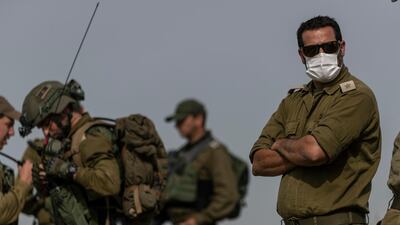
ISRAEL & LEBANON: Israeli troops take part in a drill in northern Israel on May 13, 2020, for a possible invasion of Lebanon and striking Hezbollah targets in neighboring Syria. Hezbollah is beefing up its own forces and threatening to invade Israel. AP Photo -

ISRAEL & LEBANON: A picture taken from the northern Israeli town of Metulla shows a stretch of the border fence and a view of the southern Lebanese village of Kfar Kila, on May 22, 2020, ahead of the 20th anniversary of Israel's withdrawal from southern Lebanon. AFP -

ISRAEL & PALESTINE: Right-wing Israelis wave national flags as they gather outside the Old City of Jerusalem on May 21, 2020, to mark Jerusalem Day, commemorating Israel's capture of the holy city's mainly Palestinian eastern sector in the 1967 Six-Day War. AFP -
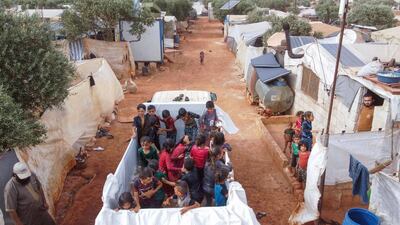
SYRIA: An aerial picture shows Syrian youths playing in a mobile makeshift pool set-up with a tarpaulin in the back of a lorry amid the heat, at a camp for the internally displaced near the village of Killi in the north of the northwestern Idlib province, on May 22, 2020, ahead of the Eid al-Fitr feast marking the end of the Muslim holy month of Ramadan. AFP -
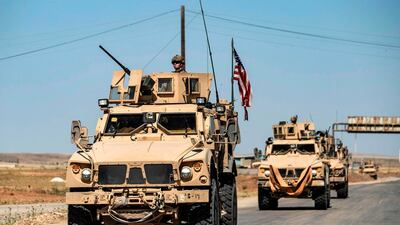
SYRIA: US military vehicles drive in a patrol along the M4 highway by the town of Tal Tamr and its countryside in Syria's northeastern Hasakeh province, near the border with Turkey, on May 20, 2020. AFP -

YEMEN: Militia members of the Southern Transitional Council during fighting against Yemeni pro-government forces in the southern province of Abyan, Yemen, on May 13 2020. EPA -

YEMEN: Militiamen of the Southern Transitional Council ride a lorry during fighting against Yemeni pro-government forces in the southern province of Abyan, Yemen, on May 13, 2020. EPA -
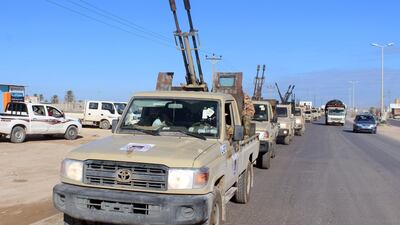
LIBYA: Military vehicles of the Libyan Government of National Accord forces head out to the front line from Misrata, Libya February 3, 2020. Reuters -

LIBYA: Forces loyal to Libya's Government of National Accord parade a Pantsir air defense system truck in the capital Tripoli on May 20, 2020. AFP


Yet for the first time in a very long time, as coronavirus continues to wash through every country on the map, there is a growing sense that the conflicts plaguing Mena pale in comparison to the actual plague brought on by the pandemic. This is especially the case today, when the nations of the region mark Eid Al Fitr, a time that would any other year be celebrated with family reunions and public feasts.
No war in the history of the Middle East has ever quieted Eid across the entire Muslim ummah the way the pandemic has. It is a force no army or band of militants can reckon with, and a lesson that the well-being of everyone in the region relies on seeing the larger picture.
The United Nations is just one of many voices that have repeatedly called for the nations of the world to use the coronavirus pandemic as an opportunity for a total ceasefire. The benefits of such actions to the Middle East and North Africa would be immeasurable.
The political aspirations that fuel the region’s wars are not trivial, nor would they be resolved through a ceasefire alone. But ending wars has little to do with either side’s desires, and more to do with what it can realistically achieve. Should the Mena region be completely overrun by a highly contagious and, in some cases, deadly virus, little will be achieved for anyone.
Now is the time for the region to rest, convalesce and to take stock of what really matters. Co-operation in health care and economic recovery, and the exploration of political solutions to old conflicts are the wisest courses of action. With a bit of space for these considerations, at least some of the actors in the region’s many conflicts might find that their aspirations can be more aligned than they had previously thought.

